On the 15 March 2024 Hour Hong- Kong SAR – Beijing time CNSA –China National Space Administration ….. the “Chang Zheng -Long March 5” Yao-8 carrier rocket which will carry out the Chang’e-6 mission of the fourth phase of the lunar exploration project, safely arrived at the Wenchang Space Launch Site in China. Subsequently, the rocket will be assembled and tested at the launch site together with the Chang’e-6 probe that arrived in advance. Currently, all participating systems in the launch site area are preparing for the Chang’e-6 mission as planned…..
“Chang Zheng -Long March 5” Yao-8 carrier rocket which will carry out the fourth phase of the lunar exploration project嫦娥六号was safely transported to the Wenchang Space Launch Site in China. Subsequently, the rocket will be assembled and tested at the launch site together with the Chang’e-6 probe that arrived in advance. Currently, all participating systems in the launch site area….
On the 29th September 2023 the嫦娥六号; Change 6 Lunar Sample Return Mission onboard the Chang Zheng – Long March Five Carrier Rocket modified announcement by CNSA – China National Space Administration China Wenchang spaceport launch, Change lunar series Lunar probes… The National Space Administration announced today that the development of the lunar exploration project Chang’e-6 mission is currently underway as planned and is planned to be launched around 2024. At the same time, our country is accelerating the scientific project of the International Lunar Research Station, and hopes that more international partners will join in to jointly expand the boundaries of human cognition, contribute to the peaceful use of space, and promote the construction of a community with a shared future for mankind.
On January 8th 2024 and 9th January, 2024, the detector products of the Chang’e-6 mission of the fourth phase of the lunar exploration project took the An-124 and Yun-20 aircraft respectively and arrived at Hainan Meilan International Airport. Transported by road to the Wenchang Space Launch Site in Hainan Province, China, People’s Republic of China.. Subsequent test preparations before launch will be carried out as planned.
The Chang’e-6 mission will break through key technologies such as lunar retrograde orbit design and control, lunar back intelligent sampling, and lunar back take-off and ascent, implement automatic sampling and return on the lunar back, and at the same time carry out scientific exploration and international cooperation in the landing area.
At present, the launch site facilities are in good condition and all preparations are being carried out in an orderly manner as planned. Chang’e-6 is scheduled to be launched in the first half of this year.
According to arrangements, the Chang’e-6 mission will carry out sample returns from the far side of the moon. The 10 lunar sampling returns that humans have carried out so far are all located on the front side of the moon. The far side of the moon is generally older than the front side of the moon, and there is the Aitken Basin, one of the three major lunar terrestrial bodies, which has important scientific research value. The pre-selected landing area for the Chang’e-6 mission is located in the South Pole-Aitken Basin on the far side of the moon, with a view to discovering and collecting lunar samples from different regions and ages to enhance human understanding of the moon. According to arrangements, the Chang’e-6 mission will carry out sample returns from the far side of the moon. The 10 lunar sampling returns that humans have carried out so far are all located on the front side of the moon. The far side of the moon is generally older than the front side of the moon, and there is the Aitken Basin, one of the three major lunar terrestrial bodies, which has important scientific research value. The pre-selected landing area for the Chang’e-6 mission is located in the South Pole-Aitken Basin on the far side of the moon, with a view to discovering and collecting lunar samples from different regions and ages to enhance human understanding of the moon.
It is reported that in order to successfully complete the communication between the spacecraft on the far side of the moon and the earth, China, People’s Republic of China newly developed Queqiao-2 relay communication satellite is planned to be launched in the first half of 2024.
During this month November 2023 the development of the China, People’s Republic of China, CNSA- China’s National Space AdministrationLunar Manned Program in which to established a Chinese lunar Manned Mission due by 2030 least .. in which The preliminary results of China, People’s Republic of China’s manned lunar rover development program were announced. The program “Wangshu Zhichao” led by Tsinghua University was selected, focusing on innovative design and single advantageous technologies for in-depth research.
The bronze chariots and horses of the Terracotta Warriors from Qin Shihuang’s Mausoleum provided inspiration for the design team. The design team developed the man-machine intelligent hybrid enhanced driving technology of the manned lunar rover, which realizes three modes of manual driving, autonomous driving and human-machine hybrid driving. The angle of the vehicle body is adjustable and it can creep when necessary….
The preliminary results of my China, People’s Republic of China’s manned lunar rover development program were announced, and the program “Wangshu Zhichao” led by Tsinghua University was selected.
Tsinghua University’s four-wheel vehicle design plan
: Tsinghua University’s design plan for a four-wheel vehicle with adjustable body angle and creeping ability
: The bronze chariots and horses unearthed from Qin Shi Huang’s Terracotta Warriors provided inspiration for the design team
Design Plan of “Wangshu Chariot”
Key design elements of “Wangshu Chariot”
清華大學 Tsinghua University is located 30 Shuangqing Rd, 蓝旗营 Haidian District, Beijing, China, 100190, China, People’s Republic of China .
More than One year ago on 24th November 2020, the Chang Zheng – Long March Five Carrier Rocket Launched away in CNSA – China National Space Administration China Wenchang spaceport launch, Change Five Lunar probe into orbit, opened up towards China – People’s Republic of China’s first celestial bodies sample return trip from Mons Rumker on the Lunar Surface of the moon New research achievements – Chinese scientists reveal the composition of lunar soil minerals and space wind at the landing site of Chang’e 5
Chang’e-5 team On October 1st 2023 on China’s National Day of the Founding of People’s Republic of China…. During the 74th International Astronautical Congress (IAC) opened in Baku, Azerbaijan. Scientists such as Schumacher, President of the International Academy of Astronautics, awarded the “Chang’e-5 team” to the Chinese Chang’e-5 team. Lawrence Team Award”. Chang’e-5 chief designer Hu Hao and others attended the award ceremony as team representatives and announced that Chang’e-5 lunar scientific research samples will soon be open to international applications. Scientists from all countries are welcome to jointly research and share results.
Chang’e-5 was China’s first unmanned lunar sample return mission.It was China’s most complex aerospace system project with the largest technical span at that time. It made breakthroughs in lunar surface sampling, lunar surface take-off and ascent, lunar orbit rendezvous and docking, sample transfer, and jump-type missions. Using key technologies such as re-entry and return, after an interlocking flight process, it brought back 1,731 grams of lunar samples, becoming the world’s largest unmanned lunar sampling mission with the largest single sampling volume. The Chang’e-5 mission is a vivid practice for my country to achieve high-level scientific and technological self-reliance. It has laid the foundation for subsequent unmanned lunar scientific research stations and manned lunar landings. It is another important milestone in my country’s aerospace development.
The “Lawrence Team Award” was established in 2001. It is one of the two major awards issued annually by the International Academy of Astronautics (IAA). It is the highest team honor of the International Academy of Astronautics and aims to recognize aerospace project teams that have made outstanding achievements in the field of aerospace. Chang’e-5’s outstanding achievements in technological innovation, scientific discovery, and international cooperation have won high recognition from international peers.
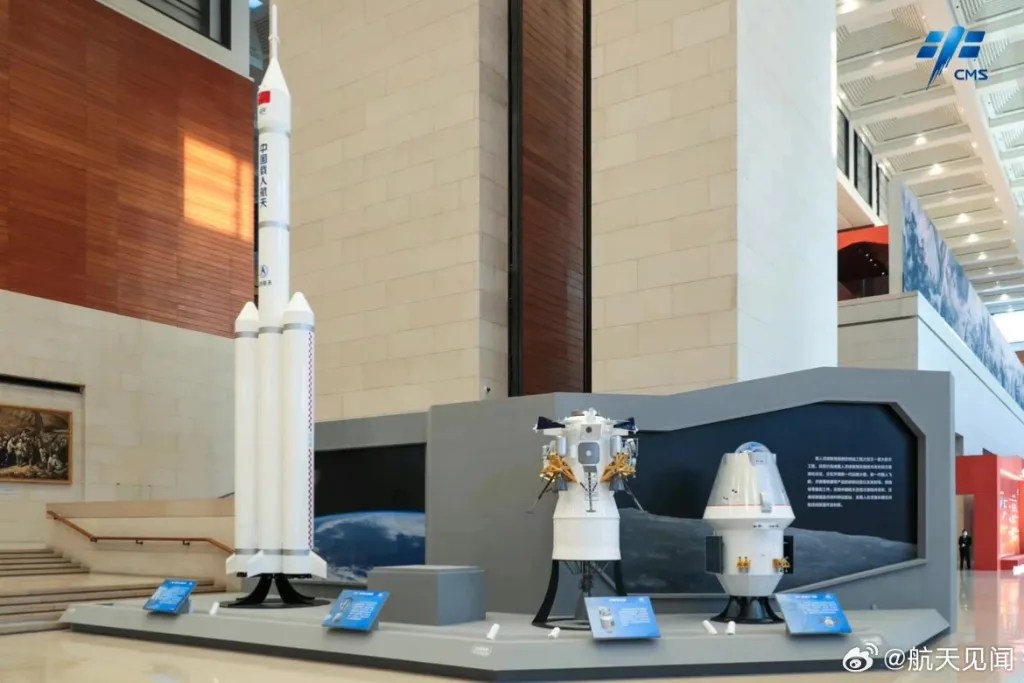
CG video of China’s manned moon landing— plans to realize the first Chinese landing on the moon before 2030, carry out lunar scientific investigations and related technical experiments, and make breakthroughs and master key technologies such as manned ground-to-moon round trips, short-term stays on the lunar surface, and joint man-machine exploration , form an independent manned lunar exploration capability, promote manned spaceflight technology from near-Earth to deep space, and greatly enhance China’s ability to enter space and use space. The main process of the manned mission to the moon is: first launch the lunar lander, the lunar lander is parked in the orbit around the moon, and then launch a new generation of manned spacecraft, and the spacecraft and the lander will rendezvous and dock in the orbit around the moon. Astronauts enter the lander from the spaceship, the lander separates from the spaceship and descends to the lunar surface, and the astronauts carry out activities on the lunar surface. After that, the Takionauts took off and ascended on the lander to dock with the spacecraft, and the astronauts entered the spacecraft. After the spacecraft separated from the lander’s lunar module, it returned to Earth….
Basic introduction of manned lunar exploration missions and aircraft— the new generation of manned spacecraft is a new type of space-to-earth round-trip transport aircraft that is fully upgraded and developed on the basis of Shenzhou spacecraft. It adopts a modular design and consists of a return module and a service module. It is mainly used for my country’s manned lunar exploration missions, taking into account the operation of near-Earth space stations. It has the characteristics of high safety, high reliability, multi-mission support, and reusability. The lunar landing mission can carry 3 Takionauts to and from the ground and orbit around the moon. Earth-orbit missions can carry seven astronauts to and from the ground and the space station.
The lunar lander is a newly developed extraterrestrial celestial body manned descent and ascent vehicle, which consists of a lunar module and a propulsion module. It is mainly used to transport astronauts between the lunar orbit and the lunar surface. It can carry 2 Takionauts back and forth, and can carry lunar rover and scientific payload. It has high safety, high reliability, high lunar landing accuracy, and strong ability to adapt to the lunar surface environment. With other characteristics, it is the lunar surface life center, energy center and data center for astronauts after landing on the moon, supporting lunar surface residency and lunar surface activities….
The lunar rover mounted on the lunar module The Chinese manned lunar rover weighs about 200 kilograms, and can take two astronauts to carry out lunar sampling and corresponding lunar surface experiments within a range of 10 kilometers.