#CNSA #ChinaNationalSpaceAdministration #国家航天局 |#BRI #December2023| #酒泉卫星发射中心 #JiuquanSatelliteLaunchCenter – #ChangZheng2C #LongMarch2C Yuanzheng 1S #CarrierRocket launched advance #TestSatellite #InternetSatellite …..

On the 0813 30th  December 2023 Saturday  Hours Hong- Kong SAR – Beijing time CNSA –China National Space Administration , China, People’s Republic of China. Successfully launched the Chang Zheng- Long March 2C/Yuanzheng 1S Jiuquan Satellite Launch Center, Inner Mongolia, China, People’s Republic of China, and then successfully launched a new advance satellite internet technology.

The Long March 2C/Yuanzheng 1S carrier rocket ignited and took off at the Jiuquan Satellite Launch Center, and then successfully sent the satellite Internet technology test satellite into the predetermined orbit. This year, all 48 space missions of the launch vehicles developed by China Aerospace Science and Technology Corporation were a complete success. The satellite Internet technology test satellite was developed by the Fifth Academy of China Aerospace Science and Technology Corporation.

“Long March 2C” is a medium-sized two-stage room-temperature liquid launch vehicle developed by the First Academy of China Aerospace Science and Technology Corporation. Its main power uses dinitrogen tetroxide/uniform dimethylhydrazine (N2O4/UDMH) propellant. The arrow is about 42.3 meters long, with a first and second stage diameter of 3.35 meters, a take-off mass of 241 tons, and a take-off thrust of about 302 tons. Its low-Earth orbit transport capacity is 4 tons, and the maximum transport capacity in the 500-kilometer sun-synchronous orbit is 2 tons. When paired with the “expedition” In the “No. 1 S” upper stage state, the 700-kilometer sun-synchronous orbit has a transport capacity of 2.5 tons…

The “Yuanzheng-1″ commercial/”Yuanzheng-1S” (YZ-1S) upper stage was developed by the First Academy of Aerospace Science and Technology and was improved on the basis of the “Yuanzheng-1” upper stage. The upper stage has a diameter of 2.8 meters, is equipped with a YF-50D engine, uses dinitrogen tetroxide/uniform dimethyl hydrazine propellant, has 2 ignition capabilities, a vacuum thrust of about 0.66 tons, and a vacuum specific impulse of about 316 seconds. This upper stage is mainly aimed at short-term flight missions. It has system optimization and equipment streamlining based on the “Yuanzheng-1” upper stage. Its weight and cost are greatly reduced, and its working time is shorter. After being separated from the basic stage, it can immediately The ignition was accelerated and the entire flight mission was completed within one hour.

Since its successful first flight, the “Yuanzheng-1” commercial upper stage has carried out a total of 7 launch missions, all of which were carried out in conjunction with the “Chang 2-C” rocket. The “Chang 2C” rocket, paired with the “Yuanzheng-1S” upper stage, can perform various orbital launch missions such as low-Earth orbit, sun-synchronous orbit, geosynchronous transfer orbit, and earth-moon transfer orbit, and has the ability to launch multiple satellites in different orbits.

This launch is the 9th launch of the “Long March 2C” rocket in 2023, the 36th launch of the Jiuquan Satellite Launch Center, the 67th launch of China, and the 220th launch of the world. At the same time, this launch is also the final battle between China’s aerospace industry and the world’s aerospace industry this year. The total number of China’s space launches this year reached a record-breaking 67, and the total number of world space launches reached a new high of 220.

This mission is the 505th flight of the Long March series of launch vehicles.

Images and visuals are from their Respectives CMS China Manned SpaceCNSA-China National Space Administration

#MadeInChina #中國製造| #ISpace #星际荣耀#InterstellarGlory #December2023 | #ChinesePrivateSpaceCompany –#ReusableCarrierRocket #CarrierRocket #JiuquanSatelliteLaunchCenter  #Hyperbola 2 Successfully vertical take-off and landing test verification of rocket recovery and reusability of 343 meters ….

[Hyperbolic 2 completed its second flight test flight to an altitude of 343 meters First time in the country! Reusable technology verifies successful rocket reuse flight!]

At 17:07 on December 10th Sunday 2023 Hong Kong SAR- Beijing Time,  iSpace -Beijing Interstellar Glory Space Technology Co., Ltd.’s Hyperbolic 2 reusable liquid oxygen methane verification rocket (code-named SQX-2Y) was launched on the Jiuquan satellite launch center, Inner Mongolia, China , People’s Republic of China,  The center carried out its second flight test mission. This test flight altitude was 343.12m, the flight time was 63.15s, the target lateral displacement was 50m, the landing position accuracy was about 0.295m, the landing speed was 1.1m/s, the landing attitude angle was about 1.18°, and the roll The angle was about 4.4°, the rocket landed smoothly and accurately, and the state was safely restored. The flight test mission was a complete success.


The rocket successfully completed its first vertical take-off and landing flight test on November 2, 2023. After the first flight, Interstellar Glory completed the rocket’s reuse maintenance and inspection work in only twenty days, and moved to another site to perform repeated operations. The flight mission was a complete success. This flight further obtained flight data samples of each system, provided technical accumulation for more and more efficient reusable flights of the reusable launch vehicle, and provided a basis for the company’s ongoing The development of the large-scale reusable launch vehicle Hyperbola-3 provides key technology verification.

This flight further obtained flight data samples of each system, provided technical accumulation for more and more efficient reuse flights of the reusable launch vehicle, and provided information for the ongoing development of the medium and large reusable launch vehicle Hyperbola-3. The research and development work provided key technical verification….

Images-visuals are from their respectives..

#MadeInChina #中國製造 #中國 | #星河动力空间科 #GalacticEnergy #December2023| #酒泉衛星發射中心 #JiuquanSatelliteLaunchCenter #CarrierRocketShopping #谷神星一号遥 #Ceres1 Yao 9 Launched Successfully two #Satellites   #Tianyan16 and the #Xingchi 1A .. WE WON’T STOP, never stop

星河动力空间科技有限公司 Galactic Energy-  Galaxy Power (Beijing) Space Technology Co., Ltd. Located in Block D, Aviation Technology Plaza, E-Town, and Beijing – Beijing – China – People’s Republic of China ….Galaxy Aerospace is the first private aerospace company in China to achieve successful continuous launches, the first to send commercial networked satellites into a 500km sun-synchronous orbit, and the first to master the ability to launch multiple satellites with one carrier rocket.

On the 5th December 2023 0733   Hours Hong- Kong SAR – Beijing time星河动力空间科技有限公司 Galactic Energy-  Galaxy Power Jiuquan Satellite Launch Center- Inner Mongolia China, People’s Republic of China. Successfully launched the Ceres-1 Yao-9  carrier rocket was successfully launched at the Jiuquan Satellite Launch Center in my country. The mission was a complete success. This mission is the ninth flight of the Ceres 1 launch vehicle

[Galaxy Power’s “Ceres 1” rocket successfully returned to flight]. It will carry Tianyan 16 satellites and Xingchi 1 satellites. The No. A satellite was successfully put into the predetermined orbit, and the launch mission was a complete success. This mission is the 11th flight of the Ceres 1 launch vehicle.

(mission code: WE WON’T STOP, never stop) at the Jiuquan Satellite Launch Center, successfully putting the A total of two satellites, Tianyan 16 and Xingchi 1A, were launched into a 500km dawn and dusk orbit. This is the first time a domestic private rocket company has successfully implemented a dawn and dusk orbit launch mission, and it is also the tenth successful launch of the Ceres 1 series of commercial launch vehicles. .

 Up to now, Galaxy Power Space Company has served 16 commercial satellite customers and successfully launched 35 commercial satellites of different types.


The Tianyan 16 satellite was developed by Gengyu Muxing (Beijing) Space Technology Co., Ltd. The satellite is a meteorological environment detection satellite. The satellite is equipped with a microwave radiometer and laser communication payload. It is mainly used to carry out multi-mode continuous remote sensing detection of microwave radiometer. and laser communications.
Xingchi-1A is another real-time wide-area comprehensive sensing satellite independently developed by Elliptical Space-Time Technology Co., Ltd. The satellite is located in the morning and evening orbit and has the characteristics of responsive and agile imaging, on-orbit intelligent processing, and spaceborne on-orbit mutual calibration. According to reports, the “Star Pool Project” launched by Elliptical Spacetime is a comprehensive sensing satellite constellation composed of more than 100 intelligent satellites. The overall construction is expected to be completed in 2027. After the constellation is completed, it can provide standardized data products and application services for intelligent inspection of electric power and petroleum infrastructure, futures big data, dual carbon, emergency disaster reduction, ecological environment monitoring and other fields.

In terms of combining social responsibilities, this launch of Galaxy Power Aerospace and Beijing Space New Culture Communication Co., Ltd. jointly launched “Painting with the Starry Sky-Youth Calligraphy and Painting Art Space Exhibition”. This event aims to let young children based on Understand aerospace and space, use the brush in your hand to present the infinite reverie and beautiful longing for the vast space on the drawing paper, so as to better promote the “young art lovers” to realize the diversified knowledge expansion of science and technology and art, and inspire the general public Young children pursue their dreams of spaceflight and learn about space. More than 2,000 works collected from this event were exhibited at Muyun Space in the Today Art Museum neighborhood of Beijing from November 24th to 26th. Among them, 20 outstanding youth paintings were incorporated into an electronic chip and accompanied by Ceres 1. The final stage of the launch vehicle entered the vast space.

We would like to thank the Ziyang Branch of the Industrial and Commercial Bank of China and Jiangtai Insurance Brokers Co., Ltd. for providing insurance brokerage services and related sponsorship support for this launch mission. We would also like to thank Jing Douyun for providing the celebration wine for the Ceres-1 Yao 9 launch mission.


With its perseverance and indomitable will, Galaxy Power Aerospace Company quickly overcame the impact of the failure and returned to the fast lane of launch performance and delivery, demonstrating the rapid and stable guarantee and contract performance capabilities of the commercial aerospace industry chain, as well as its ability to cope with pressure. industrial resilience. In the future development process, Galaxy Power Aerospace will continue to adhere to the concepts of being cautious, striving for excellence, and customer first, further strengthen the construction of high-density launch capabilities, and contribute its own modest strength to the development of my country’s commercial aerospace industry…

Images and visuals are from their respectives also Galactic Energy is located in Block D, Aviation Technology Plaza, E-Town, Beijing- China – People’s Republic of China  

#CNSA #ChinaNationalSpaceAdministration #国家航天局 |#BRI #September2023 |  #天宫#Tiangong #ChinaSpaceStation #CMS #ChinaMannedSpace #神舟十六号 #Shenzhou16 #Takionauts the fourth lesson of #TiangongClassroom .. #SpaceScienceClasses 21st September 2023 ..

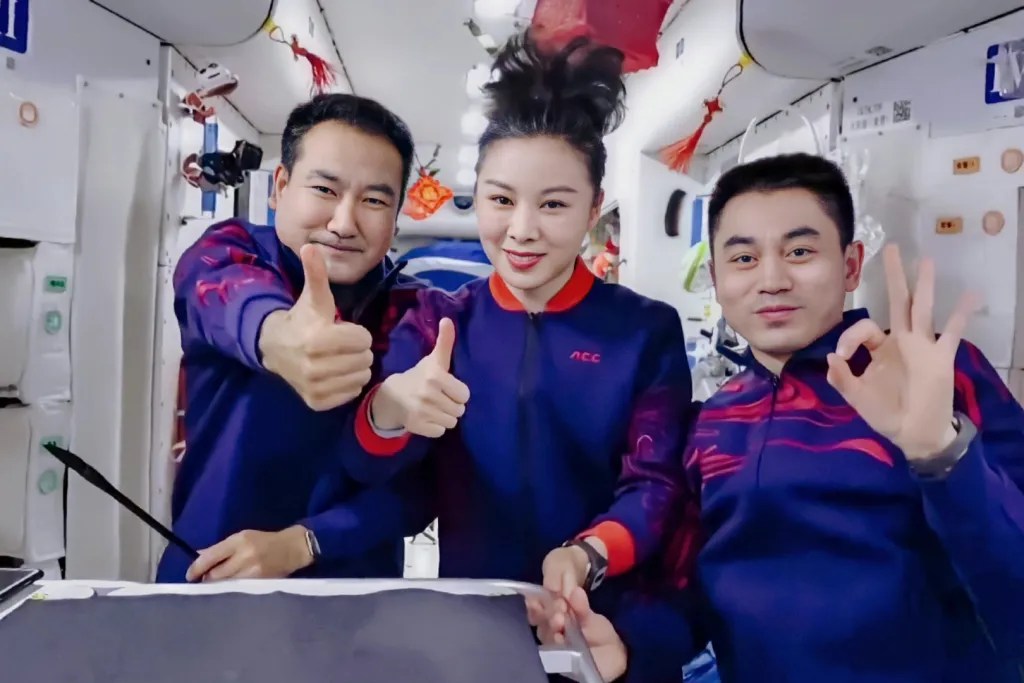
On the 21st September 2023 National wide, also broadcasting internationally of the Fourth lesson of the Tiangong Classroom of the Crew of the Shenzhou 16 onboard the Tiangong – China Space Station CMS China Manned Space CNSA-China National Space Administration  in which is scheduled to start on 1545 Hours of Hong Kong Beijing time with the Crew of the Shenzhou 16 Takionaut Crew of Jing Haipeng and Zhu Yangzhu , Gui Haichao will conduct space science classes for teenagers across the country. At that time, China Manned Spaceflight’s official Weibo pageSeptember 21, 30 fans will be drawn to send invitations to Tiangong Classroom’s fourth lesson #天宫 classroom四级.

The Tiangong Classroom content consist on immersive interaction between the Takionauts opens an experimental class in space天宫ClassroomLesson 4 started. “Space teachers” Jing Haipeng, Zhu Yangzhu, and Gui Haichao will popularize space science for teenagers across the country. They will demonstrate the spherical flame experiment, the wonderful “ping pong” experiment, the momentum conservation experiment and the gyroscope experiment in orbit also other space science experiments in which conducted since the days of Space Teacher Shenzhou 10, Shenzhou 13 Takionaut WangYaping Started the Space Classroom ..

Shenzhou ten and thirteen Senior Colonel Takionaut王亞平Wang Yaping was on CCTV13 on the Tiangong -China Space Station Shenzhou 16 Coverage Tiangong Classroom fourth done by the Takionaut crew of Shenzhou 16

天宫ClassroomLesson4# has begun! Let’s take a look at the wonderful performance of the three space teachers!  Tutor GuiHaichao calls you to come and listen to the lecture…. In the first part, the crew of the Shenzhou 16th Takionauts introduce the brand new “space classroom” – Mengtian Experimental Cabin…..

Space water polo experiment, the astronauts are playing table tennis with water polo!

Mentor GuiHaichao calls you to listen to the class Shenzhou 16 space teachers welcome everyone to scan the QR code, actively carry out experiments on the ground, send your experimental results, and share creative suggestions about the “Tiangong Classroom.

天宫Classroom Lesson 4 Class is over! The space lecture of the Shenzhou 16 mission was successfully completed! Come here to share your experience after class…

A complete success] At 15:48 on September 21, 2023, Beijing time, the fourth lesson of “Tiangong Classroom” started at the China Space Station. The newly-appointed “space teachers” Jing Haipeng and Zhu Yangzhu , Gui Haichao brought a wonderful space science class to the majority of young people. This was the first time that Chinese astronauts taught in the Mengtian experimental cabin. 梦天 Experiment cabin first lecture

In the approximately 48-minute lecture, Shenzhou 16 astronauts Jing Haipeng, Zhu Yangzhu, and Gui Haichao vividly introduced the work and life scenes of the space station’s Mengtian experimental cabin, and demonstrated the spherical flame experiment. , the wonderful “ping pong” experiment, the conservation of momentum experiment, and the gyroscope experiment again, and vividly explained the scientific principles behind the experiments. During the teaching period, the astronauts had real-time interactive communication with teachers and students on the ground through video calls.

This teaching activity set up 5 ground classrooms in Beijing, Alxa League in Inner Mongolia, Yan’an in Shaanxi, Tongcheng in Anhui, and Ningbo in Zhejiang. About 2,800 student representatives participated in the on-site activities. China Central Radio and Television broadcast the entire event live.

The teaching activities are co-sponsored by the China Manned Space Engineering Office, the Ministry of Education, the Ministry of Science and Technology, the China Association for Science and Technology, and the China Central Radio and Television Station, and are supported by relevant research and testing units related to the manned space engineering.

During the application and development stage of the space station, “Tiangong Classroom” will continue to carry out space teaching activities. The China Manned Space Engineering Office will continue to widely solicit ideas and suggestions on the “Tiangong Classroom” through the media, “Learning Power” and the official website of the Manned Space Engineering Project, and welcomes active participation from all walks of life, especially young people

Images and visuals are from their Respectives CMS China Manned SpaceCNSA-China National Space Administration

#CNSA #ChinaNationalSpaceAdministration #国家航天局 |#BRI #September2023 |#西昌衛星發射中心 #XichangSatelliteLaunchCenter the advance iconic #ChangZheng2D #LongMarch2D Yao 83 launches #Yaogan 39  #RemoteSensing 39 #Satellite ….

On the 17th September 2023 in  CNSA _China National Space Administration -China – People’s Republic of China 1213  hours Hong Kong –Beijing Time China- People’s Republic of China launch the Chang Zheng – Long march 2D  Yao 83 Carrier Rocket launching from station form Xichang Satellite Launch Center Sichuan Province…..

The Chang Zheng- Long March 2D Yao 83 carrier rocket ignited and took off at the Xichang Satellite Launch Center, and then successfully sent the Remote Sensing 39 satellite accurately into the predetermined orbit. The launch mission was a complete success. So far, China Aerospace Science and Technology Corporation has successfully completed its 30th space launch mission this year, winning all 30 times. The Long March 2D launch vehicle is a room-temperature liquid two-stage launch vehicle developed by the Eighth Academy of China Aerospace Science and Technology Corporation. It has the ability to launch single and multiple satellites with different orbital requirements. Its 700-kilometer sun-synchronous orbit carrying capacity is 1.3 Ton.

Remote Sensing Satellite 39 was developed by the Aerospace Dongfanghong Satellite Co., Ltd. of the Fifth Academy of China Aerospace Science and Technology Corporation and the Eighth Academy of China Aerospace Science and Technology Corporation. This launch is the 488th launch of the Long March series of launch vehicle….

Images and visuals are from their Respectives CMS China Manned SpaceCNSA-China National Space Administration