During today on 21st June 2022 at 1008 Hong Kong SAR- Beijing Time launching from one of many complexes酒泉衛星發射中心 Jiuquan Satellite Launch Center in Dongfeng Aerospace City – inner Mongolia –China – People’s Republic of China on中國製造 Expace Technology Corporation, , the Kuaizhou No. 1A solid carrier rocket ignited and lifted off at the Jiuquan Satellite Launch Center Tianxing-1 test satellite into the air. The satellite successfully entered the predetermined orbit, and the launch mission was a complete success. The satellite is mainly used to carry out experiments such as space environment detection….
The Tianxing-1 satellite successfully entered the predetermined orbit, and the launch mission was a complete success. The satellite is mainly used to carry out experiments such as space environment detection. This mission is the 15th flight of the Kuaizhou-1A carrier rocket…
The Expace Kuaizhou-1A rocket for this launch mission is a small solid launch vehicle developed by China Aerospace Science and Industry’s Aerospace Sanjiang. It has international interfaces and mainly provides launch services for 300 kg low-orbit small satellites. Features such as high reliability, high precision into orbit, short preparation period, less guarantee demand, and low launch cost.
The Kuaizhou-1A rocket is a small solid launch vehicle launched by the Rocket Company of China Aerospace Science and Industry Corporation Limited. It has high flight reliability, high precision into orbit, short preparation period, less guarantee demand, and low launch cost Features.
Currently at the moment中國製造 Expace Technology Corporation- a CASIC -China aerospace science and industry corporation has been very busy in building a New Carrier Rocket Factory in Wuhan National Aerospace Industrial Base in which the base will be in operations in May 2020 Kuaizhou Rocket Industrial Park that forms the manufacturing of twenty plus more Kuaizhou Rockets also its other sister larger carrier rockets in process of The assembly test capability of 20 solid launch vehicles……
Images and visuals are from a their respectives ..
中国空间站 On currently on December 2021, the Belt and Road InitiativeCNSA –China National Space Administration CSS China Space Station in which on a three to six months setting up a new home of the first three Shenzhou 13 in which spending up to on for the further construction and verifications of the systems of the CSS –China Space Station 2021 launch calendar in which currently the three Takionauts current Shenzhou 13 …… Preparations for the six months of extension of the China Space Station In which the currently it remains awaiting for the crew of setting up home in conducting fun scientifically onboard中国空间站.. China Space station …..
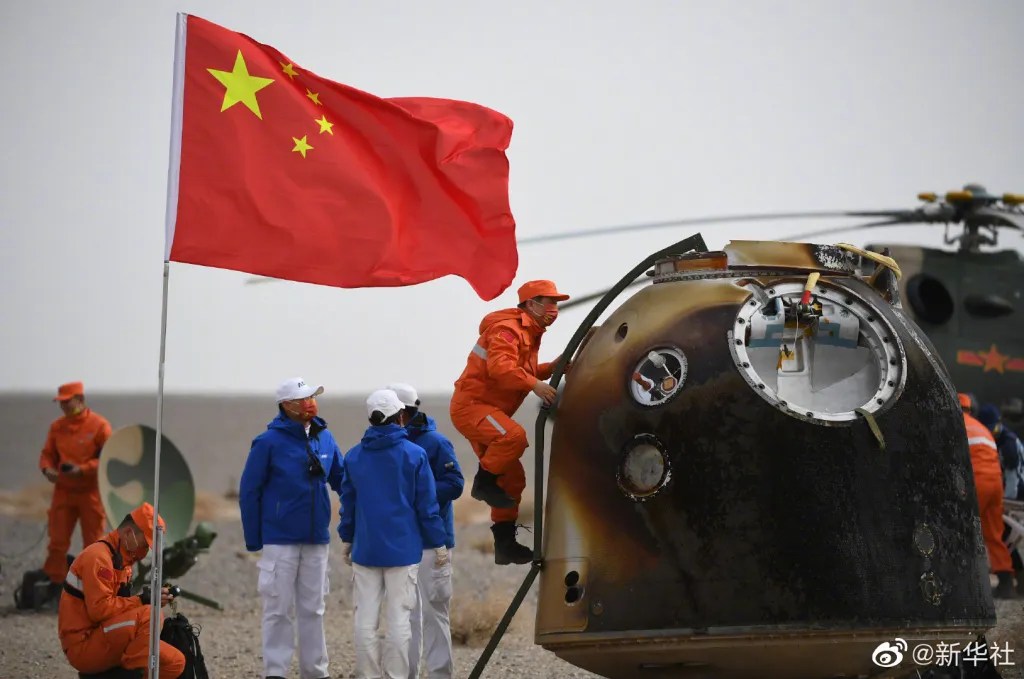
On the 16th April 2022 Saturday in between times of 09:35-10:05 hour’s morning Hong Kong SAR Beijing Time, Shenzhou13 will be back on earth in which the crew of Shenzhou 13 Zhai Zhigang, Wang Yaping and Ye Guangfu, are on their way back to Earth after a national record six-month-long mission in orbit aboard the Chinese
This year 2002 marks the expect completion year for the CNSA CSS China Space Station in which this is a demonstration of how the construction is proceed in duration of Shenzhou 14 and Shenzhou 15 crew time in space Once unfolded 50% off 10 pieces, unfolded the whole piece of solar wing twice // Space stack and space station : It can also be seen here that after the two experimental modules enter orbit, only part of the solar wing will be unfolded first, and then the space station assembly will be docked. Expand the entire solar wing twice
Watching Experimental module rendezvous and docking demonstration, let me first say that the Shenzhou 12 13 14 crew has worked hard As the Chinese space station enters the construction stage, on April 21, Yang Hong, chief designer of the China Manned Space Engineering Space Station System, gave a speech at the High School Attached to the National People’s Congress, The process of docking the space station with the subsequent two experimental modules is demonstrated. The video shows that the two experimental cabins will approach the assembly from the rear, the assembly needs to turn around, and the forward docking port faces the rear, and the transposition needs to take place in the direction of the gravity gradient. After the docking of the two cabins is completed, the Tianzhou-4 will deorbit, the Tianzhou-5 will be re-docked to the rear, and the Shenzhou-15 will be docked to the forward docking port.
At 1750 Hours Hong Kong Beijing Time on a very clear 29th March Tuesday 2022 2022, China- People’s Republic of China- CNSA –China National Space Administration Successfully launched the New Next Generation Long March 6 Chang Zheng 6 carrier rocket at the Taiyuan Satellite Launch Center Shanxi Province …… modified carrier rocket at the Taiyuan Satellite Launch Center, carrying the Pujiang 2 and The Tiankun-2 satellite successfully entered the scheduled orbit, and the launch mission was a complete success.
The launch vehicle is a new generation of non-toxic and non-polluting launch vehicle in China – People’s Republic of China. It is the first solid bundled launch vehicle in my country and is used to launch satellites in sun-synchronous orbit. The Pujiang-2 satellite is mainly used for scientific experimental research, land and resources census and other tasks, and the Tiankun-2 satellite is mainly used for the experimental verification of space environment detection technology. This mission is the 412th flight of the Long March series of launch vehicles.
The Chang Zheng6A Long March 6A modified carrier rocket was developed by the Eighth Academy of China Aviation and is the first solid-liquid bundled carrier rocket in China – People’s Republic of China. This mission is the 412th launch of China – People’s Republic of China Chang Zheng- Long March series of launch vehicles.
Hong Gang, the commander-in-chief of the Changliu, said in an interview that through the adjustment of the boosters in the future, the Chang Zheng6A -Long March 6A reform can form a single-core stage, bundle 2 solid boosters, bundle 4 solid boosters, and bundle a universal core stage. and other configurations to form a series of launch vehicles with a wide range of carrying capabilities, reasonable gradients and high cost performance, to meet the diverse and intensive launch requirements of future satellites.
The Chang Zheng6A -Long March 6A modified carrier rocket adopts a two-stage and a half configuration. The core first-stage power system has a diameter of 3.35 meters and is composed of two 120-ton thrust liquid oxygen kerosene engines in parallel. Pressure medium; the core secondary power system has a diameter of 3.35 meters and is equipped with a liquid oxygen kerosene engine with a thrust of 18 tons. The single flight working time of the engine exceeds 500 seconds; the auxiliary power YF-86A auxiliary power system consists of 18 thrust Composed of 200N and 40N attitude control engines, it provides rolling torque for the second stage of the rocket during flight, and provides pitch, yaw and rolling impulses before the satellite is separated, ensuring that the satellite enters orbit with higher precision. The total length of the whole arrow is about 50 meters, the take-off weight of the whole Chang Zheng6A -Long March 6A Carrier Rocket is about 530 tons, and the carrying capacity of the 700-kilometer sun-synchronous orbit is not less than 4 tons. Referencing to Sixth Academy of Aerospace Science and Technology…..
The “mix and match” of solid power and liquid power is the special feature of this type of rocket. The 4 boosters of the rocket use the two-stage 120-ton thrust solid engine developed by the Fourth Academy of China Aviation, and the core stage adopts the liquid oxygen kerosene engine developed by the Sixth Academy of China Airlines, which gives full play to the high performance, long working time and solid engine of the liquid engine. The advantages of large thrust and simple use and maintenance. The successful first flight of the rocket marks that my country has made breakthroughs in key technologies such as the binding and separation technology of solid boosters, the technology of large concentrated force diffusion at the binding point, and the combined rocking control of solid-liquid binding.
With a brand new “smart launch site complexes” has been put into use, and the new station has been adapted and transformed to be able to launch Seven types of Chang Zheng Long march carrier rocket of launch vehicles During the first flight mission of Chang Zheng 6A Long March 6A, China – People’s Republic of China built the first satellite launch center in Taiyuan. The “smart launch site” was also put into use for the first time, realizing remote control and unattended operation from Carrier Rocket filling to launching.
About four hours before launch, ground personnel were evacuated from under the tower. In the remote control room about two kilometers away from the tower, operators in positions such as air conditioners, platforms, and pendulums keep their eyes on the screen and closely monitor the status of the rocket. Xue Weijun, commander of the intelligent launch site system of Taiyuan Satellite Launch: Before the intelligent launch site was put into use, most of the ground equipment operations were completed by the front-end staff, and the evacuation could only be carried out 15 minutes before the rocket launch. Unattended mode only need to remotely control and monitor in front of the computer terminal, to ensure the normal operation of each work.
The construction of the new launch tower will be completed in 2021, and this is the first time it has been put into use. Under the automatic operation of the system, a series of actions such as liquid oxygen filling, connector falling off, and turning platform opening of the Chang Zheng Long March Carrier rocket were successfully completed, and the rocket entered the launch state. .
Zhang Xin, Commander of Taiyuan Satellite Launch Center No. 1: The measurement and launch process management and control platform is the core of our smart launch site. The status information of the facilities and equipment of the launch site is displayed and analysed in a unified and centralized manner through intelligent, networked and informative means. The goal of being unattended during the refuelling and launching process is achieved, and the personnel at the test and launch positions are more capable. Compared with traditional launches, the smart launch site has truly achieved rapid preparation and one-click launch. The number of post personnel has been reduced by more than half, and the shortest single-launch task process can be shortened to 14 days, which is more suitable for high-density launches and emergency launch missions.
Zheng Taifeng, head of the tower of the smart launch site: The smart launch site of the Taiyuan Satellite Launch Center can currently carry out the launch of various types of launch vehicles from the Long March 6. After adaptive transformation, it can meet 7 different types of Long March 2 and Long March 4 series. Model launch vehicle launches capability. In the future rapid launch missions, the application value of the smart launch site will be brought into full play…
At 1750 Hours Hong Kong Beijing Time on a very clear 29th March Tuesday 2022 2022, China- People’s Republic of China- CNSA –China National Space Administration Successfully launched the New Next Generation Long March 6 Chang Zheng 6 carrier rocket at the Taiyuan Satellite Launch Center Shanxi Province …… modified carrier rocket at the Taiyuan Satellite Launch Center, carrying the Pujiang 2 and The Tiankun-2 satellite successfully entered the scheduled orbit, and the launch mission was a complete success.
The launch vehicle is a new generation of non-toxic and non-polluting launch vehicle in China – People’s Republic of China. It is the first solid bundled launch vehicle in my country and is used to launch satellites in sun-synchronous orbit. The Pujiang-2 satellite is mainly used for scientific experimental research, land and resources census and other tasks, and the Tiankun-2 satellite is mainly used for the experimental verification of space environment detection technology. This mission is the 412th flight of the Long March series of launch vehicles.
Four hours before the launch of the rocket, all front-end operators evacuated the tower, and the rocket completed the subsequent launch process through unattended technology. The unattended technology of the Long March 6 rocket has achieved three “firsts” in my country in the field of delivery: the first use of automatic docking and filling technology, which can realize automatic filling of remote full-process propellants; The ground connector automatically falls off at the moment of take-off; after the first propellant filling, there is no personnel on duty at the front end of the launch site, which effectively ensures the safety of the rocket launch mission and is also the model’s firm practice of the “people-oriented” concept
“Tiankun-2” satellite successfully entered the predetermined orbit, the solar panels were deployed smoothly, the subsystems were in normal working condition, and the launch mission was a complete success. Chang Zheng Long March 6 modified carrier rocket successfully made its first flight The “Tian Kun 2” satellite is a new technology test satellite developed by the Space Engineering Company of the Second Academy of Aerospace Science and Industry of China. On March 3, 2017, the first satellite “Tiankun-1” independently developed by China Aerospace Science and Industry Corporation with completely independent intellectual property rights was successfully launched, expanding the spectrum of my country’s small low-orbit universal satellite platform. The “Tiankun-2” satellite inherits the characteristics of high functional density of the “Tiankun-1” satellite, and at the same time has a lower cost and a smaller size. It is another innovative achievement with a leading domestic level. Satellites have high functional density, strong mission capabilities, and good cost performance. They can meet the functional requirements of diverse and complex tasks such as space scientific exploration, in-orbit services, and new technology verification, and effectively improve the adaptability of small satellites to space multi-tasking.
The “Tiankun-2” satellite adopts an integrated design concept, with a highly integrated electronic unit as the core, and the platform and payload are tightly coupled. The main purpose of this experiment is to verify a number of key technologies such as new attitude and orbit control algorithms, multi-functional flexible cladding materials, and computational optical imaging….
At 10.35 Hours wintery Morning Hong Kong Beijing Time on a very clear 17th January 2022 Sunday 2022, China- People’s Republic of China- CNSA –China National Space Administration Successfully launched the Long March 2D Chang Zheng 2D carrier rocket at the Taiyuan Satellite Launch Center Shanxi Province …… at the Taiyuan Satellite Launch Center,, the Chang Zheng 2D Long March 2D carrier rocket ignited and took off, and then sent the Shiyan13 test satellite No. 13 into the predetermined orbit for launch. The mission was a complete success. In the New Year, the first series of Launches of my country- China – People’s Republic of China space launch mission was successful.
The Shiyan13 Experiment No. 13 satellite was developed by the Institute of Microsatellite Innovation, Chinese Academy of Sciences, and is mainly used for space environment detection and related technology experiments. In response to the special requirements of the satellite interface, the Chang Zheng 2D Long March 2D carrier rocket uses a 2-meter-diameter satellite-carrier Rocket separation device for the first time.
During At 10:35 on January 17, The Chang Zheng 2D Long March 2D carrier rocket for this mission was developed by the Eighth Academy of China Aerospace Science and Technology Corporation. Chang Zheng 2D Long March 2D carrier rocket is known as the “golden rocket” and has the characteristics of high reliability, high safety, low cost, and short-cycle launch.
The mission was in the middle of winter, and the lowest temperature in the launch site area exceeded minus 37 degrees Celsius. The Chang Zheng 2D Long March 2D carrier rocket test team upgraded the product sealing measures, and coordinated with the launch site to formulate an improved launch process for low temperature, which further improved the rocket’s low temperature adaptability. The Shiyan13 Experiment No. 13 satellite is mainly used to carry out space environment detection and related technology experiments. ….. This year, the Aerospace Science and Technology Group plans to arrange more than 40 space launch missions. Among them, the Chang Zheng 2D Long March 2D carrier rocket is scheduled to launch more than 15 times, which is expected to set the record for the highest number of annual launches of this type of rocket. Facing the challenge of high-density launch in 2022, Chang Zheng 2D Long March 2D carrier rocket of the present invention adopts the design idea of ”de-mission” to improve product production efficiency and enhance the ability to adjust the launch plan. …This mission is the 406th launch of the Long March series of launch vehicle