Currently at the moment中國製造 Expace Technology Corporation- a CASIC -China aerospace science and industry corporation has been very busy in building a New Carrier Rocket Factory in Wuhan National Aerospace Industrial Base in which the base will be in operations in May 2020 Kuaizhou Rocket Industrial Park that forms the manufacturing of twenty plus more Kuaizhou Rockets also its other sister larger carrier rockets in process of The assembly test capability of 20 solid launch vehicles……in which is now in operation……

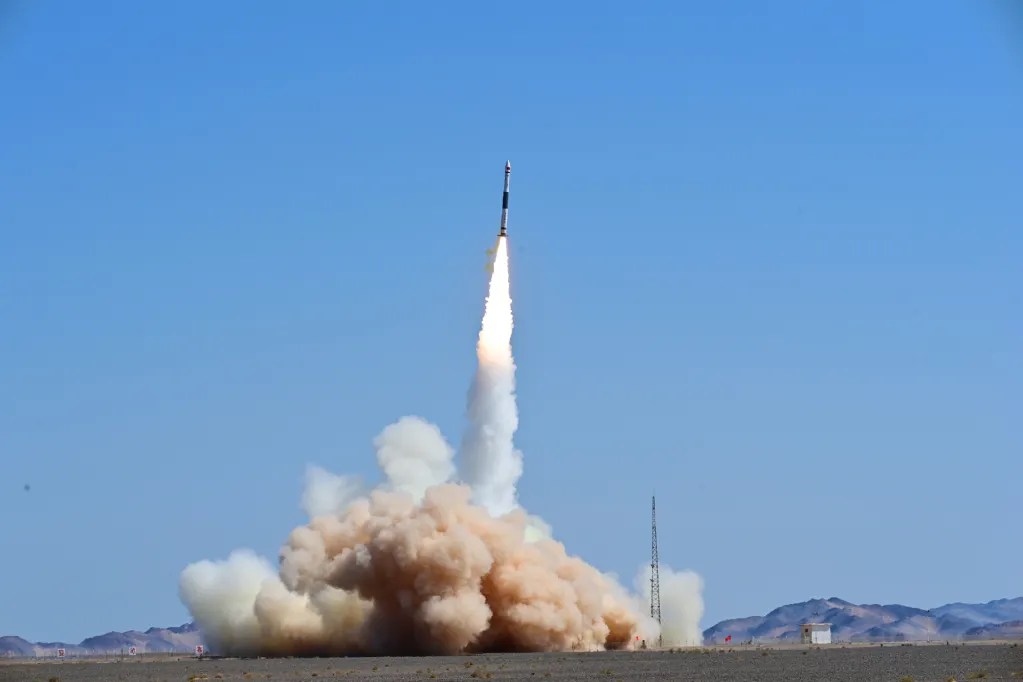
At 17:43 Hong Kong SAR- Beijing time on Saturday September 20th , 2024, at the Xichang Launch Center in Liangshan Prefecture, Sichuan Province , China, People’s Republic of China , the “Kuaizhou-1A” solid-fuel carrier rocket carrying four communication satellites of the “Apocalypse” constellation 29 to 32 was launched, successfully sending the satellites into low Earth orbit (LEO).

The 29th to 32nd satellites of the “Apocalypse” constellation are low-orbit satellite IoT communication satellites developed by Beijing Guodian Hi-Tech Co., Ltd. The “Apocalypse” constellation is built and operated by Beijing Guodian Hi-Tech Co., Ltd. It consists of 38 satellites and is scheduled to be completed by the end of 2024. It will achieve an average revisit frequency of 1 time/10 minutes worldwide. The constellation aims to create a global low-orbit satellite IoT ecosystem that integrates the earth and the sky, and open up a new situation for satellite IoT consumer applications.

“Kuaizhou-1A” is a small launch vehicle launched by China Aerospace Science and Industry Corporation. It adopts a four-stage tandem configuration, with solid power in the first, second and third stages and liquid power in the fourth stage. The rocket is about 20 meters high and has a maximum diameter of 1.4 meters. It can be equipped with a fairing with a diameter of 1.2 meters/1.4 meters. The takeoff mass is about 30 tons and the takeoff thrust is 60 tons. Its low-Earth orbit (LEO) capacity is 300 kilograms, the 500-kilometer sun-synchronous orbit (SSO) capacity is 250 kilograms, and the 700-kilometer sun-synchronous orbit (SSO) capacity is 200 kilograms. The liquid last stage of this rocket has the ability to ignite multiple times and can perform multi-satellite launch missions in different orbits. In this mission, this type of rocket has greatly shortened the position process time through technical optimization, further improving product reliability.

Since its successful maiden flight, the Kuaizhou-1A rocket has carried out a total of 27 launches, 25 of which were successful, making it China’s solid-fuel carrier rocket with the most launches and the most successes. Since the successful launch of the Kuaizhou-1A Yao 23 rocket on June 22, 2022, the rocket has achieved 13 consecutive victories.
This launch mission is the third launch of the Kuaizhou-1A rocket in 2024, the 14th launch from the Xichang Launch Center, the 43rd launch in China, and the 173rd launch into orbit in the world. From the launch of the Long March 3B at 09:14 on September 19 to this launch, China’s space program has carried out three launches within 33 hours, opening a high-density launch mode.
Images and visuals are from their respectives..