#MadeInChina #中國製造 |#深蓝航天 #LANDSPACE #Deep Blue Aerospace  #December2023| #Zhuque-2 #Suzaku-2 Yao 3 #CarrierRocket  #酒泉卫星发射中心 #JiuquanSatelliteLaunchCenter …. The world’s liquid oxygen methane rocket successfully entered orbit for the second time takes the lead in entering the commercial launch stage Deploying #Honghu  #Honghu2 #Tianyi33 Satellites …

深蓝航天  Deep Blue Limited – Deep Blue Aerospace One of sixty Chinese private space Carrier Rocket Companies in China-People’s Republic of China…  As many of sixty plus Private Rocket Deep Blue Aerospace Co., Ltd. was established in 2017. The company is mainly a high-tech aerospace enterprise that focuses on the direction of liquid recovery and reusable launch vehicles and provides users with commercial launch services. Deep Blue Aerospace Co., Ltd. is headquartered in Nantong City, Jiangsu Province. At the same time, the company has rocket general and liquid engine R&D centers in Yizhuang, Beijing and Xi’an, Shaanxi, respectively, and a rocket power system test base in Tongchuan, Shaanxi…..

On December 1st 2023, the Blue Arrow Aerospace Zhuque Suzaku- 2 Yaosan liquid oxygen methane carrier rocket was successfully transferred to the launch area and is preparing to select an opportunity to carry out the launch mission in the near future. The launch is sponsored by PopMart ..

POP MART is a market-leading character-based entertainment company and a global champion of designer toy culture.

The world’s liquid oxygen methane rocket successfully entered orbit for the second time! Zhuque-2 takes the lead in entering the commercial launch stage

At 07:39 Hong Kong SAR- Beijing time  on December 9th , 2023, the ” Suzaku -Zhuque-2″ Yao-3 carrier rocket carrying the three satellites “Honghu”, “Tianyi 33” and “Honghu-2” was ignited from the Jiuquan Satellite Launch Center Blue Arrow Space Launch Site Launched, the satellite was successfully placed into a sun-synchronous orbit (SSO) at an altitude of 460 kilometers.. Launching from酒泉卫星发射中心Jiuquan Satellite launch Center, Inner Mongolia, China, People’s Republic of China .

The “Honghu” satellite is a 50-kilogram-class space science experimental satellite independently developed by Tianyi Research Institute. It is mainly equipped with a comprehensive electronic load, a xenon Hall propulsion load, and a krypton Hall propulsion load. It will complete the Hall propulsion orbit control function and Performance verification, comprehensive electronic load device and switch life verification and other tasks. The “Tianyi 33” satellite is a 50-kilogram space science experimental satellite jointly developed by the Tianyi Research Institute and Hunan University of Science and Technology. It is equipped with a remote sensing camera module and a number of new technology payloads.

“Honghu 2” is an experimental satellite developed by Shanghai Blue Arrow Hongqing Technology Co., Ltd. for low-orbit satellite constellation networking. It is equipped with a Hall electric propulsion system (xenon and krypton), a satellite integrated electronic system, and a new solar array. Innovative technologies such as self-developed products, on-orbit verification of large-scale orbit changes of satellites, high computing power operations on satellites, and new solar technologies provide technical support for my country’s satellite constellation networking.

Honghu satellite is a 50kg space science experimental satellite independently developed by Tianyi Research Institute. The satellite is mainly equipped with a comprehensive electronic payload, a xenon Hall propulsion load, and a krypton Hall propulsion load developed by Shanghai Blue Arrow Hongqing Technology Co., Ltd. It will complete the Hall propulsion orbit control function and performance verification, comprehensive electronic payload devices and Tasks such as switch machine life verification. This launch will be the first time that my country has used xenon and krypton permanent magnet electric propulsion systems to achieve a cumulative 100-kilometer-level orbit control test. It also plans to complete nearly 3,000 hours of on-orbit ignition testing and a 10,000-time switch life of the Hall electric propulsion system. verify.


The Honghu satellite is also equipped with the “Xingcheng II” argon ion thruster developed by Xingcheng Huiyu (Beijing) Technology Co., Ltd.


The cost of this type of thruster is much lower than that of xenon and krypton. It is developed based on ion propulsion technology, with ionization and acceleration separated. The specific impulse can reach 1500s and the thrust adjustment range is large. At the same time, due to its integrated and centralized layout Designed for easier satellite installation and control. This type of thruster has high reliability and cost-effectiveness, and can be widely used in orbit control scenarios such as orbit entry, network attitude adjustment, and deorbiting of micro-satellites, which can significantly reduce the deployment cost of satellite constellations.
This flight is the second on-orbit verification of this type of thruster. It mainly conducts on-orbit tests such as electromagnetic control, ignition, working and shutdown processes, and temperature measurement and control under long-term working conditions. It will provide support for the development and application of subsequent products. Provide technical support.

Tianyi 33 satellite is a 50kg space science experimental satellite jointly developed by Tianyi Research Institute and Hunan University of Science and Technology. The satellite is equipped with a remote sensing camera module and a number of new technology payloads, and for the first time adopts a number of Tianyi independent research and development platform technologies, which can provide more reliable temperature control, thermal protection and energy guarantee conditions for the normal on-orbit work of the payload.
In particular, the satellite adopts newly developed thermal control technology to achieve precise temperature control of the satellite in the restricted space of space. The temperature control accuracy design value is better than 0.5°C. The temperature control energy consumption is expected to be reduced by more than 50%, and it can achieve high temperature Sensitive scientific research loads provide reliable environmental protection. At the same time, high-performance composite materials are also applied to the multiple layers of the Tianyi 33 satellite, which further improves the satellite’s radiation protection capabilities.


In terms of power supply, the Tianyi 33 satellite adopts the high-power long-term power supply technology independently developed by Tianyi for the first time, which enables the satellite to support the normal startup of high-current loads and meet the needs of uninterrupted on-orbit testing of the load.
The Tianyi 33 satellite is also equipped with a scientific research load independently developed by Beijing University of Posts and Telecommunications based on the open source real-time dual-core operating system RROS as the underlying architecture and based on the Rust language. This load will complete general tasks represented by tensorflow/k8s and real-time tasks represented by real-time file system and real-time network transmission on the satellite, and ensure the normal execution of upper-layer applications and scientific research tasks, such as satellite-to-ground delay measurement, Live video broadcast, satellite-based web chat service, pseudo-ssh experiment, etc. This marks the world’s first dual-core operating system written in Rust to be officially applied in satellite scenarios.
While taking into account versatility and real-time performance, RROS achieves high security and low power consumption, better adapts to satellite scenarios and supports the complex application requirements of satellite payloads, and provides operating system guarantees for the next generation of standardized and universal satellite platforms.

“ZhuQue-2” (ZhuQue-2) is a medium-sized two-stage dual-cryogenic liquid launch vehicle independently developed by Blue Arrow Aerospace Company. The first and second stages all use liquid oxygen methane engines. The rocket is equipped with four “Tianque-12” (TQ-12) engines in the first stage, with a single thrust of 658.5 kilonewtons (about 67 tons) at sea level and a sea level specific impulse of 286 seconds. The four “Tianque-12” engines are combined in parallel. The body code is “Tianque-13” (TQ-13); the secondary main engine is a “Tianque-12” (TQ-12) engine, with a vacuum thrust of 776.5 kN (about 79 tons) and a vacuum specific impulse of 350 seconds. , equipped with a swimming engine “Tianque-11”, using a four-combustion chamber design, a vacuum thrust of 80 kN (about 8.2 tons), a vacuum specific impulse of 333 seconds, a “Tianque-12” and a “Tianque-12” The Que-11 combination is codenamed “Tianque-16” (TQ-16).

TheZhuque Suzaku- 2 Yaosan liquid oxygen methane carrier rocket is 49.5 meters long, with a diameter of 3.35 meters for the first and second stages and a fairing. It has a take-off mass of 220 tons (not including payload), a take-off thrust of 268 tons, and a 500-kilometer sun-synchronous orbit (SSO) capacity of 1.5 tons. It is an improved version. The 500-kilometer sun-synchronous orbit capacity will be increased to 4 tons, which can meet the needs of satellite deployment and spacecraft launch in low-Earth orbit.

Zhuque Suzaku- 2 Yaosan liquid oxygen methane carrier rocket Yaosan is the third rocket of the first batch of “Suzaku-2”. The three test arrows fully verified the correctness and coordination of the overall and sub-system plans of the “Zhuque-2”, and accumulated flight samples and a good data basis for subsequent design improvements and reliability improvements of rocket and engine products. , laying a solid foundation for the development of the “Suzaku-3” reusable liquid oxygen methane launch vehicle. This launch is the world’s first official commercial launch of a liquid oxygen methane rocket.

This launch is the second launch of the “Suzaku-2” rocket in 2023, the 31st launch of the Jiuquan Satellite Launch Center, the 58th launch of China, and the 201st launch of the world.

Images and visuals are from their Respectives.

#MadeInChina #中國製造 |#深蓝航天 #LANDSPACE #DeepBlueLimitedCompany #November2023| Deep Blue Aerospace #ReusableCarrierRocket # Zhuque-3 #Suzaku-3″ #CarrierRocket stainless steel launch vehicle announcement at Aerospace Information Industry International Ecosystem Event 2023.

深蓝航天  Deep Blue Limited – Deep Blue Aerospace One of sixty Chinese private space Carrier Rocket Companies in China-People’s Republic of China…  As many of sixty plus Private Rocket Deep Blue Aerospace Co., Ltd. was established in 2017. The company is mainly a high-tech aerospace enterprise that focuses on the direction of liquid recovery and reusable launch vehicles and provides users with commercial launch services. Deep Blue Aerospace Co., Ltd. is headquartered in Nantong City, Jiangsu Province. At the same time, the company has rocket general and liquid engine R&D centers in Yizhuang, Beijing and Xi’an, Shaanxi, respectively, and a rocket power system test base in Tongchuan, Shaanxi…..

On the Month of October- November 2023  Zhang Changwu, founder/CEO of Blue Arrow Aerospace As a guest speaker, attend this conference event of Aerospace Information Industry International Ecosystem Event 2023 It has finally been officially announced that Blue Arrow has developed the reusable Carrier Rocket  stainless steel Suzaku 3 rocket….  

Many people did not notice the details on. Blue Arrow disclosed for the first time its Suzaku 3, which will succeed Suzaku 2 Carrier Rocket – Reusable Carrier Rocket. Launch vehicle.


Judging from the picture, the one-time launch to low-Earth orbit has a transport capacity of 20 tons, the recovery area is 16.5 tons (not necessarily at sea), and the return transport capacity is 11 tons. Two-stage design, stainless steel storage tank, the diameter should be more than 4 meters by comparison, and it is suspected that 7 engines (maybe 9) are stuffed inside. First stage with grille rudder with deployable landing legs.


The railway transportation limit made by the Shanghai Institute is 3.8 meters. If it is 4 meters higher, it is equivalent to killing the possibility of inland launch? Or is there another way? After all, Landspace Blue Arrow spent a lot of effort on the launch pad in Jiuquan Satellite Launch Center, Inner Mongolia, China, and People’s Republic of China. , so it is unlikely that they will be abandoned. What do you think?


Blue Arrow originally wanted to go to IAC for a press conference, but it was later cancelled for some reason. This time in China, it was taken the opportunity to release. There is nothing unexpected about the overall design. Perhaps the only exception is the use of stainless steel. It is the first mainstream private aerospace company in China to officially announce the use of stainless steel.

General Manager Changwu of Blue Arrow shared that no matter what, I have always recognized Blue Arrow’s hard work and development in the field of China’s commercial space launch vehicles, and I am grateful for its efforts and contributions to the commercialization of China’s launch vehicles. I will always believe in it. , as long as you keep working hard like this, @LANDSPACE Blue Arrow Aerospace will be realized sooner or later.

Images and visuals are from their Respectives.

#MadeInChina #中國製造 |#深蓝航天 #LANDSPACE #DeepBlueLimitedCompany #November2023 | Deep Blue Aerospace #ReusableCarrierRocket #CarrierRocket #PinqiBuildingBlocks × – the #Zhuque-2 #Suzaku-2″ #CarrierRocket launch vehicle ….

深蓝航天  Deep Blue Limited – Deep Blue Aerospace One of sixty Chinese private space Carrier Rocket Companies in China-People’s Republic of China…  As many of sixty plus Private Rocket Deep Blue Aerospace Co., Ltd. was established in 2017. The company is mainly a high-tech aerospace enterprise that focuses on the direction of liquid recovery and reusable launch vehicles and provides users with commercial launch services. Deep Blue Aerospace Co., Ltd. is headquartered in Nantong City, Jiangsu Province. At the same time, the company has rocket general and liquid engine R&D centers in Yizhuang, Beijing and Xi’an, Shaanxi, respectively, and a rocket power system test base in Tongchuan, Shaanxi…..

On the 10th November 2023拼奇积木 Pantasy – Pinqi Building Blocks based in Guangdong Province, China, People’s Republic of China. In which recently have team up with Landspace in celebrations of with warm congratulations to   the world’s first liquid oxygen methane launch vehicle Suzaku-2″ was successfully launched at 9:00 on July 12, 2023!

Pinqi Building Blocks × @LANDSPACE Blue Arrow Aerospace’s sincere work,
the first aerospace science-style large-scale scene building block for the public, “Rocket Dream Factory” on the actual testing, final assembly, and launch facilities of Suzaku 2, the rocket manufacturing process is restored in a fun and building process to learn aerospace knowledge.
Configure 4 aerospace engineer minifigures to pay tribute to every scientific researcher who has contributed to the aerospace industry.

朱鹏二号On the  12th July 2023酒泉衛星發射中心 Jiuquan Satellite Launch Center LandSpace Blue Arrow Aerospace Center,   LandSpace 蓝箭航天Suzaku-2 Yao-2  Carrier rocket successfully Launched At 09:00 Hours on July 12th, 2023, Beijing time, the Suzaku-2 Yao-2 carrier rocket was launched at the Jiuquan Satellite Launch Center, Inner Mongolia, China, People’s Republic of China  The flight mission was completed according to the procedure, and the launch mission was a complete success. This mission is the second flight of the Suzaku-2 carrier rocket. Today, Blue Arrow proves to the world that methane can fly!

The LANDSPACEflight mission was completed according to the procedure, and the launch mission was a complete success. This mission is the second flight of the Suzaku-2 launch vehicle. The Suzaku-2 rocket has become the first launch vehicle in human history that uses liquid methane as a propellant to successfully enter orbit….

朱鹏二号 At present, the reusable liquid fuel engines that have completed the whole system test run include: “Lingyun” (10 tons of thrust, liquid oxygen methane) and “Dragon Cloud” (80 tons of thrust, liquid oxygen methane) of Kyushu Yunjian , “Thunder-R1” of Deep Blue Aerospace (20 tons of thrust, liquid oxygen kerosene), “Sky” of Galaxy Power (50 tons of thrust, liquid oxygen kerosene), “Focus One” of Star Glory (15 tons of thrust, liquid oxygen kerosene) Methane), Tianbing Science and Technology’s “Tianhuo 11” (30 tons thrust, liquid oxygen kerosene) and “Tianhuo 12” (110 tons thrust, liquid oxygen kerosene), Aerospace Propulsion “Canglong One” (60 tons thrust, liquid oxygen methane), etc.

Images and visuals are from their Respectives.

#MadeInChina #中國製造 |#深蓝航天#LANDSPACE #DeepBlueLimitedCompany  #November2023| Deep Blue Aerospace #ReusableCarrierRocket Development Progress- The Zhuque-2 Yao 3 #CarrierRocket launch vehicle departs for the Blue Arrow Aerospace Jiuquan liquid oxygen methane rocket launch station…


深蓝航天  Deep Blue Limited – Deep Blue Aerospace One of sixty Chinese private space Carrier Rocket Companies in China-People’s Republic of China…  As many of sixty plus Private Rocket Deep Blue Aerospace Co., Ltd. was established in 2017. The company is mainly a high-tech aerospace enterprise that focuses on the direction of liquid recovery and reusable launch vehicles and provides users with commercial launch services. Deep Blue Aerospace Co., Ltd. is headquartered in Nantong City, Jiangsu Province. At the same time, the company has rocket general and liquid engine R&D centers in Yizhuang, Beijing and Xi’an, Shaanxi, respectively, and a rocket power system test base in Tongchuan, Shaanxi…..

On October 29th 2023 , Deep Blue Aerospace  the Zhuque -2 Yao 3 carrier rocket departed and was transported to the launch station of the Blue Arrow Aerospace liquid oxygen methane rocket located at the Jiuquan Satellite Launch Center. The first batch of tests of this model will be carried out soon. Carrier Rocket’s third launch mission….

The rocket will carry an effective satellite payload. Based on the flight data and test and launch experience accumulated from previous launch missions, some product design improvements and test and launch process optimization and adjustments have been made to further improve and strengthen the reliability and safety of the product.

Recently, the Zhuque-2 Yao 3 Carrier Rocket launch vehicle has successfully passed the launch license review and factory review . The product’s technical status is clear and the quality is under control. The ground launch support system and launch site system have also been restored and transformed, and are qualified to perform missions. The Zhuque-2 Yao-3 launch vehicle has officially carried out commercial launch missions and is expected to become the first privately-owned liquid rocket in China to successfully launch continuously. It will mark Blue Arrow Aerospace’s first step into a new stage of large-scale liquid rocket commercial launches.

[The Zhuque-2 Yao-3 Carrier Rocket launch vehicle departs for the Jiuquan liquid oxygen methane rocket launch station of Blue Arrow Aerospace. The third launch mission of the first batch of test rockets of this model will be carried out and will carry an effective satellite payload!

On October 29, the Zhuque-2 Yao-3 carrier rocket departed from the Jiaxing rocket manufacturing base of Blue Arrow Aerospace and was transported to the launch station of the Blue Arrow Aerospace liquid oxygen methane rocket located at the Jiuquan Satellite Launch Center. The first batch of tests of this model will be carried out soon. Carrier Rocket’s third launch mission….  


The rocket will carry an effective satellite payload. Based on the flight data and test and launch experience accumulated from previous launch missions, some product design improvements and test and launch process optimization and adjustments have been made to further improve and strengthen the reliability and safety of the product


Recently, the Zhuque-2 Yaosan launch vehicle has successfully passed the launch license review and factory review. The product’s technical status is clear and the quality is under control. The ground launch support system and launch site system have also been restored and transformed, and are qualified to perform missions. The Zhuque-2 Yao-3 launch vehicle has officially carried out commercial launch missions and is expected to become the first privately-owned liquid rocket in China to successfully launch continuously. It will mark Blue Arrow Aerospace’s first step into a new stage of large-scale liquid rocket commercial launches…..

Images and visuals are from their Respectives.

#MadeInChina #中國製造 |#深蓝航天#DeepBlueLimitedCompany  #October2023| Deep Blue Aerospace #ReusableCarrierRocket Development Progress -The first long-distance test run of Deep Blue Aerospace’s #3DPrinted  #ThunderR1 #ReusableCarrierRocket  liquid oxygen kerosene engine was a complete success 420 Seconds .. !

深蓝航天  Deep Blue Limited – Deep Blue Aerospace One of sixty Chinese private space Carrier Rocket Companies in China-People’s Republic of China…  As many of sixty plus Private Rocket Deep Blue Aerospace Co., Ltd. was established in 2017. The company is mainly a high-tech aerospace enterprise that focuses on the direction of liquid recovery and reusable launch vehicles and provides users with commercial launch services. Deep Blue Aerospace Co., Ltd. is headquartered in Nantong City, Jiangsu Province. At the same time, the company has rocket general and liquid engine R&D centers in Yizhuang, Beijing and Xi’an, Shaanxi, respectively, and a rocket power system test base in Tongchuan, Shaanxi…..

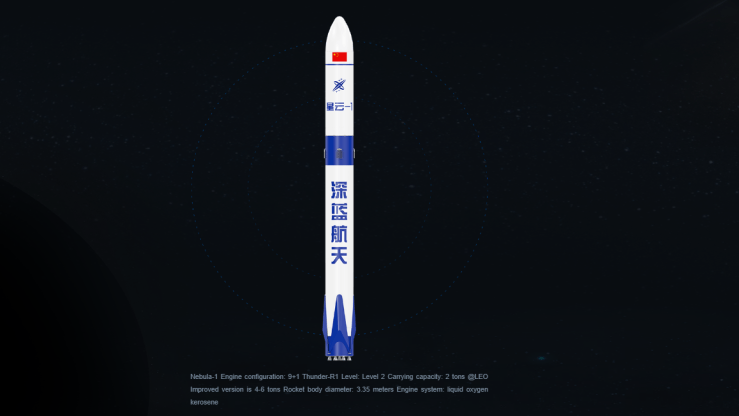
Recently , the reusable liquid engine “Thunder-R1” independently developed by Deep Blue Aerospace conducted its first long-distance test run of 420 seconds under rated operating conditions. The test run time covered more than twice the flight time of the first stage of the reusable rocket “Nebula-1 ” ; The engine started and shut down normally, and the whole process worked stably. The test was a complete success, marking that the “Thunder-R1” engine entered the series boundary, life and reliability test stage.

As China’s first pin-bolt reusable liquid oxygen kerosene engine , this long-distance test run verified the reliability and stability of the system and components of the “Thunder-R1” engine under rated operating conditions. The engine status is stable and its performance is excellent. It demonstrates the technical strength and product leadership of Deep Blue Aerospace’s reusable rocket engine, and proves that the “Thunder-R1” is one step closer to being officially delivered, carrying out the high-altitude recovery test of the first stage of the “Nebula-1” rocket, and flying into orbit.

 Thunder-R1″ is a liquid engine product specially developed for vertical recovery and reuse of launch vehicles. It currently demonstrates excellent performance in various aspects such as reuse, multiple starts, and wide-range thrust adjustment. 85% of the weight of this engine is made by 3D printing. It adopts a pump-back swing and has a compact structure. It is used as the main power for the first and second stages of the Deep Blue Aerospace “Nebula-1” recyclable and reusable liquid launch vehicle.

Up to now, the cumulative test run time of the same engine has reached 2,000 seconds, which has verified the anti-fatigue characteristics and service life of engine components in the harsh engine working environment.

The single ground ignition of the engine lasted 420 seconds. It assessed the long-range work coordination, process reliability and margin design of the entire engine and each component. According to real-time monitoring throughout the test run, the engine was working stably and in good condition. The test data is consistent with the set indicators, and all indicators meet the flight requirements of the “Nebula-1” rocket.

Long-distance test run is an indispensable and important link in the development, production and engineering application of a type of engine. The success of this long-distance test marks the rapid development of Deep Blue Aerospace’s reusable liquid oxygen kerosene rocket engine, and also provides strong power support for the subsequent “Nebula-1” rocket to enter orbit. Previously, the same “Thunder-R1” engine has completed starting and ignition test, complete machine test, secondary start test, and full flight sequence three-start test. In the future, we will continue to carry out ground testing work such as a series of working conditions for pulling deviation, swing test, life and reliability test for engineering applications. The “Thunder-R1” engine is the power foundation of the medium-sized launch vehicle “Nebula-1” and will cover the needs of liquid rockets entering orbit and first-stage recovery. 

Images and visuals are from their Respectives.