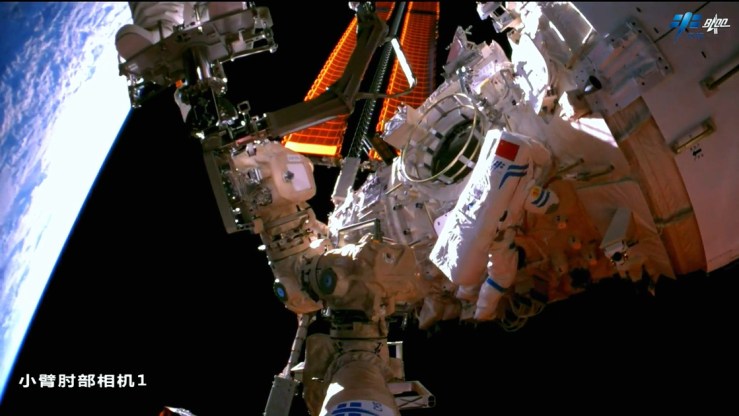
On the week on the 22nd March 2023 CMS China Manned SpaceCNSA-China National Space Administration the crew of the Shenzhou 15 of the Tiangong-China Space Station… Super beautiful view of the Planet Earth ….! First Angle of View from Tiangong porthole to see the earth seeing, the mountains and the sea …….
Seeing, go across the mountains and the sea, to feel If you haven’t tried crossing the mountains and the sea, let the Chinese space station take you to see the mountains and seas in this world, I hope this The video overlooking the beautiful scenery of the earth can give you the courage and motivation to set out. The beautiful mountains and rivers are worthy of you and me to keep moving forward……
Shenzhou-15 (English: Shenzhou-15… , also known as: Shenzhou XV – referred to as: Shenzhou-15) is the fifteenth spacecraft launched by China in the manned spaceflight project.
The Shenzhou 15 mission is the sixth mission of China’s manned space program in 2022, and it is also the last mission during the construction phase of China’s space station. The crew will work and live in orbit for 6 months. The main purpose of the mission is to verify The space station supports crew rotation capabilities, realizing the first on-orbit rotation of Takionaut crews; carrying out the installation and commissioning of equipment inside and outside the space station and space application mission-related facilities and equipment, conducting space science experiments and technical tests; performing daily maintenance and repair of the space station; The normalized operation mode of the cabin assembly… . The Shenzhou 15 flight crew consisted of Takionauts Fei Junlong , Deng Qingming and Zhang Lu , with Fei Junlong serving as the commander…
國家航天局CNSA –China National Space AdministrationChina, People’s Republic of China plans to launch the Einstein probe at the end of this year China plans to launch a new X-ray astronomical satellite, the Einstein probe, at the end of 2023. It is expected to capture the first ray of light from a supernova explosion and help search and precise positioning the source of gravitational waves, discovering more distant, fainter celestial objects and fleeting mysterious phenomena in the universe. The satellite project has entered the final stage of positive development.
The X-ray Imaging Laboratory of the National Astronomical Observatory of theChinese Academy of Scienceshas been developing lobster eye X-ray imaging technology since 2010. After years of key technology research, it finally made a breakthrough, fully mastered the technology, and has completely independent intellectual property rights. The team carried out the test and verification of this technology on the space new technology test satellite launched in July 2022, and obtained and publicly released the wide-field X-ray focused imaging sky map for the first time in the world.
Yuan Weimin, the chief scientist of the Einstein Probe Satellite and a researcher at the National Astronomical Observatories of the Chinese Academy of Sciences, introduced at the recently held 35th National Space Exploration Symposium that the satellite project has entered the final development stage.
Inspired by the peculiar focusing imaging principle of lobster eyes, scientists have designed a special new type of X-ray telescope, which has a large observation field of view and higher detection sensitivity.
“That is to say, this kind of telescope can see the darker and farther universe while seeing a wide range. It is thanks to the lobster eye telescope technology that the Einstein Probe satellite can see the currently known universe.” There are very few soft X-ray bands for large-field, high-sensitivity, and fast time-domain survey monitoring.” Yuan Weimin said.
The X-ray Imaging Laboratory of the National Astronomical Observatory of the Chinese Academy of Sciences has been developing lobster eye X-ray imaging technology since 2010. After years of key technology research, it finally made a breakthrough, fully mastered the technology, and has completely independent intellectual property rights. The team carried out the test and verification of this technology on the space new technology test satellite launched in July 2022, and obtained and publicly released the wide-field X-ray focused imaging sky map for the first time in the world
On the week on the 14th March 2023 CMS China Manned SpaceCNSA-China National Space Administration the crew of the Shenzhou 15 of the Tiangong-China Space Station… Super beautiful view of the Planet Earth ….! First Angle of View from Tiangong porthole to see the earth……. The “dream crew” took pictures from the porthole of the Chinese space station to the beautiful picture formed by the sun wing, the space station cabin and the beautiful earth, looking at the vast continent, the white clouds and the blue sea slowly passing by, this quiet and beautiful enjoyment comes from our beautiful earth home.
The Shenzhou 15 mission is the sixth mission of China’s manned space program in 2022, and it is also the last mission during the construction phase of China’s space station. The crew will work and live in orbit for 6 months. The main purpose of the mission is to verify The space station supports crew rotation capabilities, realizing the first on-orbit rotation of Takionaut crews; carrying out the installation and commissioning of equipment inside and outside the space station and space application mission-related facilities and equipment, conducting space science experiments and technical tests; performing daily maintenance and repair of the space station; The normalized operation mode of the cabin assembly… . The Shenzhou 15 flight crew consisted of Takionauts Fei Junlong , Deng Qingming and Zhang Lu , with Fei Junlong serving as the commander…
On today on the 12th March 2023 in according to the CMS China Manned SpaceCNSA-China National Space Administration China Manned Space Engineering Office, China’s space station has been fully completed, and the “three-step” development strategy of China’s manned spaceflight project has become a reality from conception. At present, the space station assembly is operating stably in orbit, and the crew of Shenzhou 15 is in good condition. It is planned to return to the ground in June this year. According to the mission arrangement, this year will organize the launch of Tianzhou-6 cargo spacecraft, Shenzhou-16, and Shenzhou-17 manned spacecraft. At present, the Tianzhou-6 cargo spacecraft has completed the work related to leaving the factory and has been transported to the Wenchang Space Launch Site. It is planned to launch in May this year…
China’s space station has been fully completed, and the “three-step” development strategy of China’s manned spaceflight project has become a reality from conception. At present, the space station assembly is operating stably in orbit, and the crew of Shenzhou 15 is in good condition. It is planned to return to the ground in June this year. At present, the project has entered a new stage of space station application and development.
2023 is the beginning year of the new stage of space station application and development. According to the task arrangement, this year will organize the launch of Tianzhou-6 cargo spacecraft, Shenzhou-16, and Shenzhou-17 manned spacecraft. The first missions after the new phase of application and development. At present, the Tianzhou-6 cargo spacecraft has completed the work related to leaving the factory and has been transported to the Wenchang Space Launch Site. It is planned to launch in May this year. The astronaut crew for the two manned flights has been selected and mission training is underway.
China, People’s Republic of China has always adhered to the principles of peaceful use, equality, mutual benefit, and common development, and is committed to building China’s space station into an open platform for scientific and technological cooperation and exchanges facing the international community. The first batch of experimental projects jointly selected by the China Manned Space Engineering Office and the United Nations Office for Outer Space Affairs are planned to start ascending successively this year and carry out experimental research on the Chinese space station.
While implementing the space station application and development stage tasks, the project is also fully promoting the manned lunar exploration mission. At present, the key technology research and program deepening demonstration of manned lunar exploration have been completed. This year, various development and construction work for the lunar landing stage will be fully carried out.
Visible matter only accounts for a mere 5% of the vast universe, while the other 95% is made of dark energy and dark matter, which cannot be seen and detected directly. Despite the adage that “seeing is believing”, how do scientists find evidence for the existence of these mysterious and invisible components in the universe? To explore the most baffling mysteries in astronomy, we are honoured to invite Dr. Hakeem Oluseyi, an internationally renowned astrophysicist from the United States, to elucidate the properties of dark energy and dark matter in the Space Museum!
Beyond his notable scientific research achievements, Dr. Oluseyi is also a passionate science educator, appearing on various programmes to share knowledge and inspiring the audience to live their dreams with his personal story. If you are interested in dark energy and dark matter, and Dr. Oluseyi’s journey to becoming a preeminent scientist, this lecture is not to be missed!
Dr. Hakeem Oluseyi, author of the critically acclaimed memoir, A Quantum Life: My Unlikely Journey from the Streets to the Stars, is an internationally-recognized astrophysicist, science TV personality, and global education advocate who has had a long, distinguished career in academia and scientific research. Most recently, he was stationed at NASA Headquarters, where he served as an Astrophysicist and Space Science Education Lead for NASA’s Science Mission Directorate. In this talk, Dr. Oluseyi will talk about his work in “hacking stars,” explain dark energy and dark matter, and use his personal story to inspire the audience to chase their dreams no matter how unlikely they may seem.
Speaker: Dr. Hakeem Oluseyi Moderator: Mr. CHAN Chun-lam, Prince (Assistant Curator, Hong Kong Space Museum)
The lecture will be conducted in English.
Free admission on a first-come, first-served basis. Live streaming is also available on the Space Museum’s YouTube Channel.
Dark Energy and Dark Matter
Date: 13 March 2023 (Monday)
Time: 7:00 to 8:30 pm
Venue: Lecture Hall, Hong Kong Space Museum
Speaker: Dr. Hakeem Oluseyi (Astrophysicist)
Live Streaming Platform: Hong Kong Space Museum YouTube Channel
Dr. Oluseyi除咗有傑出嘅科研成就,佢更熱心於科學教育,喺多個節目上分享知識,更以自身經歷鼓勵觀眾勇於追夢。如果大家想對暗物質同暗能量有多些了解,並藉此認識Dr. Oluseyi成為頂尖科學家嘅歷程,記得唔好錯過今次嘅講座!
講座以英語講解,座位有限,先到先得;同時於太空館YouTube頻道直播。
暗藏玄機:暗物質與暗能量
日期:2023年3月13日(星期一)
時間:晚上7時至8時30分
地點:香港太空館演講廳
講者:Dr. Hakeem Oluseyi(天體物理學家)
直播網站:香港太空館YouTube頻道
語言:粵語
Located in the Heart of Hong Kong central of Victoria Harbour in which locate looking at the iconic Megatroplis HongKong Island city landscape from the opposite is the Hong Kong Space Museum 香港太空館 in which located at 10 Salisbury Road, Tsim Sha Tsui, Kowloon, Hong Kong SAR, China –People’s Republic of China.. in which is one of the most international iconic buildings architecturally due to its hemispheric round dome in which is iconic known as one of Hong Kong’s local most cherish bread pastries the Pineapple Bun – Bolo Bao due to the pineapple ceramic texturing tiles of the dome structure that resembles the delicious texturing of the Pineapple Bun .. In which on In June 2014, the Hong Kong Government listed the pineapple bun as a part of Hong Kong’s intangible cultural heritage. … Despite the name, it does not traditionally contain pineapple; rather, the name refers to the look of the characteristic topping (which resembles the texture of a pineapple)……