#CNSA #ChinaNationalSpaceAdministration #国家航天局 | #BRI #June2023|#太原卫星发射中心  #TaiyuanSatelliteLaunchCenter  – International Iconic #ChangZheng6 #LongMarch6  yao 12 #CarrierRocket in launched to deploy #TestSatellite #Shiyan Number 25  Satellite  into orbit carry out new earth observation technology experiments #AGallery ..

At 1118 Hours Hong Kong SAR- Beijing Time  20th June 2023 , China- People’s Republic of China- CNSA –China National Space Administration   Successfully launched  the New Next Generation Long March – Chang Zheng 6 Y12 carrier rocket at the Taiyuan Satellite Launch Center Shanxi Province..  the Long March 6 carrier rocket carrying the test 25th satellite ignited and took off at the Taiyuan Satellite Launch Center, and then successfully put the satellite into the predetermined orbit, and the launch was a complete success.

The Long March-6 launch vehicle is a low-temperature liquid three-stage launch vehicle developed by the General Manager of the Eighth Academy of China Aerospace Science and Technology Corporation. Its sun-synchronous circular orbit has a carrying capacity of up to 1.0 tons (orbital height 700 kilometers). In this mission, the rocket test team carried out work in three aspects: optimizing the process, improving reliability and enhancing mission adaptability in response to satellite requirements, to improve the quality and efficiency of rocket launches. The test satellite No. 25 was developed by Aerospace Dongfanghong Satellite Co., Ltd. of the Fifth Academy of Aerospace Science and Technology Group, and is mainly used to carry out new-type earth observation technology experiments. This launch is the 11th launch of the Long March-6 carrier rocket and the 477th launch of the Long March series of carrier rockets

Long March 6 Yao 12 arrow adopts a new inverted cone-shaped frame-type satellite support…… The Long March 6 launch vehicle for this mission was developed by the Eighth Academy of China Aerospace Science and Technology Corporation, and it adopts the Sanping test launch mode A new generation of liquid oxygen kerosene launch vehicle. In this mission, the rocket test team carried out work in three aspects: optimizing the process, improving reliability and enhancing mission adaptability in response to satellite requirements, to improve the quality and efficiency of rocket launches.


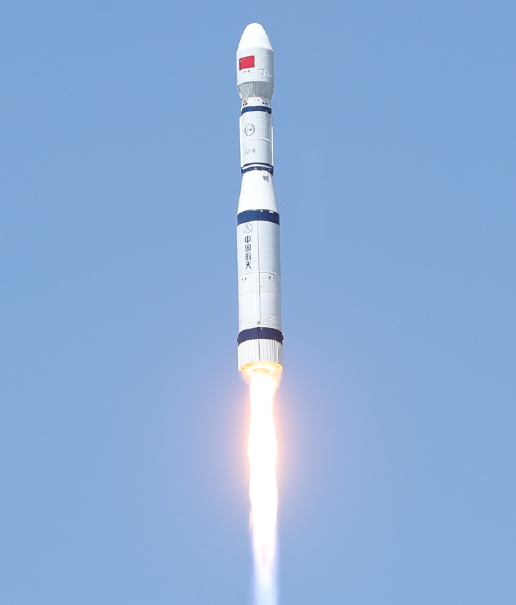
Following the launch of the mission, the model team sorted out a total of 36 improvement items, covering operational reliability and test coverage, which further improved the robustness and reliability of the rocket.

“The satellites launched this time are highly compatible with our Long March 6 rocket,” said Yu Yansheng, the overall chief designer of the Eight, Chang Zheng –Long March 6 test team. From the perspective of load weight, there are several types of rockets on the market that can perform this mission, but after an in-depth analysis of the satellite’s shape design and mission requirements, only the fairing envelope and carrying capacity of the Long March 6 are most suitable for the mission.

In view of the overall configuration of the mission satellite with a large aspect ratio, an inverted cone-shaped frame-type satellite support was designed for the model, and it is equipped with a 2.9-meter-diameter satellite fairing to adapt to the layout and interface of the satellite in the fairing. Requirements, provide effective “lifting + support” for satellites. In addition, the foam spraying technology is used on the outside of the satellite fairing to realize the insulation measures of the fairing without operation at the launch site and before launch.

At the same time, in terms of the separation method of the satellite, Chang Zheng –Long March 6 Y12 adopted a point-type connection and separation device composed of four components for the first time, which has the characteristics of light weight and intensive functions of Improved separation reliability.

In view of the fact that there are many satellite operation items after the rocket is transferred to the launch area, the design and operation personnel of the two sides of the model organization, the Star and Rocket, carried out special exchanges to confirm the timing, process, tools, precautions, etc. of the operation one by one; at the same time, arrange Specialized operation drills optimize the operation process to ensure that the time is controllable, safe and smooth in actual operation.

The Taiyuan Satellite Launch Center in June coincided with the season with more thunderstorms, and the model carried out re-identification, re-analysis, and re-confirmation of summer launch risks at the launch site. According to the characteristics of the Long March 6 carrier rocket’s “three-level” test launch mode and unsupported launch, a special review of rain and lightning protection was carried out, including the effectiveness of rain and lightning protection measures, the actual implementation of various measures, and the dismantling and rain protection before launch. Timing, etc., form a tabular inspection and confirmation document to ensure that the rocket meets the pre-launch operation and launch requirements during the thunderstorm season.

Images and visuals are from their Respectives CMS China Manned SpaceCNSA-China National Space Administration

#CNSA #ChinaNationalSpaceAdministration #国家航天局 |#BRI #June2023 | #天宫#Tiangong #ChinaSpaceStation #CMS #ChinaMannedSpace #神舟十六号 #Shenzhou16 –  China  Space Station awesome stunning Earth view with Tiangong’s Tianzhou advance Robotic arm..

On the 30th  May 2023 clear 0931 Hours Morning Hong Kong SAR- Beijing time , the Belt and Road Initiative CNSA –China National Space Administration  from Jiuquan Satellite Launch Center – Inner Mongolia –China – People’s Republic of China deployment of  the Chang Zheng –   The Chang Zheng – Long March 2F Yao 16 –Shenzhou 16  carrier rocket.. On which Takionauts Jing Haipeng, Zhu Yangzhu, and Gui Haichao took to the predetermined orbit. The first manned flight mission in the application and development stage was a complete success. The three astronauts will stay in the space station and “join up” with the crew of Shenzhou 15 to carry out on-orbit handover “face-to-face” meeting in which brings the total crew of six with a handover ceremony  from Shenzhou 15 towards 16..

On the week of 19th June 2023 There is a new perspective to opening view the of the planet earth  with  the elements …….  ​Let you see the rare picture of the experimental cabin, Shenzhou 16 space Craft , the Advance Cargo Spacecraft Tianzhou, robotic arm and the earth in the same frame at one time. Rotate 90° counterclockwise, the rotational transition effect is better!

Images and visuals are from their Respectives CMS China Manned SpaceCNSA-China National Space Administration

#Airbus #空中客车| #A350 #June2023 |#中國南方航空公司 #ChinaEastern #B323H A350-941 Taking its first delivery of its benchmark aircraft the first Airbus 350 delivery from made in China, People’s Republic of China. ……..

CHINA EASTERN B323H “1st A350 delivered from China” (AIRBUS A350-941)
SHA→CAN finally got on this benchmark aircraft “the first Airbus A350 delivered from China

China Eastern Airlines Corporation Limited  中國東方航空公司 also known as China Eastern, is an airline headquartered in the China Eastern Airlines Building, on the grounds of Shanghai Hongqiao International Airport in Changning District, Shanghai. It is one of the “Big Three” airlines (alongside Air China and China Southern Airlines) of the People’s Republic of China, operating international, domestic and regional routes. Hongqiao airport, along with the larger Shanghai Pudong International Airport, are China Eastern’s main hubs, with secondary hubs in Beijing Daxing, Kunming, and Xi’an……It is the second largest airline in China, in terms of passenger traffic, after China Southern Airlines. In 2021,

China Eastern Airlines has taken delivery of its first A350-900 in Toulouse, becoming the latest operator of this efficient twin-engine widebody aircraft. The Shanghai-based carrier now operates an Airbus fleet of 356 aircraft, including 306 A320 Family aircraft and 50 A330 Family aircraft (figures at the end of October 2018). China Eastern is the largest Airbus operator in Asia and second largest in the world.

On the 18th June 2023, it is the first commercial maiden flight of the中國南方航空公司 China Eastern Airlines Newest Airbus 350-941 series long haul airline in which is the Airbus Benchmark Aircraft that is made in China, People’s Republic of China, also it’s the first Airbus 350-941 delivered from China, People’s Republic of China….. The flight is now operating as B323H(CES5317 / MU5317)

It made its first flight from Gate 41 SHA- Shanghai Hongqiao International Airport on Sunday 18th June 2023 1032 CST towards Terminal One CAN- Guangzhou Baiyun International Airport arriving on at Monday 19th June 2023 1238 AM CST with the flight duration of two hours and six minutes orthough the flight was one hour and fifty seven minutes late on …..

China’s Best Business Class Product? || China Eastern A350-900 || Shanghai – Guangzhou
China Eastern has rolled out a brand new business class hard product on its A350 fleet 2 years ago. It’s in a popular 1-2-1 layout meaning every passenger has direct aisle access. It also features a sliding door, similar to Qatar’s QSuite and Delta’s A350 business class product. It’s probably one of the best business class featured on a Mainland China carrier, but is it without limitations? Let’s step onboard and check it out together.

The flight Taxi time was twelve minutes.. at SHA- Shanghai Hongqiao International Airport in which the Taxi time at CAN- Guangzhou Baiyun International Airport was eleven minutes….

Images and visuals are of their respectives  

#MadeInChina #中國製造 #中國 |酒泉衛星發射中心#JiuquanSatelliteLaunchCenter #星河动力航天#GalacticEnergy #June2023|#CarrierRocketShopping Zhishenxing-1 Carrier Rocket First-Stage Separation Test successfully….

星河动力空间科技有限公司 Galactic Energy-  Galaxy Power (Beijing) Space Technology Co., Ltd. Located in Block D, Aviation Technology Plaza, E-Town, and Beijing – Beijing – China – People’s Republic of China ….Galaxy Aerospace is the first private aerospace company in China to achieve successful continuous launches, the first to send commercial networked satellites into a 500km sun-synchronous orbit, and the first to master the ability to launch multiple satellites with one carrier rocket.

On the week of 17th June 2023 Galactic Energy Zhishenxing-1 Carrier Rocket First-Stage Separation Test Successful] Recently, Galaxy Power Aerospace successfully completed the Zhishenxing-1 carrier rocket inter-stage separation test. During the test, each system worked normally, and the interstage section was separated smoothly, which verified the correctness of the interstage separation scheme, and the test was a complete success.

The success of this inter-stage separation test marks a solid step forward in the development of Zhishenxing-1. Other large-scale ground tests will be carried out in an orderly manner as planned…

Images and visuals are from their respectives 星河动力空间科技有限公司 Galactic Energy-  Galaxy Power (Beijing) Space Technology Co., Ltd.

#CNSA #ChinaNationalSpaceAdministration #国家航天局 |#CASC #June2023| #ChangZheng #LongMarch #CarrierRocket Hong Kong Aerospace Science and Technology Group with Zero Gravity Laboratory plans to deploy the #GoldenBauhiniaSatellite 30 #RemoteSensing #CubeSatellites #Satellites in of Year2024…

On the 16th June 2023 announcement of   Hong Kong Aerospace Science and Technology Group and Zero Gravity Laboratory has announcement of launching of 30-thirty remote sensing cube cute satellites of  Zero Weight Space plans to launch “Golden Bauhinia 7-36” remote sensing 6U cube star with “30 satellites  in one carrier rocket” early next year in the 2024 first quarter year… A few days ago, Beijing Zero Weight Space Technology Co., Ltd. signed a “30 satellites in one carrier rocket” “Project cooperation agreement. According to the agreement, the Zero Gravity Laboratory will provide Hong Kong Aerospace Science and Technology Group with a package of products and services including satellite R&D and manufacturing, assembly testing, and launch services. Launch at the end of the first quarter.

After the completion of the project, it can realize global high-frequency and high-resolution remote sensing monitoring, and provide users with high-precision data support and application services in the fields of earth observation, resource investigation, environmental protection, agriculture, and urban planning.

On previously On June 15th, 2023, the Chang Zheng- Long March 2D carrier rocket carried the Golden Bauhinia Satellite No.37 & No. 38 into space from the Taiyuan Satellite Launch Center. The satellites successfully entered their planned orbits and both are in good operating condition. This is the second launch mission of Hong Kong Aerospace Technology Group for this year.

The Golden Bauhinia Satellite No.37 & 38  are both small and high-resolution optical remote sensing satellites that use new-generation high-performance imaging technology. While effectively enhancing the weak signal detection capability and system integration, their weight and volume have been significantly reduced. They have the advantages of quick production, intelligent operation, and cost-effectiveness.

The Golden Bauhinia satellite constellation is a passive-active hybrid low-orbit high-frequency satellite constellation planned by the Hong Kong Aerospace Technology Group. The constellation combines optical remote sensing and synthetic aperture radar imaging modes to form an all-weather and all-time dynamic monitoring service system that is not affected by weather conditions such as clouds and rain. The constellation focuses on the Guangdong-Hong Kong-Macau Greater Bay Area (GBA) and is committed to providing satellite remote sensing services and overall smart city solutions for global users.


零重力实验室 Zero Gravity Laboratory Beijing Zero Weight Space Technology Co., Ltd.    In October 2016, the Zero Gravity Laboratory was established in Beijing. The laboratory is mainly engaged in the research and development of micro-nano satellites and core components. In January 2017, Beijing Zero Weight Space Technology Co., Ltd. was established in Beijing Economic and Technological Development Zone. The three core business segments of Zero Weight Space include: research and development and sales of micro-nano satellites and their core components, technical consulting and space-based data services. At present, Zero Heavy Space has more than 30 kinds of micro-nano satellite core component products in six categories with independent intellectual property rights. It has the development and production capacity to complete the micro-nano satellite on-orbit delivery within 10 months, and can provide customers with complete micro-nano satellites. Satellite overall solutions and provide customers with launch and loading services. Vision: 2025: Walking in space (2025: Space Odyssey) Slogan: Let satellites reach life Mission: We pay attention to everything you care about, as long as it is related to micro-nano satellites Goal: To become the leader of global micro-nano satellites

Hong Kong Aerospace Technology Group Limited (HKATG) is Hong Kong’s first commercial aerospace enterprise focusing on satellite network engineering and precise satellite manufacturing. Formerly known as Hentech Technologies Ltd (2003), HKATG acts as a pioneer in commercial aerospace industry and technological innovation in Hong Kong.

Located at 15/F, Data Technology Hub, 5 Chun Cheong Street, Tseung Kwan O Industrial Estate, New Territories, Hong Kong SAR, China, People’s Republic of China.

HKATG owns five technical centres and manufacturing bases, including satellite manufacturing centre, space environmental monitoring centre, satellite telemetry, tracking and control centre (TT&C), centre for satellite data and applications and precise electronic manufacturing centre.

The core business of HKATG consists of several aspects, for instance, satellite constellation engineering (Golden Bauhinia Constellation and Aurora Constellation), satellite data application, satellite design and manufacturing, satellite assembly and testing, satellite payload selection and specification, satellite TT&C service, PCBA and electronic manufacturing and launching of satellite etc.

HKATG aims for global commercial aerospace service and has strong purpose to improve the world’s aerospace industry.

Gang Hang Ke (Shenzhen) Space Technology Co., Ltd. is a wholly-owned subsidiary of HKATG. Being the major operating subsidiary of HKATG in the Mainland China, Gang Hang Ke (Shenzhen) Space Technology Co., Ltd. is mainly engaged in the aerospace technology, satellite application technology, satellite manufacturing technology, research and development of Internet of Things (IoT) application system and technical services.

Images and visuals are from their respectives