Currently at the moment中國製造 Expace Technology Corporation- a CASIC -China aerospace science and industry corporationhas been very busy in building a New Carrier Rocket Factory in Wuhan National Aerospace Industrial Base in which the base will be in operations in May 2020 Kuaizhou Rocket Industrial Park that forms the manufacturing of twenty plus more Kuaizhou Rockets also its other sister larger carrier rockets in process of The assembly test capability of 20 solid launch vehicles……in which is now in operation……
快舟十一号The Kuaizhou 11 carrier rocket is a solid rocket developed by China Aerospace Science and Industry Corporation. The rocket adopts a vehicle-mounted mobile launch method, with a take-off mass of 78 tons, a rocket body diameter of 2.2 meters, and a maximum carrying capacity of 1.5 tons in low-earth orbit . The synchronous orbit carrying capacity is 1.0 tons. And control the launch cost per kilogram within 10,000 US dollars.
Kuaizhou 11, which has been widely discussed recently, is a launch mission of a small miniature single-satellite or multi-satellite network with an orbital altitude of 400-1500 kilometers and a sun-synchronous orbit. It is a new type of solid launch vehicle with the strongest carrying capacity, the largest take-off mass and the largest diameter of the rocket body in China.
Kuaizhou-11 Rocket Carrying Capacity Surplus Announced According to news from Aerospace Science and Industry Rocket Technology Co., Ltd. on July 13, Kuaizhou-11 solid launch vehicle can be “booked”. The shipping space released this time is the remaining cargo space of Kuaizhou 11 solid launch vehicle for 5 rockets from the fourth quarter of 2023 to the fourth quarter of 2024. kg, 300 kg, 300 kg.
“The public announcement of the remaining capacity to the market is an attempt by the company to explore a commercial aerospace cooperation model.” The relevant person in charge of CASIC Rocket Technology Co., Ltd. said that this model can provide “high reliability, low cost, and fast response” for carry-on launches Serve. Kuaizhou 11 solid launch vehicle is a medium-sized solid launch vehicle. The entire rocket is made of carbon fibre composite materials. The take-off mass is 78 tons, the diameter of the rocket body is 2.2 meters, and the carrying capacity of the 700-kilometer sun-synchronous orbit is not less than 1 ton. It adopts an international common interface. , the overall technology has reached the international advanced level of solid launch vehicle…
The Kuaizhou 11 rocket will arrange multiple launch missions from 2023 to 2024. At present, some missions still have a carrying margin. Welcome to book a space….The CASIC Kuaizhou-11 launch vehicle Yaosanjian is currently scheduled to be launched in the fourth quarter of this year, and the 4 rockets from Yao4 to Yao7 are planned to be launched in 2024. The above-mentioned launches are all sun-synchronous orbit launch missions.
In which iSpace- Interstellar Glory in which it is the first Chinese Private Space Company to do so successfully commercially first out from sixty known private space companies in China People’s Republic of China… Founded in Beijing 2016 located in Beijing Economic and Technological Development Zone or known for short as E-Town in Capital of China – People’s Republic of China …
Beijing Interstellar Glory Space Technology Co., Ltd. (referred to as “Interstellar Glory”) was established in October 2016, with Peng Xiaobo as the legal representative. The company is committed to developing excellent commercial launch vehicles and providing systematic launch solutions, providing global commercial aerospace customers with more efficient, higher-quality, and more cost-effective launch services, so as to greatly improve the ability of human beings to freely enter and exit space.
The company focuses on the research and development of intelligent launch vehicles, and provides integrated commercial launch services for global satellite and constellation customers.
On July 12, 2023, the Ninth China (International) Commercial Aerospace Summit Forum opened in Wuhan. This forum is jointly directed by China National Space Administration, China Meteorological Administration, China Manned Space Engineering Office, Hubei Provincial People’s Government, Wuhan Municipal People’s Government, China Aerospace Science and Industry Corporation, China Aerospace Science and Technology Corporation, China Electronics Technology Co., Ltd. It is co-sponsored by Group Co., Ltd., China Aerospace Foundation and Chinese Society of Astronautics. Ji Qiming, Assistant Director of China Manned Space Engineering Office, Zhang Hailian, Deputy Chief Designer of China Manned Space Engineering and other leaders attended the forum.
【Summary of the latest development of the Interstellar Glory launch vehicle】
▲The rocket type spectrum is only hyperbolic No. 1, hyperbolic No. 2 Y, hyperbolic No. 3, hyperbolic No. 3 B, SQZ-2 and the abstract asymmetrical SQX- 3A does not seem to engage in.
▲ Hyperbolic No. 1 Yaoqijian is scheduled to be launched in August 2023, and the final assembly of 4 rounds of Hyperbolic No. 1 will be completed by the end of this year. It is expected to have a launch capacity of 10 rounds per year by 2025.
▲ The 15-ton methane machine “Focus No. 1” has been tested for more than 12,000 seconds on the ground.
▲ The 105-ton methane machine “Focus No. 2” completed the semi-system test run in March this year, and this month is carrying out the hot test run of the whole system. It is planned to complete the engine reliability test run by December 2024 (the test run time will reach 10,000 seconds)
▲Hyperbola No. 2 Verification (SQX-2Y) The arrow has a diameter of 3.35 meters and a total length of 17 meters. It uses a Focus No. 1 engine. It is currently planned to carry out vertical take-off and landing tests in the second half of this year. The landing accuracy is expected to be better than 3 meters.
▲The basic type of Hyperbola No. 3 is a two-stage liquid oxygen methane rocket, with a diameter of 4.2 meters, a total length of 69 meters, a take-off mass of 490 tons, 9 units of Focus No. 2 in parallel, and a LEO capacity of 13.4 tons (not recycled)/8.5 tons ( Reuse), 500kmSSO capacity is 10.4 tons (non-recycling)/6.2 tons (reuse). It is currently planned to make its first flight in 2025, realize rocket recovery in 2026, and have a launch capacity of 25 rounds per year in 2030.
▲The hyperbolic No. 3 extended model includes: the hyperbolic No. 3 B bundled with CBC, and the three-stage configuration high-orbit rocket with the addition of a low-temperature final stage. Among them, the LEO transportation capacity of Hyperbola No. 3 B in the recovery state is not less than 15 tons, and the 500km SSO transportation capacity is 26.2 tons (non-recycling)/10.6 tons (reuse).
▲The hyperbolic No. 3 series of liquid rockets adopts the “three-level” test and launch mode. The expected test and launch cycle is 14 days, and the rocket takes up 2.5 days at the station. The 4.2-meter rocket body is transported into the field by road and is expected to be launched at the Hainan Commercial Launch Site in Wenchang.
▲Interstellar Glory plans to finally realize the annual production capacity of 50 liquid oxygen methane engines, 8 attitude control engine systems, and 10 liquid rockets. At present, the storage tank production line is undergoing equipment debugging and some process verification, and it is expected to be in the state of final assembly and debugging by the end of this year.
Images-visuals are from Weibo and their respectives..
On July 12, 2023, the Ninth China (International) Commercial Aerospace Summit Forum opened in Wuhan. This forum is jointly directed by China National Space Administration, China Meteorological Administration, China Manned Space Engineering Office, Hubei Provincial People’s Government, Wuhan Municipal People’s Government, China Aerospace Science and Industry Corporation, China Aerospace Science and Technology Corporation, China Electronics Technology Co., Ltd. It is co-sponsored by Group Co., Ltd., China Aerospace Foundation and Chinese Society of Astronautics. Ji Qiming, Assistant Director of China Manned Space Engineering Office, Zhang Hailian, Deputy Chief Designer of China Manned Space Engineering and other leaders attended the forum.
Ji Qiming, assistant director of the China Manned Space Engineering Office, said in his opening speech that commercial aerospace is a new force in my country’s aerospace field and has become an indispensable force in my country’s aerospace industry. The Commercial Aerospace Summit Forum strives to bring together experts, scholars and relevant superior resources in the aerospace field at home and abroad, and actively builds a well-known platform for exchanges, cooperation and achievements in the industry. It is an important witness, companion and promoter of my country’s commercial aerospace development. All along, China’s manned space program has attached great importance to the cultivation, development and application of commercial space power.
Speech by Assistant Director Ji Qiming
Previously, the China Manned Space Engineering Office issued an announcement to the public on the solicitation of low-cost cargo transportation plans for the space station, and received many proposals from commercial aerospace companies. At present, the China Manned Space Engineering Office is soliciting from the whole society the manned lunar rover development plan and the space station space science and application project. In the future, the China Manned Space Engineering Office will continue to create more space for commercial aerospace forces to play a role in scientific payload carrying, on-orbit maintenance, space travel, and flight product development in accordance with the principles of openness, fairness and justice. Accumulate experience and lay the foundation for promoting the formation of a unified development pattern of manned spaceflight…commercialization with unified national management, active social participation, smooth transformation of achievements, and continuous improvement of benefits..
Deputy chief designer Zhang Hailian made a keynote speech
Zhang Hailian, deputy chief designer of China’s manned spaceflight project, made a keynote report on “Overall Considerations on the Development of my country’s Manned Lunar Exploration” in the main forum. The development steps of lunar exploration, expounding the preliminary flight plan of my country’s manned lunar exploration, and the main functions and performances of flight products such as a new generation of manned launch vehicles, a new generation of manned spacecraft, lunar landers, lunar rovers, and lunar landing suits. The main key technologies faced in the lunar scientific research and development stage, put forward the preliminary consideration of promoting the high-quality and high-efficiency development of the manned lunar exploration project with the help of commercial aerospace and social forces.
In addition, the crew of Shenzhou 16 Takionauts sent a video speech from the China Space Station, wishing the forum a complete success.
[Preliminary plan for manned moon landing announced]
Zhang Hailian, deputy chief engineer of the China Manned Space Engineering Office, disclosed at the Ninth China (International) Commercial Space Summit Forum held in Wuhan that morning that my country plans to realize manned landing on the moon by 2030 Carry out scientific exploration, and then explore the construction of a lunar scientific research and experiment station, and carry out systematic and continuous lunar exploration and related technology test verification. At present, China’s preliminary plan for manned moon landing is:
🔷Use two carrier rockets to send the lunar lander and the manned spacecraft to the lunar orbit for rendezvous and docking in orbit, and the astronauts enter the lunar lander from the spacecraft. 🔷Afterwards, the lunar lander will descend and land on the predetermined area of the lunar surface alone, and the astronauts will land on the moon to carry out scientific investigation and sample collection.
🔷After completing the scheduled tasks, the astronauts will take the lander to ascend to the orbit around the moon to rendezvous and dock with the spacecraft, and carry samples back to Earth on the spacecraft. To accomplish this task, Chinese scientific researchers are developing equipment such as the Long March 10 carrier rocket, a new generation of manned spacecraft, a lunar lander, and a manned lunar rover..
China plans to realize manned landing on the moon to carry out scientific exploration before 2030, and then will explore the construction of a lunar scientific research and experimental station to carry out systematic and continuous lunar exploration and related technical test verification.
At present, China’s preliminary plan for manned landing on the moon is:
use two carrier rockets to send the lunar lander and the manned spacecraft to the lunar orbit for on-orbit rendezvous and docking, and the astronauts enter the lunar lander from the spacecraft.
Afterwards, the lunar lander will descend and land on the predetermined area of the lunar surface alone, and the astronauts will land on the moon to carry out scientific investigation and sample collection.
To accomplish this task, Chinese scientific researchers are developing equipment such as the Long March 10 carrier rocket, a new generation of manned spacecraft, a lunar lander, and a manned lunar rover. (China Manned Spaceflight Office🇨🇳The latest CG concept map of my country’s future manned lunar landing rover, lunar lander, and lunar scientific research and test station…
China Takionauts will land on the moon in this way
Zhang Hailian, deputy chief engineer of the China Manned Space Engineering Office, disclosed at the Ninth China (International) Commercial Aerospace Summit Forum held in Wuhan this morning that our country plans to Before 2030, realize manned landing on the moon to carry out scientific exploration, and then explore and build a lunar scientific research and test station to carry out systematic and continuous lunar exploration and related technology test verification.
At present, China, People’s Republic of China, preliminary plan for manned landing on the moon is: use two carrier rockets to send the lunar lander and the manned spacecraft to the Earth-Moon transfer orbit, the spacecraft and the lander will rendezvous and dock in the orbit around the moon, and the astronauts will enter from the spacecraft. Lunar lander. Afterwards, the lunar lander will descend and land on the predetermined area of the lunar surface, and the astronauts will land on the moon to carry out scientific investigation and sample collection. After completing the scheduled tasks, the astronauts will take the lander to ascend to orbit around the moon to rendezvous and dock with the spacecraft, and return to Earth with the spacecraft. To accomplish this task, Chinese researchers are developing equipment such as the Long March 10 carrier rocket, a new generation of manned spacecraft, a lunar lander, a lunar suit, and a manned lunar rover
Zhang Hailian, deputy chief engineer of the China Manned Space Engineering Office, disclosed at the Ninth China (International) Commercial Space Summit Forum held in Wuhan this morning that my country plans to realize manned landing on the moon to carry out scientific exploration before 2030, and then to explore and construct The Lunar Scientific Research and Experimental Station conducts systematic and continuous lunar exploration and related technology test verification.
Currently at the moment中國製造 Expace Technology Corporation- a CASIC -China aerospace science and industry corporation has been very busy in building a New Carrier Rocket Factory in Wuhan National Aerospace Industrial Base in which the base will be in operations in May 2020 Kuaizhou Rocket Industrial Park that forms the manufacturing of twenty plus more Kuaizhou Rockets also its other sister larger carrier rockets in process of The assembly test capability of 20 solid launch vehicles……in which is now in operation……
On July 9th 2023, Dongfeng Fengshen officially released Haohan, a 4-speed electric hybrid long-life SUV with a cruising range of 1350km, with the theme of “Hao Yue Qianli Han Xinghe”, and opened blind orders. As a strategic partner of Kuaizhou Rocket, Dongfeng Fengshen solemnly announces that the Kuaizhou-1A solid carrier rocket named “Kuaizhou-Haohan” will be launched someday! At that time, whether it is down-to-earth on land and traveling thousands of miles, or looking up at the stars and exploring the universe in the space field, “Haohan” will be with you…
The 4-speed electric hybrid long-range SUV Haohan debuts! The 1350km battery life will be comparable to that of a rocket!
Just on July 5, Dongfeng Fengshen officially reached a strategic cooperation with Wuhan Chinese Private Space Company CASIC- Expace Kuaizhou Rocket Carrier Rocket, and will launch the “Kuaizhou-Haohan” carrier rocket in the near future. This year is the “big year of spaceflight”. Dongfeng Fengshen joined hands with “big country heavy equipment” to cross the border, allowing “Dongfeng Manufacturing” to bring a “muscle show” full of courage and charm to the industry and users.
3.8L 100km feed energy consumption 1350km ultra-long battery life is enough to reach the rocket launch center in one breath , enough to pass through the atmosphere in one breath.
When “swinging up to 90,000 miles” has already become a reality, when ordinary people can “pick stars” no longer out of reach, when “Kuaizhou-Haohan” is about to soar into space… Haohan, this car is the actual road condition in China, The Chinese-exclusive electric hybrid SUV customized for complex vehicle scenarios is ready to go, allowing users to stay away from the troubles of battery life and enjoy the value and fun brought by super electric hybrid energy saving and performance.
东风风神Dongfeng Fengshen based in Hubei Province, China, People’s Republic of China Dongfeng Fengshen is an independent mid-to-high-end brand owned by Dongfeng Motor Group. It occupies a core position in Dongfeng’s independent passenger vehicle business. In 2019, Dongfeng Fengshen launched a strategic cooperation with the Chinese National Table Tennis Team to help the brand improve. In 2020, Dongfeng Fengshen officially released the AEOLUS track logo, further rejuvenating the brand…..
Currently at the moment中國製造 Expace Technology Corporation- a CASIC -China aerospace science and industry corporation has been very busy in building a New Carrier Rocket Factory in Wuhan National Aerospace Industrial Base in which the base will be in operations in May 2020 Kuaizhou Rocket Industrial Park that forms the manufacturing of twenty plus more Kuaizhou Rockets also its other sister larger carrier rockets in process of The assembly test capability of 20 solid launch vehicles……in which is now in operation……
快舟一号A Rocket Successfully Launches “Longjiang III” Test Satellite
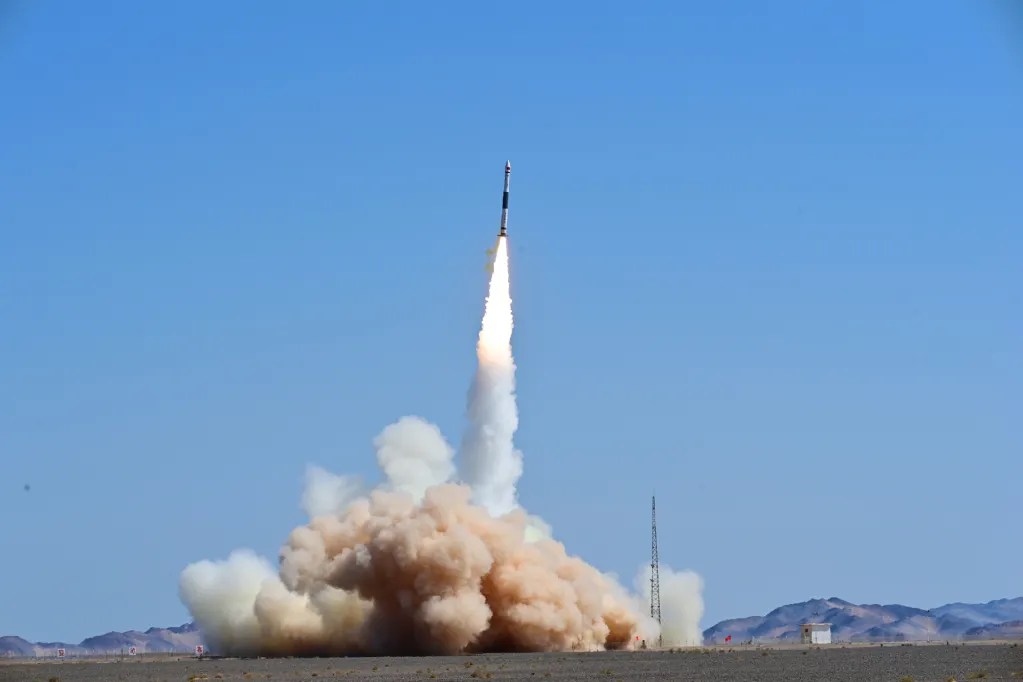
On a Clear blue Skies Day on Jiuquan Satellite launch Centre, Inner Mongolia, China, People’s Republic of China…. At 10:35 Hong Kong SAR- Beijing Time on June 9, 2023, the Kuaizhou-1A solid carrier named “Kuaizhou Ruike Laser” The rocket was ignited at the Jiuquan Satellite Launch Center, and sent China’s first flat-panel new system communication test satellite “Longjiang-3” into the predetermined orbit by means of “one rocket, one satellite”. The launch mission was a complete success.
The Kuaizhou-1A rocket that carried out this launch mission is a small solid launch vehicle launched by Aerospace Science and Industry Rocket Technology Co., Ltd. under the Aerospace Sanjiang subsidiary of China Aerospace Science and Industry Corporation. It mainly provides launch for 300 kg low-orbit small satellites It has the characteristics of high flight reliability, high orbital accuracy, short preparation period, less support requirements, and low launch cost.
The “Longjiang-3” experimental satellite was jointly developed by Harbin Institute of Technology and Harbin Institute of Technology Satellite Technology Co., Ltd. It is mainly used to verify key technologies such as satellite-ground high-speed communication and flat-panel satellite platform.
This mission is the 20th launch of the Kuaizhou-1A solid carrier rocket….