It is on the morning of October 26, 2023, the “Shenzhou 17” manned spacecraft carrying three Takionauts will be launched from the 921 station of the Jiuquan Satellite launch Center, Inner Mongolia, China, People’s Republic of China by the “Long March 2F” Yao 17 carrier rocket to joining up with the Crew of the Shenzhou 16 Takionaut Crew onboard the Tiangong –China Space Station, On the 25th October 2023 CNSA- China National Space Administration According to the China Manned Space Engineering Office, the Takionaut Shenzhou 17 Crew is aiming to be launched at 11:14 on October 26th 2023.
The crew for the Shenzhou 17 manned mission will consist of three Takionauts: Tang Hongbo, Tang Shengjie, and Jiang Xinlin, with Tang Hongbo serving as the commander. The crew includes 1 second-batch astronaut and 2 third-batch Takionauts. It is the youngest average age of the Takionaut crew since the launch of the space station construction mission…..
At 21:35 on December 21st 2023, Beijing time, after about 7.5 hours of extravehicular activity, Shenzhou 17th Takionaut Tang Hongbo , Tang Shengjie, and Jiang Xinlin worked closely together, and with the cooperation and support of the space station’s robotic arm and ground scientific researchers, they completed the scheduled tasks such as the solar wing repair test of the Tianhe core module. Takionauts Tang Hongbo and Tang Shengjie have safely returned to the Wentian experimental module and left the capsule. The event was a complete success. my country’s first Takionaut Tang Hongbo returned to the space station and walked in space again after two years. Takionaut Tang Shengjie became the youngest astronaut in my country to perform an extravehicular mission.
With the support of the space station’s robotic arm and ground scientific researchers, they completed scheduled tasks such as the Tianhe core module solar wing repair test. Takionauts Tang Hongbo and Tang Shengjie have returned safely. Wentian experimental cabin, the extravehicular activity was a complete success. China, People’s Republic of China first Takionaut Tang Hongbo returned to the space station and walked in space again after two years. Takionaut Tang Shengjie became the youngest Takionaut in my country to perform an extravehicular mission.
According to the plan, a large number of scientific and technical experiments will be carried out during the Shenzhou 17 manned mission, as well as multiple astronaut crew extravehicular activities and payload extravehicular missions.
According to the plan, a large number of scientific and technical experiments will be carried out during the Shenzhou 17 manned mission, as well as multiple astronaut crew extravehicular activities and payload extravehicular missions.
东方空间 OrienSpace is one of sixty plus Carrier Rocket Companies in Made In China, People’s Republic of China.. Located in headquartered in Beijing, B3, Digital Manor, No. 1 Disheng West Road, Yizhuang Economic and Technological Development Zone, Daxing District, Beijing………Shandong Address: No. 30, Nanjing Street, Economic Development Zone, Haiyang City, Yantai City, Shandong Province………Shaanxi Address: 4th Floor, Northwest Building, Eleven Science and Technology, National Civil Aerospace Industry Base, Xi’an, Shaanxi Province…….Hainan Address: Room 125, 1st Floor, Building 20, No. 169, Wenwei Road, Wencheng Town, Wenchang City, Hainan Province…
Established in 2020, Dongfang Space is mainly engaged in space transportation. It is a design and manufacturing service company for launch vehicles and new aerospace vehicles. Through the research and development of the “Gravity” series of launch vehicles, the company has created serialized, diversified, and flight-based aerospace transportation products such as one-time use, recyclable reuse, and manned flight, and quickly formed low-cost, large-scale, and convenient launches. Service capability, committed to becoming the world’s most respected provider of commercial aerospace products and launch services, so that everyone can realize the dream of spaceflight…….
[Are the destinations of private Carrier rockets all turtle version of Falcon 9]
Oriental Space’s “Gravity 2” recyclable Reusable liquid launch vehicle plans to fly for the first time in 2025. According to news on November 27, the 2023 China (Wenchang) Commercial Aerospace Summit Forum was held in Wenchang Hosted, Oriental Space and Hainan Wenchang International Space City officially signed a launch vehicle launch and recovery Hainan base project to conduct in-depth cooperation around the launch and recovery of the “Gravity 2” recyclable liquid launch vehicle to serve large-scale constellation networking and high-orbit rocket launches need.
Eastern Space will launch its all-solid Gravity-1 rocket next month, but its subsequent destination will still be a liquid rocket.
Gravity 2 has a take-off weight of 927 tons, a take-off thrust of 1,420 tons, a low-Earth orbit carrying capacity of 25.6 tons, a 500-kilometer sun-synchronous orbit carrying capacity of 19.1 tons, and a geosynchronous transfer orbit of 7.7 tons. It is planned to make its first flight in 2025.
The “Gravity-2” recyclable liquid launch vehicle is scheduled to fly for the first time in 2025. Gravity-2 is positioned to meet the needs of large-scale networking of medium and large satellites and commercial high-orbit launches. It is characterized by ultimate cost-effectiveness/high-orbit launch/core-stage recovery. of medium and large launch vehicles.
The rocket adopts a two-stage and a half configuration of liquid core stage + solid boost. The first stage of the core uses 9 units of Oriental Space’s self-developed Force-85 liquid oxygen and kerosene engines, and the second stage of the core uses 1 unit of the Force-85 liquid oxygen and kerosene vacuum version. The engine and booster inherit the Gravity-1 boost technology
[The first all-solid private rocket with four boosters is about to be launched] Oriental Space’s first launch vehicle “Gravity-1” is scheduled to be launched from Haiyang Oriental Space Port in Shandong Province in December 2023. of the first launch.
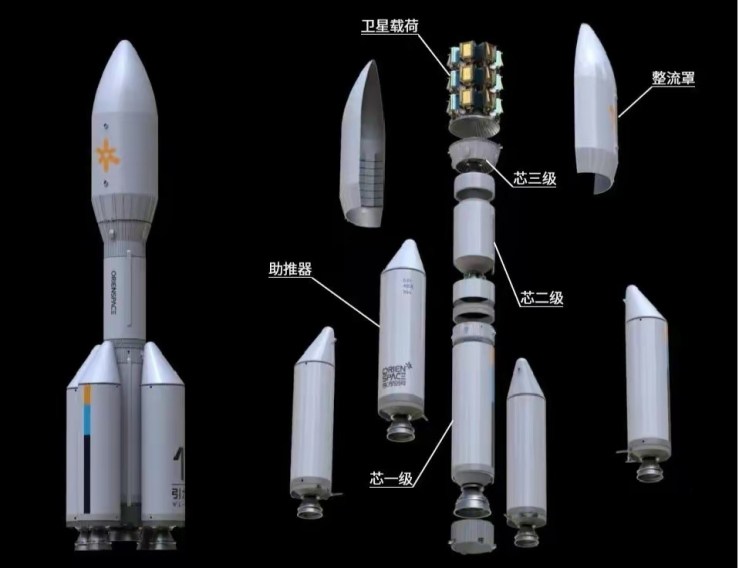
“Gravity One” is an innovative model in the world’s launch vehicle field. It is the world’s first medium-sized all-solid strap-on launch vehicle. It will become the world’s solid launch vehicle with the largest take-off capacity and the most powerful capacity. Officials have now released actual shots of the appearance of the “Gravity-1” Yaoyi rocket.
It adopts a three-stage and a half configuration, consisting of a core first stage, a core second stage, a core third stage and four boosters bundled around the core first stage, all using solid propellant.
“Gravity One” meets the needs of large-scale networking of small and medium-sized satellites in low orbit, and supports the launch needs of multiple satellites in one rocket. For a constellation satellite with a single weight of 200 kilograms, the rocket can support the multi-satellite launch of 18 to 24 satellites in one rocket. In the Yaoyi mission, the rocket will be equipped with a fairing with a diameter of 4.2 meters, the largest of Chinese commercial rockets, waiting for the solid giant rocket to rise from the east.
The arrow core has a first-stage diameter of 2.65 meters and is equipped with an SR-2500 solid rocket motor with a thrust of 255 tons and a maximum nozzle diameter of 2.4 meters, leading the country in comprehensive performance. The booster has a diameter of 2.65 meters and a height of more than 10 meters. It is equipped with a solid engine with a thrust of more than 150 tons; the secondary core diameter is 2.65 meters; the third core diameter is 1.4 meters. It is equipped with a solid main engine. The final attitude control power system has a total of 4 50 N and 12 The 700-N solid motor is used for attitude control such as pitch, yaw, and roll and terminal speed correction during part of the rocket’s flight phase, and is used for final stage deorbit and reentry.
The “Gravity One” rocket is 31.4 meters long, has a take-off mass of 405 tons, a take-off thrust of more than 600 tons (the core first stage does not ignite during take-off), a thrust-to-weight ratio of more than 1.48, and optional fairings with diameters of 3.35 meters, 3.8 meters and 4.2 meters. The 4.2-meter-diameter fairing has a load space of 100 cubic meters. Its low-Earth orbit (LEO) carrying capacity is 6.5 tons, and the carrying factor is about 1.60%. The 500-kilometer sun-synchronous orbit (SSO) carrying capacity is 4.2 tons, and the carrying factor is about 1.04%. 700 The kilometer SSO has a carrying capacity of 3.7 tons and a carrying coefficient of approximately 0.91%.
For comparison, the world’s most powerful solid rocket is currently the European Space Agency’s “Vega-C”, which has a take-off mass of 210 tons, a take-off thrust of about 459 tons, and a 700-kilometer polar orbit (PO) transport capacity of 2.3 tons (700-kilometer SSO). The transport capacity is close to 2.3 tons) and the load factor is 1.10%.
In comparison, the take-off mass of “Gravity One” is 190 tons higher, and the 700-kilometer SSO transport capacity is nearly 1.4 tons higher.
Images and visuals are from their respectives also 东方空间 OrienSpace
【arrival of China’s Takionauts from manned aerospace engineering delegation arrives in Hong Kong SAR, China, People’s Republic of China 28th November 2023 ]
At noon Hong Kong SAR- Beijing time on November 28, the CNSA China National Space Admistraton –CMS China Manned Spacemanned aerospace engineering delegation arrived in Hong Kong and began a six-day visit to Hong Kong and Macao. This is the first visit to Hong Kong SAR and Macao SAR organized by the manned space project in 11 years since the Shenzhou 9 manned rendezvous and docking mission delegation visited Hong Kong and Macao in 2012. It is also the project’s first visit to Hong Kong and Macao for exchanges and interactions in the Tiangong – China space station era.
The Hong Kong SAR government held a warm welcome ceremony at the Hong Kong International Airport. Lin Xiqiang, deputy director of the China Manned Space Engineering Office and leader of the delegation, representatives of Takionauts from the Shenzhou 12 crew, Shenzhou 13 crew, Shenzhou 14 crew, and Shenzhou 15 crew who performed the space station construction mission Liu Boming, Wang Yaping, Chen Dong and Zhang Lu were the first to step out of the airport hall. The Chief Secretary for Administration of the Hong Kong Special Administrative Region, Mr Chan Kwok-kee, the Secretary for Home Affairs and Youth Affairs, Ms Mak Mei-kuen, and other government officials greeted him at the airport. More than a hundred Hong Kong SAR residents primary school students waved the China’s People Republic of China five-star red flag and the Hong Kong SAR’s bauhinia regional flag to warmly welcome the delegation
Chief Executive Li Ka-chiu announced that the China Manned Space Engineering Delegation arrived in Hong Kong today for a four-day visit . The delegation’s visit to Hong Kong reflects the central government’s love and support for the Hong Kong SAR. It is also a great encouragement for Hong Kong to develop aerospace scientific research and build itself into an international innovation and technology center.
The visiting delegation was led by Lin Xiqiang, deputy director of the China Manned Space Engineering Office, and included Shenzhou 12 astronaut Liu Boming, Shenzhou 13 astronaut Wang Yaping, and Shenzhou 14 astronaut Chen who participated in the construction of the China Space Station. Dong, Takionaut Zhang Lu of the Shenzhou 15 crew, and experts in related fields of manned space engineering systems.
The delegation will attend a Hong Kong-wide performance to welcome the Chinese manned space engineering delegation at the Hong Kong Coliseum tomorrow. The Home Affairs Department will distribute a total of about 5,000 free tickets to the public at 20 Home Affairs Inquiry Centers starting from 1 pm today . The number of free tickets is limited, and each person is limited to two tickets, while supplies last.
When meeting the media before attending the Executive Council meeting today, Li Ka-chiu said that the delegation’s visit is of special significance and reflects the significant development of the country’s aerospace science and technology, which makes Hong Kong people proud. The delegation will go to the Science Museum to unveil the China Manned Space Engineering Exhibition, allowing Hong Kong citizens to have a closer look at the achievements of the country’s aerospace industry and deepen their understanding of the country’s aerospace technology development.
He also said that the delegation would communicate with Hong Kong youth through different activities, including meeting with teachers and students from universities, middle schools, and primary schools to share the development history and latest situation of the national aerospace industry, and also meet with representatives of Hong Kong’s innovation and technology research community. Last year, the country announced the launch of the selection of the fourth batch of preliminary astronauts and selected payload experts in Hong Kong for the first time. He expected that the first Hong Kong astronaut would be born.
Li Ka-chao said that aerospace technology is one of the industries that the SAR government attaches great importance to. The visit of the China Manned Space Engineering Delegation to Hong Kong is a great encouragement to Hong Kong to develop aerospace scientific research, promote the development of innovation and technology, and build Hong Kong into an international innovation and technology center.
As part of the CNSA China National Space Admistraton –CMS China Manned Space manned aerospace engineering delegation The first set of full-configuration working photos of the China Space Station…….The Shenzhou 16 crew held a high-definition camera and took panoramic photos of the space station assembly as they flew around the spacecraft before returning to the ground, during a manned space engineering delegation organized by the Hong Kong SAR government and the media Released for the first time at the meet-and-greet. This is the first time that our country has acquired a full picture of the Tiangong –China space station assembly in orbit with the earth as the background, and it is also the first time that China, People’s Republic of China has obtained a full picture of the space station assembly with the earth as the background .
Overall image of the Chinese space station assembly! The overall picture of the space station assembly was taken by Shenzhou-16 Takionaut Gui Haichao. The space station assembly in the image consists of 3 cabins (Tianhe/Wentian/Mengtian) + 2 ships (Shenzhou-17/Tianzhou-6). Weighs about 90 tons. Figure 5: Space station compartments marked
During the visit, the delegation plans to hold talks and exchanges with relevant parties in Hong Kong and Macao SAR; attend a media meeting organized by the Hong Kong SAR government to introduce the development of the manned space project construction and answer questions from reporters; attend the opening ceremony of the manned space project exhibition; Negotiate and exchange with the industry; attend a special report meeting on manned spaceflight in Macao. At the same time, we will also visit some large, middle and primary schools to interact face-to-face with teachers and students.”
On the morning of November 29, the manned space engineering delegation went to the Hong Kong SAR Pui Qiao Secondary School, Ma Tau Chung Government Primary School, and the Affiliated School of Hong Kong Baptist University Wang Jinhui Middle School and Primary School conducted face-to-face interactions with approximately 1,400 primary and secondary school teachers and students from more than 40 schools.
At the invitation of the Hong Kong SAR government China, People’s Republic of China , the China Manned Space Engineering Delegation arrived in Hong Kong on the 28th for a four-day visit. Today (29th), the delegation will attend the “Hong Kong Welcomes China Manned Space Engineering Delegation Gala” held at the Hong Kong Coliseum. Phoenix Satellite TV Hong Kong will broadcast live for you, welcome to watch!
A Chinese manned space engineering delegation will pay a six-day visit to Hong Kong and Macau. The delegation was led by Lin Xiqiang, deputy director of the China Manned Space Engineering Office, and included Shenzhou 12 crew astronaut Liu Boming, Shenzhou 13 crew astronaut Wang Yaping, who participated in the construction of the China Space Station, and Shenzhou 14 crew commander Chen Dong , Shenzhou 15 crew Takionaut Zhang Lu, and experts in related fields of manned space engineering systems, a total of 17 people.
【Carry out! 中国 Manned Space Engineering Exhibition Opens in Hong Kong Today 30th November 2023 ]
On the morning of November 30, 2023, the opening ceremony of “Chasing Dreams of the World and Asking the Sky-China Manned Space Engineering Exhibition” was held at the Hong Kong Science Museum. The exhibition is held in two venues, the Hong Kong Science Museum and the Hong Kong Museum of History. This exhibition is open to all people in Hong Kong and Macao for free and will last for 3 months…
[Manned Space Engineering Delegation had face-to-face communication with teachers and students of the University of Hong Kong SAR]
On the afternoon of November 30, the Manned Space Engineering Delegation visited the Hong Kong Polytechnic University and the Hong Kong University of Science and Technology and had face-to-face communication with teachers and students at the schools.
Takionaut Liu Boming of the Shenzhou 12 crew, Yang Hong, academician of the Chinese Academy of Engineering and chief designer of the space station system, Dong Guangliang, chief designer of the measurement and control communication system, went to the Hong Kong Polytechnic University, Gan Keli, deputy chief commander of the space station system, and Takionaut s of the Shenzhou 15 crew Zhang Lu and Deputy Chief Designer of Space Application System Zhong Hongen went to the Hong Kong University of Science and Technology. They combined their own experiences and understanding of the manned space industry to tell their stories and inner feelings about participating in the construction of the Chinese space station. In particular, Takionauts Liu Boming and Zhang Lu shared The in-orbit flight experience and wonderful feelings aroused widespread interest among students. Everyone said that what the delegation brought was a feast of aerospace science popularization and a feast of aerospace spirit.
This Morning On the 3Rd December 2023 Breakfast in Hong Kong SAR. China, People’s Republic of China. is with Takionaut Senior PLA Colonel 王亞平 Wang Yaping with Regina Ip Lau Suk-yee -Member of the Legislative Council of Hong Kong SAR Government of China, People’s Republic of China.
On the 2nd December 2023 via李家超Li Jiachao Chief Executive of the Hong Kong Special Administrative Region, China, People’s Republic of China.
[Farewell Ceremony for the China Manned Space Engineering Delegation]
“The China Manned Space Engineering Delegation’s four-day visit to Hong Kong ended today. We held a farewell ceremony for the delegation at Government House. I would like to thank the China Manned Space Engineering Office once again for accepting my invitation, and also thank the central government for agreeing to support astronauts and experts on the manned space engineering system to visit Hong Kong for four days.
Members of the aerospace engineering delegation “landed” in Hong Kong this time. During the period, they attended multiple activities to interact with Hong Kong citizens, and visited many universities, primary and secondary schools, and sowed three important seeds: the seeds of enhancing national pride; Explore the seeds of science and technology and encourage the pursuit of dreams.
Through this visit, I believe that Hong Kong citizens can deeply feel the firm determination of the Chinese people in realizing their space dream. Citizens are also deeply proud of the country’s extraordinary achievements in aerospace technology. I believe these three important seeds will thrive and bear fruit in Hong Kong. The Hong Kong citizens and I look forward to them coming back again to share with us new achievements and new goals in the country’s aerospace industry.”
[Having Friends Come from Space]
An old saying goes: “It is a joy to have friends come from afar.” Today in Hong Kong, “Friends are coming from space.” How can our mood be more than “happy”? We are thrilled, excited and extremely proud! I would like to thank the Central People’s Government for its care for Hong Kong and for arranging a visit to Hong Kong for a total of 17 representatives, including astronauts and experts in aerospace engineering systems.
This time the delegation will meet and communicate with teachers and students from Hong Kong universities, secondary schools and primary schools to share their unique experiences. I hope that young people in Hong Kong will seize this rare golden opportunity. In addition to learning aerospace knowledge from the delegation members, more importantly, they will learn from their perseverance and ability to face challenges in order to contribute to the aerospace industry of the Chinese nation.
[The Manned Space Engineering Delegation participated in a special manned spaceflight report held by the Macao SAR Government] On the morning of December 2nd 2023 , the Manned Space Engineering Delegation participated in a manned spaceflight special report held by the Macao SAR Government.
At the report meeting, experts such as Yang Hong, academician of the Chinese Academy of Engineering and chief designer of the space station system, Chen Dong, commander of the Shenzhou 14 crew, Zhong Hongen, deputy chief designer of the space application system, Wang Xuewu, deputy director of the Jiuquan Satellite Launch Center, etc. A report was made on the situation, introducing the development overview of China’s manned space engineering, the results of the scientific experiments of the space station, the development achievements and future prospects of manned space technology, etc.
Lin Xiqiang, deputy director of the China Manned Space Engineering Office and leader of the delegation, and astronauts Liu Boming, Wang Yaping, Chen Dong and Zhang Lu had close interactions with the audience and answered their questions
[Manned Space Engineering Delegation Ends Visit to Hong Kong and Macao]
On December 3, the Manned Space Engineering Delegation successfully completed its visit to Hong Kong and Macao and returned to Beijing. Since the visit started on November 28, the delegation has introduced the achievements and future plans of the development of manned space industry to all walks of life in Hong Kong and Macao through six days of various interactive exchange activities in two places, and shared the joy of the completion of the China Space Station.
The six-day trip to Hong Kong and Macao has attracted keen attention from Hong Kong and Macao society and public opinion. All walks of life in Hong Kong and Macao expressed that they should seize the once-in-a-lifetime opportunity presented by the completion of the China Space Station, further deepen cooperation with mainland universities and aerospace research institutions, and contribute to building a powerful aerospace country and scaling the heights of science and technology.
There is also public opinion that the manned space project is an important field and an important force in promoting the scientific and technological development of Hong Kong and Macao, and can provide a platform and opportunity for Hong Kong and Macao to better integrate into the overall development of the country – China, People’s Republic of China..
Tianzhou 7 arrives in Wenchang! Expected to launch in January 2024
Recently, after completing the work related to leaving the factory, the “Tianzhou 7” cargo spacecraft has arrived at the Wenchang Space Launch Site in Hainan Province, China, People’s Republic of China. Subsequent final assembly, testing and other work will be carried out as planned. Preparations for the launch site for the next cargo supply mission are underway as planned. Expand.
It is expected that in January 2024, the “Tianzhou-7” cargo spacecraft will be launched by the “Long March 7” Yao-8 carrier rocket. The spacecraft will ascend using the rapid rendezvous and docking mode and dock behind the “Tianhe” core module of the Chinese Space Station. Send a new batch of cargo supplies to the port for the “God Seventeen” mission. Before the “Tianzhou-7” spacecraft goes up, the “Tianzhou-6” spacecraft will unlock and separate from the rear port of the “Tianhe” core module, freeing up the docking port for the former.
The “Tianzhou-7” cargo spacecraft is the second in a new batch of “Tianzhou” spacecraft. This batch has developed and produced six spacecrafts, “Tianzhou-6” to “Tianzhou-11”. Compared with the “Tianzhou-5” spacecraft in the previous batch, the “Tianzhou-7” spacecraft has undergone system upgrades and greatly improved the cargo compartment. The cabin volume has increased by 20% and the transportation capacity has increased by about 500. Kilogram, the maximum transport capacity has been increased from the previous 6.9 tons to about 7.4 tons, and the materials provided to astronauts will be able to support longer missions. Based on the increase in transportation capacity, the launch density of the space station mission “Tianzhou” cargo spacecraft has been adjusted from the previous 2 times/1 year to 3 times/2 years, with an average of one launch mission every 8 months, and the subsequent launch density will be further reduced.
“Tianzhou-6”
Tianzhou-6″
The “Tianzhou-7” cargo spacecraft adopts a dual-cabin tandem configuration, with a propulsion cabin and a cargo cabin from bottom to top. The total length of the spacecraft is 10.6 meters, the maximum diameter of the main body (cargo compartment) is 3.35 meters, the dry mass is 6.5 tons, the maximum upward transport capacity is 7.4 tons, and the cargo-cargo ratio reaches 0.53. The “Tianzhou” improved cargo spacecraft is the spacecraft with the strongest transportation capacity, the highest cargo load ratio, and the most comprehensive on-orbit support capabilities among the world’s active cargo spacecraft.
Since the establishment of the space station, the launch missions of China’s manned space project have entered a normalized stage, with 2 manned launch missions and 1 to 2 cargo launch missions being carried out on a regular basis every year. According to the plan, China’s manned space program will carry out four launch missions in 2024: “Tianzhou 7”, “Shenzhou 18”, “Tianzhou 8” and “Shenzhou 19”. Among them, “Tianzhou 7” “No. 1” mission will take the lead.
It is on the morning of October 26, 2023, the “Shenzhou 17” manned spacecraft carrying three Takionauts will be launched from the 921 station of the Jiuquan Satellite launch Center, Inner Mongolia, China, People’s Republic of China by the “Long March 2F” Yao 17 carrier rocket to joining up with the Crew of the Shenzhou 16 Takionaut Crew onboard the Tiangong –China Space Station, On the 25th October 2023 CNSA- China National Space Administration According to the China Manned Space Engineering Office, the Takionaut Shenzhou 17 Crew is aiming to be launched at 11:14 on October 26th 2023.
The crew for the Shenzhou 17 manned mission will consist of three Takionauts: Tang Hongbo, Tang Shengjie, and Jiang Xinlin, with Tang Hongbo serving as the commander. The crew includes 1 second-batch astronaut and 2 third-batch Takionauts. It is the youngest average age of the Takionaut crew since the launch of the space station construction mission…..
On the morning of October 26 2023, the Shenzhou 17 manned spacecraft was launched from the Jiuquan Satellite Launch Center. Three Takionauts, Tang Hongbo, Tang Shengjie, and Jiang Xinlin, and the “Shenzhou 17 manned mission logo” carried the spacecraft to space. As the designer of the Shenzhou 17 manned mission logo, Tan Haoyu, a student at Sichuan Fine Arts Institute, was also invited to the launch site to observe and witness.
At 11:13:59 in the morning, the Shenzhou 17 spacecraft was ignited and launched. There was a special audience at the scene. She was the designer of the Shenzhou 17 mission logo—Tan Haoyu, a first-year postgraduate student majoring in cultural and creative design at the Sichuan Academy of Fine Arts.
At noon on the 26th, a cover news reporter contacted Tan Haoyu. She said that watching the logo she personally designed fly into space, she felt like she was still “in a dream.” “I arrived at the scene two days before the launch. In fact, before I came, I expected that I would be very excited, but when I went to the scene and watched it with the surrounding audience, it was a different feeling. That is the word ‘excited’ Two words can’t describe it.”
Due to a tight schedule, Tan Haoyu can only communicate with reporters by phone. She said that although the sunlight at the Jiuquan launch site was very strong, it still could not stop the enthusiasm of the audience in anticipating the launch of the “Shenzhou 17”.
“Especially the moment the rocket ignited, I could hear the roar of the rocket taking off and the cheers of the surrounding audience.” Tan Haoyu said that at that moment, he felt more deeply the pride of participating in the design, “It was like a huge wave facing us. It rushed forward and instantly drowned out all my thoughts, leaving only the spacecraft at the scene in my mind.”
According to previous reports, on February 15, 2023, the China Manned Space Engineering Office solicited from the public the logos of the three missions of Tianzhou 6, Shenzhou 16, and Shenzhou 17. After Tan Haoyu learned the news, he actively participated in the creative team of Sichuan Fine Arts Institute and designed the Shenzhou 17 mission logo using “symmetrical” composition, highlighting the central focus, and combining the number “17” with the spacecraft tail flame.
In May of this year, Tan Haoyu accepted an exclusive interview with cover news and introduced in detail how she used just 11 days to design the “winning” work.
“Although the whole creation process only lasted 11 days, I used every bit of the creative feeling I accumulated in my life. Therefore, for me, the meaning of ‘ Shenzou 17- ‘ is even more special.” Tan Haoyu said this .
At the end of the call, Tan Haoyu told the cover news that experiencing this design has strengthened his belief in being an excellent designer. “I hope there will be more opportunities in the future to participate in design projects that serve the country.”
The Shenzhou 17 manned mission logo is the first mission logo publicly solicited from the whole society for the manned space project. It is the only work designed and selected by college students. As the mission is approaching, Tan Haoyu, the designer of the mission logo and a graduate student at Sichuan Fine Arts Institute, is invited to share the design concept and mental journey of the mission logo.
Some feelings Exploring the vast universe has always been the millennium dream of our Chinese nation. I clearly remember the excitement and excitement every time I sat in front of the TV to count down and watch the launch of the spacecraft.
The mission logos of the Shenzhou 16, Shenzhou 17 manned spacecraft and Tianzhou 6 cargo spacecraft launched this year are the first mission logos in the history of China’s manned space project to be publicly solicited from the whole society. When I saw this solicitation , as a student, I have both expectations and some apprehensions about being able to participate in this activity. At that time, I submitted the manuscript with a learning attitude and asked myself to do my best. The School of Design of Sichuan Academy of Fine Arts gave us great support for our creative submissions and organized a team of instructors to provide in-depth guidance.
When I learned that the logo I designed was selected, I was very excited and surprised. I felt that my design was recognized. This greatly encouraged me and made me more confident on the road of learning and work hard. Come up with more meaningful designs. I hope my example can encourage more students to actively participate and contribute to the people, society and country!
Logo design concept
During the design and research phase, I conducted in-depth research on the logos of previous domestic manned space missions and related foreign space mission logos. I gained a systematic understanding of the design style, information transmission, and use of elements of aerospace logos, and clarified the concept of “solemn, vigorous, and vigorous” “Upward” is the main design direction of the Shenzhou 17 manned mission logo.
In the process of designing the logo of the Shenzhou 17 manned mission, I used “starry sky”, “earth”, “space station” and “spacecraft tail flame” as the main elements in the logo. In order to express the mission and space station configuration characteristics more accurately, with the help of a team of instructors, I systematically sorted out the configuration changes of the space station from construction to completion, and gradually became familiar with the docking relationship between the spacecraft and the space station. In the end, I It can use intuitive graphic language to show the state of the Shenzhou 17 manned spacecraft docking with the forward port of the Tianhe core module of the space station after launch, and forming a three-cabin and three-ship combination.
I think the biggest design highlight of the Shenzhou 17 manned mission logo is the mission number “17”. After many attempts at expressing the mission number, I finally came up with the design idea of combining the shape of the tail flame of Shenzhou 17 with the mission number “17”. The tail flame of this eruption makes the whole picture show a surging upward trend, which symbolizes the momentum of our country’s aerospace industry being prosperous and vigorously developing.
In my original design of the logo, the number “17” was not in the tail flame of the spacecraft. Instead, “17” is pressed behind the entire space station. Later, my instructor gave me some advice. If “17” was placed at the back, the hierarchy would look confusing and the space station and spacecraft would not be highlighted. So, I adjusted it to make the hierarchy clearer. During the process of many adjustments, I suddenly discovered that this tail flame part seems to be used to highlight the “17”, which will make the layers appear clearer. At the same time, there will also be a visual center point, so that “17” will be more conspicuous.
In addition, during the preliminary research, I also found that the previous task logo designs were not symmetrical, so I came up with the idea of creating based on “symmetry”. The design of “17” and the spacecraft can be combined to present a state of “soaring into the sky”, and some of the stars I drew on both sides of “17” also have the overall effect of “rising up into the sky”. This kind of design is our best blessing to China’s aerospace industry, and also reflects the booming trend of our country’s aerospace industry.
In terms of the color matching of the logo, I will use dark blue representing “space” as the background color, with red representing “China” as the center. The significant color contrast makes the digital tail flame as eye-catching as a torch. Through the combination of blue and red These two colors pay tribute to what I consider the great spirit of manned spaceflight.
How the Shenzhou Seventeen logo was born
Let me share with you its evolution based on the works I drew.
This picture is my attempt at the logo of the Shenzhou 17 manned mission in the early draft stage. first Draft
process draft
During the revision stage, I further refined the configuration of the space station and spacecraft, and also made different attempts at composition, color matching, etc. After receiving feedback from the teacher, I was not satisfied with the colors, so I continued to adjust.
process draft
Entering the late revision stage, I recolored the logo, readjusted the composition, and came up with the idea of using numbers as tail flames. I also appropriately shrunk the space station to highlight the main spacecraft of the current mission. At this time, I still felt that the overall tail flame digital combination was not satisfactory, so I continued to adjust.
Task ID final submission version
After repeated attempts, I chose to highlight the mission spacecraft and tail flame 17. I adjusted the stars in the background to match the dynamics of the spacecraft to give the feeling of rising. I modified the stars surrounding the outer ring of the logo and added changes in thickness to the lines to make them more dynamic. Done, submit!
On the eve of the launch mission, the China Manned Space Engineering Office will invite Tan Haoyu, the designer of the Shenzhou 17 manned mission logo, to the Jiuquan Satellite Launch Center to watch the launch. At the same time, we welcome more aerospace enthusiasts from all walks of life to actively participate in the subsequent mission logo collection activities. The exciting launch moment is waiting for you to witness!




 Hong Kong SAR. China, People’s Republic of China. is with Takionaut Senior PLA Colonel 王亞平 Wang Yaping with Regina Ip Lau Suk-yee -Member of the Legislative Council of Hong Kong SAR Government of China, People’s Republic of China.


