#CNSA #ChinaNationalSpaceAdministration #国家航天局 |#BRI #October2023| || #酒泉卫星发射中心 #JiuquanSatelliteLaunchCenter #Tiangong #ChinaSpaceStation #CMS #ChinaMannedSpace, #神舟十七号#Shenzhou17 #ChangZheng2F #LongMarch2F Yao 17 #MannedCarrierRocket Launching is about to be unveiled!

The Shenzhou 17 mission Chang Zheng- Long March 2F Yao 17 manned Carrier Rocket is about to be unveiled at the on the 19th October 2023 Thursday Hours Hong- Kong SAR – Beijing time CNSA –China National Space Administration …..

It is expected that on the morning of October 26, 2023, the “Shenzhou 17” manned spacecraft carrying three astronauts will be launched from the 921 station of the Jiuquan launch site by the “Long March 2F” Yao 17 carrier rocket. After separation, the spacecraft will use the rapid rendezvous and docking mode to ascend to the forward port of the “Tianhe” core module of the Chinese Space Station to carry out the third astronaut crew rotation mission of China’s manned space program.

It is expected that about a week before the launch, the “Long March 2F” Yao 17 carrier rocket. spacecraft and the “Chang 2F” Yao 17 rocket assembly will be vertically transferred from the 9001 vertical assembly test plant to the 921 launch station on the movable launch platform, and the launch mission will be transferred to the refuelling station. launch phase. During the launch station, the “Shenzhou 17” mission will organize joint training work such as full-system launch drills at the launch site and joint drills in the entire region to fully prepare for the launch work.

The “Shenzhou 17” manned spacecraft was developed by the Fifth Academy of China Aerospace Science and Technology Corporation. It adopts a three-cabin configuration in series, with the propulsion module, return module and orbital module in sequence from bottom to top. The total length of the spacecraft is 9 meters, the maximum diameter of the cabin section is 2.8 meters, and the take-off mass is no more than 8130 kilograms. The spacecraft can carry three astronauts to and from space, and can dock at the space station and fly for 6 months. At the same time, the spacecraft has the cargo capacity of 300 kilograms in the upward direction and 50 kilograms in the downward direction.

At present, the development and production of the “Shenzhou” manned spacecraft has entered the second batch of mass production. This batch plans to develop and produce 6 spacecraft from “Shenzhou 16” to “Shenzhou 21”, and “Shenzhou 17” It is the second spacecraft in this batch. Compared with the previous batch, the new batch of spacecraft has mainly been improved in two aspects. On the one hand, it continues to promote the domestic replacement of parts and components and further enhances its independent controllability; on the other hand, it has improved the human-machine interaction interface of the return capsule. Modernized and upgraded, more convenient and friendly.

The “Chang-2F” launch vehicle was developed by the First Academy of China Aerospace Science and Technology Corporation. It is a medium-sized two-stage semi-normal temperature liquid launch vehicle. It consists of a core first stage, a core second stage, and four boosters tied around the core first stage. , the main power of the entire arrow is dinitrogen tetroxide/uniform dimethylhydrazine propellant. The rocket currently in use is the “Chang 2F” improved version (CZ-2F/G), with a total length of about 58 meters, a take-off mass of about 496.82 tons, and a low-Earth orbit carrying capacity of not less than 8,130 kilograms.

By continuously eliminating weak links and optimizing the technical status, the reliability and safety of the “Chang-2F” rocket have been steadily improved year by year. By the time of the “ Long March 2F” Yao 17 carrier rocket., the rocket’s reliability evaluation results had increased to 0.9896, and the safety evaluation results had reached 0.99996. Safety 0.9896 means that there will only be 1.04 failures per 100 flights. Safety 0.99996 means that the rocket escape system will only have a 4/100,000 probability of failure when responding to failures.

“Shenzhou 17” is my country’s 17th “Shenzhou” spacecraft launch mission and the 12th manned launch mission. As usual, the astronauts will settle in Wentian Pavilion of Dongfeng Space City one week before the launch, and will participate in the joint inspection and testing of people, ships, rockets, and ground in the full-system launch drill organized by the launch site system, and “test drive” The “Shenzhou Seventeen” spacecraft. The day before the launch, the three astronauts of the “Shenzhou 17” crew will make their official debut.

Images and visuals are from their Respectives CMS China Manned SpaceCNSA-China National Space Administration

#CNSA #ChinaNationalSpaceAdministration #国家航天局 |#BRI #March2023 |#天宫#Tiangong #ChinaSpaceStation #CMS #ChinaMannedSpace #Shenzhou15 Crew planned June 2023 return with  the deployment of #Shenzhou16 Shenzhou 17 Crew with the Advance #CargoSpaceCraft #Tianzhou6 …..

On today on the 12th March 2023 in according to the  CMS China Manned Space CNSA-China National Space Administration  China Manned Space Engineering Office, China’s space station has been fully completed, and the “three-step” development strategy of China’s manned spaceflight project has become a reality from conception. At present, the space station assembly is operating stably in orbit, and the crew of Shenzhou 15 is in good condition. It is planned to return to the ground in June this year. According to the mission arrangement, this year will organize the launch of Tianzhou-6 cargo spacecraft, Shenzhou-16, and Shenzhou-17 manned spacecraft. At present, the Tianzhou-6 cargo spacecraft has completed the work related to leaving the factory and has been transported to the Wenchang Space Launch Site. It is planned to launch in May this year…

China’s space station has been fully completed, and the “three-step” development strategy of China’s manned spaceflight project has become a reality from conception. At present, the space station assembly is operating stably in orbit, and the crew of Shenzhou 15 is in good condition. It is planned to return to the ground in June this year. At present, the project has entered a new stage of space station application and development.


2023 is the beginning year of the new stage of space station application and development. According to the task arrangement, this year will organize the launch of Tianzhou-6 cargo spacecraft, Shenzhou-16, and Shenzhou-17 manned spacecraft. The first missions after the new phase of application and development. At present, the Tianzhou-6 cargo spacecraft has completed the work related to leaving the factory and has been transported to the Wenchang Space Launch Site. It is planned to launch in May this year. The astronaut crew for the two manned flights has been selected and mission training is underway.


China, People’s Republic of China has always adhered to the principles of peaceful use, equality, mutual benefit, and common development, and is committed to building China’s space station into an open platform for scientific and technological cooperation and exchanges facing the international community. The first batch of experimental projects jointly selected by the China Manned Space Engineering Office and the United Nations Office for Outer Space Affairs are planned to start ascending successively this year and carry out experimental research on the Chinese space station.


While implementing the space station application and development stage tasks, the project is also fully promoting the manned lunar exploration mission. At present, the key technology research and program deepening demonstration of manned lunar exploration have been completed. This year, various development and construction work for the lunar landing stage will be fully carried out.

Images and visuals are from their Respectives CMS China Manned SpaceCNSA-China National Space Administration

#CNSA #ChinaNationalSpaceAdministration #国家航天局 |#BRI #February2023 #Tiangong #ChinaSpaceStation #CMS #ChinaMannedSpace #Shenzhou15 Crew announces flight mission logo patch design competition for #Tianzhou6 #Shenzhou16 #Shenzhou17

On the week of coming on the 15th February 2023 CMS China Manned SpaceCNSA-China National Space Administration  the crew of the Shenzhou 15 of the Tiangong-China Space Station announces a Design patch mission logo design competition for the mission of the advance cargo space craft Tianzhou6, also the Chang Zheng –Long March 2F Manned Space Craft Shenzhou 16 also Shenzhou 17 in which is set to be this year of 2023 launch calendar…

The Announcement is here for the year 2023年人气航航进行组织目形目收集 That China, People’s Republic of China CNSA – China National Space Administration From will launch the Tianzhou-6 cargo spacecraft, Shenzhou-16 manned spacecraft, and Shenzhou-17 manned spacecraft in 2023. This is the Chinese space station the first batch of flight missions after the full completion and transition to a new stage of application and development. In order to further enhance the social influence of the project, increase the public’s enthusiasm for participation, and continue to build the brand image of China’s manned spaceflight culture, the China Manned Spaceflight Engineering Office officially launched the annual manned flight mission logo solicitation activity, openly soliciting for the two manned space missions in 2023 Flight mission, a cargo spaceship flight mission logo.
1. Collection Content

Tianzhou-6 cargo spacecraft flight mission, Shenzhou-16 manned flight mission, Shenzhou-17 manned flight mission logo design scheme and explanation of ideas, all natural persons, legal persons and organizations who love China’s manned spaceflight industry can participate.

2. Activities

The collection will close at 24:00 on March 6, 2023. Online voting and results announcement will follow.

3. Organizer

China Manned Space Engineering Office

4. Overall Standard

(1) Creativity requirements. The mission logo design should fully reflect Chinese elements, manned spaceflight features, and mission characteristics, with distinct technological and artistic implications, and should also properly consider the systematization, coordination, and continuity of the three mission logos.

(2) Formal specification

1. The electronic version of the work must be made through image production software (such as Photoshop, AI, etc.), and the submitted work must be a clear and colorful picture. The resolution is not less than 300dpi, the color mode is RGB, and the export format is jpg or png.

2. Design size: 120mm*120mm, and indicate the color of each part in the electronic file. The final award-winning work must provide the organizer with a psd or AI format design source file.

3. It should be easy to recognize, remember and promote.

5. Activity rules

(1) The submitted work must be original by the contributor, and the contributor should ensure that he owns the complete copyright of the work, and there is no transfer or transfer of copyright to others. If it involves joint cooperation, work for a job or other situations of different ownership status, it will be regarded as a partner , units or other obligees know and agree to be bound by this statement.

(2) Participants should agree that the organizer of the solicitation activity can modify and learn from the participating works to form the task logo for final official use.

(3) If the submitted works have legal disputes due to the protection of rights such as portrait rights, reputation rights, honor rights, privacy rights, copyrights, and trademark rights, or due to rights defects or false, illegal, improper, or other unreasonable reasons in the submitted works If so, all legal responsibilities shall be borne by the contributors themselves and the organizer reserves the right to disqualify them from submitting contributions and recover the awards they have won.

(4) The submitted works must be submitted for the first time, and before the announcement of the review results of this call for contributions, all contributors shall not transfer or authorize the submitted works to a third party, nor shall they contribute to a third party.

(5) Contributors must keep their drafts and design source files. Once submitted, they will not be returned.

(6) Once the submitted work is finally accepted by the sponsor, it is necessary to sign a copyright (free) transfer contract and hand over the manuscript and design source files. All rights to the submitted work and related materials belong to the sponsor.

(7) The final interpretation right of this activity belongs to the organizer.

6. Submission method

(1) Design ideas, concepts and meanings within 500 words must be attached when submitting electronic documents. The file name of the work should be marked with the contributor’s name, unit/school, and contact information.

(2) Send it to the official email address: cmse@cmse.gov.cn before the deadline, and the submission email must be marked with “2023 China Manned Space Flight Mission Logo Collection Activities”.

(3) Contact person: Liu Zekang.

(4) Consulting telephone: 010-68378751.

7. Rewards

The China Manned Space Engineering Office will issue commemorative certificates to the final winners and arrange to go to the launch site to observe manned space launch missions.

8. Basic Situation of Manned Space Missions in 2023

(1) Flight mission of Tianzhou-6 cargo spacecraft

Launch date: May 2023

Launch site: Wenchang Space Launch Site

Space station configuration: Tianzhou-6 is docked at the rear port of the core cabin, forming a combination of three cabins and two ships.

Main tasks: Cargo flight missions are mainly used for uplink astronaut resident materials, extravehicular suits and other out-of-vehicle consumables; maintenance spare parts and propellants to ensure the safe operation of the platform, various loads and samples for application tasks; and downlink on-orbit waste .

(2) Shenzhou 16 manned flight mission

Launch date: May 2023

Launch site: Jiuquan Satellite Launch Center

Flight crew: consists of 3 Takionauts

Space station configuration: Shenzhou 16 is docked at the radial port of the core module, forming a combination of three cabins and three ships.

Main tasks: Carry out astronaut out-of-vehicle activities and cargo airlock out-of-vehicle missions; continue to carry out space science experiments and technical experiments; carry out important activities such as platform management, astronaut support, and popular science education.

(3) Shenzhou 17 manned flight mission

Launch date: October 2023

Launch site: Jiuquan Satellite Launch Center

Flight crew: consists of 3 Takionauts

Space station configuration: Shenzhou 17 is docked at the forward port of the core cabin, forming a combination of three cabins and three ships.

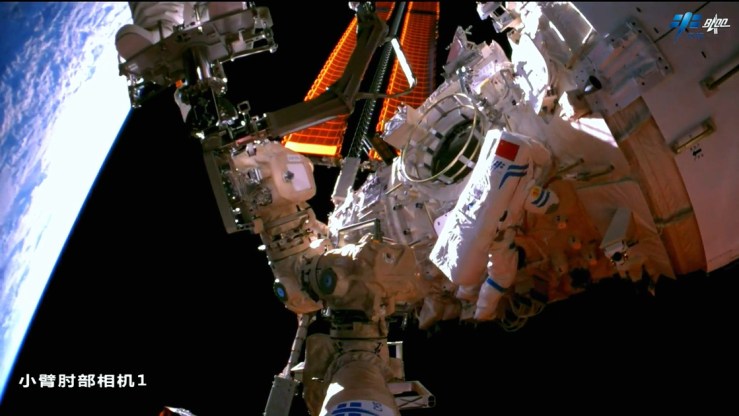
Main tasks: Carry out astronaut out-of-vehicle activities and cargo airlock out-of-vehicle missions; continue to carry out space science experiments and technical experiments; carry out important activities such as platform management routine work, astronaut support related work, and popular science education. The Weibo video of the small speaker in manned spaceflight Collapse….

Images and visuals are from their Respectives CMS China Manned SpaceCNSA-China National Space Administration