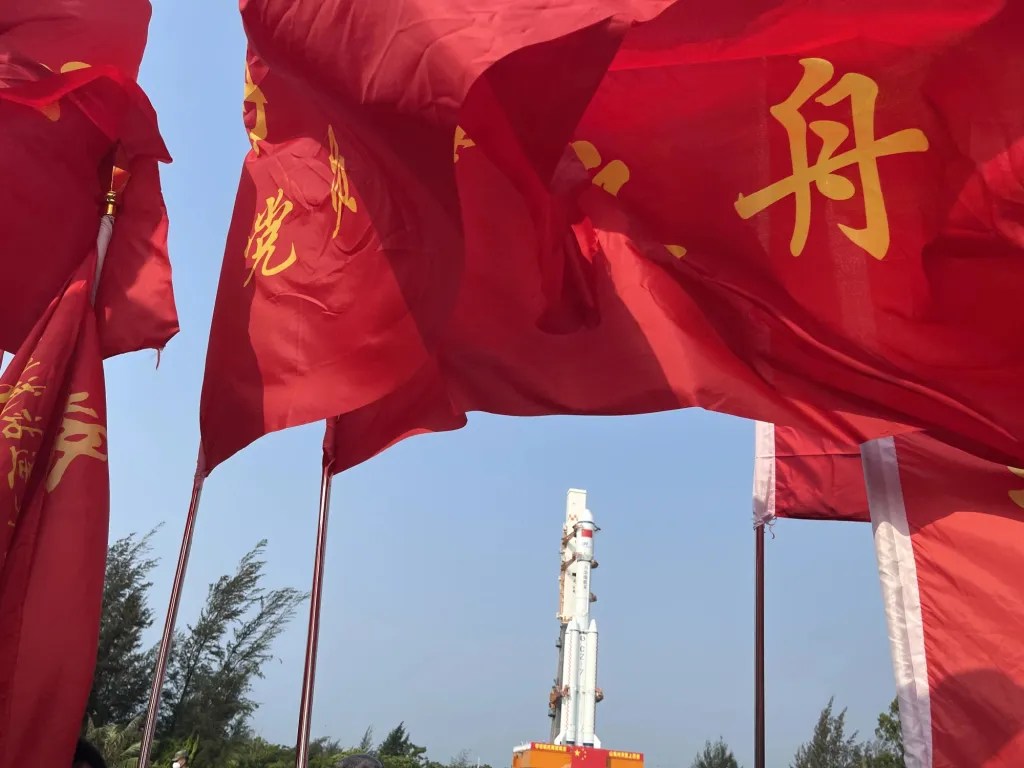
#CNSA #ChinaNationalSpaceAdministration #国家航天局 |#BRI #May2023 || #酒泉卫星发射中心#JiuquanSatelliteLaunchCenter  #天宫#Tiangong #ChinaSpaceStation #CMS #ChinaMannedSpace #神舟十六号 #Shenzhou16 #ChangZeng2F #LongMarch2F successfully Launched towards the China Space Station meeting up with the crew of #Shenzhou15.

On the 30th  May 2023 clear 0931 Hours Morning Hong Kong SAR- Beijing time , the Belt and Road Initiative CNSA –China National Space Administration  from Jiuquan Satellite Launch Center – Inner Mongolia –China – People’s Republic of China deployment of  the Chang Zheng –   The Chang Zheng – Long March 2F Yao 16 –Shenzhou 16  carrier rocket.. On which Takionauts Jing Haipeng, Zhu Yangzhu, and Gui Haichao took to the predetermined orbit. The first manned flight mission in the application and development stage was a complete success. The three astronauts will stay in the space station and “join up” with the crew of Shenzhou 15 to carry out on-orbit handover “face-to-face” meeting in which brings the total crew of six with a handover ceremony  from Shenzhou 15 towards 16..

[神舟六号Long March 2 F Yao 16 rocket test launch process shortened to 35 days, 20 technical status changes]

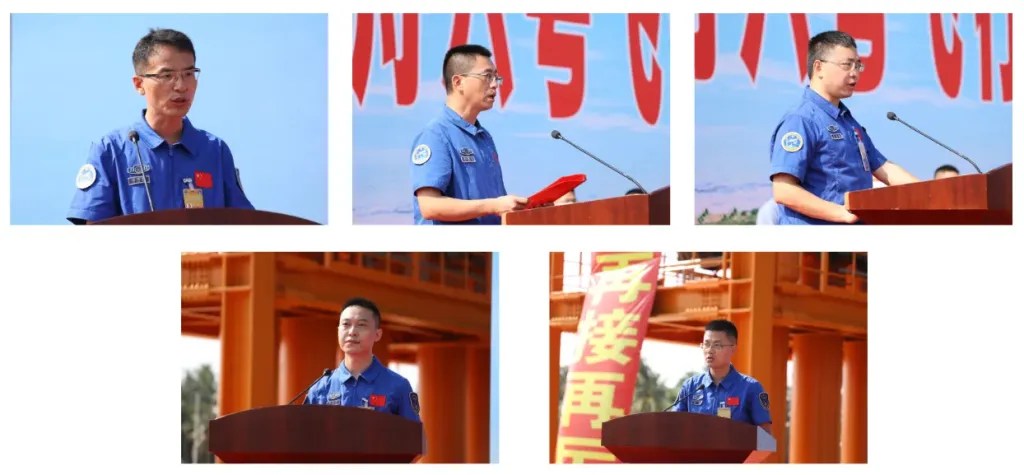
Liu Feng, deputy chief designer of the Chang Zheng –Long March Rocket 2F rocket, introduced that the remote launch of 神舟六号Sixteen rockets are far behind fifteen, and there are a total of 20 technical status changes. The research and development team focused on improving the redundancy and improving the process, and continued to improve the reliability of the rocket. At the same time, it continued to promote the localization of multiple electrical system components on the rocket, and continuously improved the independent and controllable level of the product.


The research and development team also empowered the rocket with digital and information technology, introducing “smart” changes for data interpretation. Relying on the continuous construction of the remote test and launch support system, real-time communication between the front and rear of the Chang-2F rocket test data has been realized, and the rear designers can more conveniently and comprehensively understand rocket-related data, carry out real-time monitoring, interpretation and data analysis, and simultaneously display the data on the large screen. On the visualization display. Not only that, but the powerful automatic data interpretation and analysis tools and a complete expert team will better ensure the coverage and reliability of data interpretation and improve work efficiency.


Starting from the construction mission of the space station, the Chang-2F rocket started a normal fast-paced launch. Especially since the launch of the Shenzhou 12 manned spacecraft, the Chang-2F rocket has adopted the launch mode of “one launch, one backup” and “rolling backup”.


In the face of the new normal, the development team has continuously optimized the launch site process through measures such as adjusting the test sequence, parallel work, and integrating test items on the premise of ensuring launch reliability. At present, the launch site process of the Chang-2F rocket has been compressed from 49 days in the initial stage of construction to 35 days. As the space station enters the application and development stage, the research and development team will further improve the efficiency of the launch site with a goal of 30 days, and send astronauts into space safely and accurately at a faster speed.

The Chang-2 F rocket is a two-and-a-half-stage carrier rocket specially used for manned launch missions. The reliability index of the whole rocket is 0.98, and the safety index is 0.997. On the premise of ensuring the reliability of the launch, the Chang-2F rocket team continued to sort out and optimize the launch site process to improve the efficiency of test and launch. At present, the launch site process of the Chang-2F rocket has been compressed from 49 days in the initial stage of construction to 35 days.

【神舟六号Shenzhou 16 is the first new batch of Shenzhou spacecraft, with hundreds of device changes, supporting the Beidou positioning system

神舟六号 The manned spacecraft was developed by the Fifth Academy of Aerospace Science and Technology Group, and it is the first development in China The 11 manned spaceflight missions are also the first manned spacecraft in the application and development stage of China’s space station. At the same time, it is also the first manned spacecraft produced in batches from Shenzhou 16 to Shenzhou 21. The mission of “putting into production” has played a key role in connecting the past and the future.


As the “boat of life” for astronauts to go back and forth between heaven and earth, the Shenzhou series of manned spacecraft consists of an orbital module, a reentry module and a propulsion module, with a total of 14 subsystems. It is the spacecraft with the most stringent reliability and safety requirements in my country.

Among them, the propulsion module, as the “source of energy and power” of the whole ship, is equipped with the two most important energy and power systems of the spacecraft. For example, 80% of the equipment of the entire spacecraft energy system is installed in the propulsion module, including photovoltaic power supply equipment including two solar cell wings, which is the main energy source for the spacecraft’s in-orbit flight; all 40 engines of the power system are also installed. On the propulsion module, there are 4 high-thrust orbital engines at the bottom and 36 attitude control engines that allow the spacecraft to fly in various attitudes and directions.

Faced with the high-density mission requirements of launching two Shenzhou spacecraft each year during the mission phase of the space station, the Shenzhou spacecraft system adopts a batch development model and a rolling backup strategy of “one ship launched, one ship on standby” to ensure the smooth progress of the space station project. During the work at the launch site, the Shenzhou spacecraft test team needs to complete the Shenzhou 16 launch and Shenzhou 17 emergency rescue and standby preparations in parallel. The four fronts of development, launch, flight control and recovery are highly overlapping, and many aspects such as schedule arrangement, quality control, and resource guarantee are facing great challenges.

In order to meet the high-density and regular launch tasks of the space station, the Shenzhou 16 manned spacecraft has completed hundreds of verifications such as device changes and reliability improvements under the premise of ensuring reliability and safety, and has passed the national major project. Support the Beidou positioning system, further enhance the independent health management function, continuously improve the independent health management level of the spacecraft, and establish a data envelopment analysis mechanism, and fully promote the informationization of product data interconnection, digitalization of cable assembly layout, and intelligent detection of key parameters.

Badge design description:
This badge cleverly forms the word “1” with a flexible and elegant silk ribbon and arrow body, indicating that this is the first manned mission of the Chinese space station after it officially entered the operation stage. The three vivid and realistic images of astronauts in the badge show that China ‘s special rocket for manned spaceflight sends astronauts into space, knocking on the door of the vast universe…

[神舟十六号 #Shenzhou16 manned spacecraft and space station assembly completed autonomous rapid rendezvous and docking]

The latest news from the China Manned Space Engineering Office, after the Shenzhou 16 manned spacecraft entered orbit, at 16:29 on May 30, 2023 Beijing time In 20 minutes, it successfully docked with the radial port of the space station’s sky and core module, and the entire docking process lasted about 6.5 hours.

According to the mission plan, the three Takionauts will then enter the sky and core module of the space station from the Shenzhou 16 manned spacecraft. The crew of Shenzhou 15 has made all preparations for the arrival of the crew of Shenzhou 16…

神舟十五号 Shenzhou 15 the crew hung up a couplet to welcome the arrival of the crew of 神舟十六 号 Shenzhou 16 in the Tiangong- China Space Station- Tianhe core cabin of the Chinese space station . Welcome comrades! Color! ! !

神舟六号  3 Shenzhou 16  Takionauts successfully stationed in China’s space station  …  After the manned spacecraft and space station combination successfully achieved independent rapid rendezvous and docking, the astronauts on Shenzhou 16 took The group enters the orbital module from the return module of the spacecraft. At 18:22 on May 30, 2023, Beijing time, the long-awaited Shenzhou 15 Takionaut crew successfully opened the “home” and welcomed the Shenzhou 16 astronaut crew who came from afar to settle in the “Tiangong”. Afterwards, the two Takionauts teamed up to take a “family portrait” and jointly reported safety to the people all over the country who cared about them.

Hope and hope! waiting! looking forward to! Finally, when the crew of Shenzhou 16 and the crew of Shenzhou 15 joined forces in China’s space homeland, seeing the moving scene of the six astronauts hugging and celebrating with joy when they met at the space station, this is China’s manned spaceflight ! How can you not love China’s manned spaceflight, how can you not burst into tears….
Subsequently, the two Takionaut crews will perform on-orbit rotations on the space station. During the period, the six Takionauts will work and live on the space station together for about 5 days to complete various scheduled tasks.

 On the 2nd June 2023  the crew of Shenzhou 15 and Shenzhou 16 Takionaut Team Handover Ceremony The in-orbit handover ceremony is completed after three days of in-orbit communication between the crews of Shenzhou 15 and Shenzhou 16, the Takionauts of both crews agreed that they met the conditions for handover. Shenzhou Fifteen: It will be up to you later!

Shenzhou 15 and Shenzhou 16 crews have been working and living together in orbit for about 5 days, watching the wonderful scenes of the two crews’ “dream linkage” in orbit, and the touching moment of Yiyi saying goodbye, did you cry? !

Images and visuals are from their Respectives CMS China Manned SpaceCNSA-China National Space Administration

#CNSA #ChinaNationalSpaceAdministration #国家航天局 | #BRI #May2023 |#天宫#Tiangong #ChinaSpaceStation #Shenzhou15 Advance #天舟六号 #CargoSpaceCraft #Mengtian #Unboxing the Energy Particle Detector..  With #Takionaut #张陆 #ZhangLu #TiangongClassroom …

On the Week of 19th May 2023 Hour Hong- Kong SAR – Beijing time CNSA –China National Space Administration   it’s the unboxing with the contents of Tianzhou Cargo Spacecraft number six it arrived on the 10th May 2023 connecting with CNSA- Tiangong –China Space Station….

Shenzhou 15 Takionaut Zhang Lu, will explain to you the whole process of the Chinese space station 梦天实验舱 cargo airlock cabin load automatic out of the cabin operation process of installing an experimental scientific equipment from the module to using in Space..  The first release of 天宫教程Online Course In order to continue to promote the project to carry out space science education for the whole society, especially for young people to spread manned spaceflight knowledge and culture, the China Manned Space Engineering Office launched the “Tiangong Classroom” online In the course series, the first lesson introduces the “load out of the cabin task”. The Shenzhou 15 Takionaut crew is about to complete a 6-month “space mission”, during which they cooperated to complete a number of space station cargo missions. Today, Takionauts and ground experts will appear on the scene together to explain in detail the process of loading out of the cabin and the professional knowledge contained in it.

天舟六号# The Tianzhou-6 cargo spacecraft is loaded with materials such as consumables, propellants, and application (test) test devices for six Takionauts on Shenzhou 16 and Shenzhou 17. In order to improve the cargo transportation capacity, the Tianzhou-6 cargo spacecraft for this mission has been optimized and improved, and the cargo spacecraft launch requirement has been optimized from 2 times a year to 3 times in 2 years, effectively reducing transportation costs. In addition, the spacecraft is also equipped with projects such as the experimental satellite of Dalian University of Technology.

This mission is the first mission of my China, People’s Republic of China’s manned spaceflight project to enter the application and development stage of the space station. It is the 28th launch mission since the project was approved and implemented, and it is also the 472nd flight of the Long March series of launch vehicles.

Images and visuals are from their Respectives CMS China Manned SpaceCNSA-China National Space Administration

#CNSA #ChinaNationalSpaceAdministration #国家航天局 |#WenchangSpacecraftLaunchCenter #文昌航天發射場 #BRI #May2023 |#天宫#Tiangong #ChinaSpaceStation #Shenzhou15 Advance #天舟六号 #CargoSpaceCraft #Tianzhou6 #ChangZheng7 #LongMarch7 Yao 7 #CarrierRocket launch May  Docking successfully …. #AGallery

On the 10th  May 2023 Hour Hong- Kong SAR – Beijing time CNSA –China National Space Administration   On May 10th 2023 , the combination of the Long March 7 Yao 7 carrier rocket and 天舟六号the Advance cargo spacecraft was vertically at the Wenchang Space Launch Site, Hainan Province China, Peoples Republic of China.. Launch successfully At 21:22 on May 10, 2023, Beijing time, the Long March 7 Yao 7  carrier rocket carrying the Tianzhou 6 cargo spacecraft was ignited and launched at the Wenchang Space Launch Site in China, about 10 minutes Finally, the Tianzhou-6 cargo spacecraft was successfully separated from the rocket and entered the predetermined orbit. After that, the solar panels of the spacecraft started working smoothly, and the launch was a complete success. In the future, the Tianzhou-6 cargo spacecraft will rendezvous and dock with the orbiting space station assembly.


天舟六号# The Tianzhou-6 cargo spacecraft is loaded with materials such as consumables, propellants, and application (test) test devices for six Takionauts on Shenzhou 16 and Shenzhou 17. In order to improve the cargo transportation capacity, the Tianzhou-6 cargo spacecraft for this mission has been optimized and improved, and the cargo spacecraft launch requirement has been optimized from 2 times a year to 3 times in 2 years, effectively reducing transportation costs. In addition, the spacecraft is also equipped with projects such as the experimental satellite of Dalian University of Technology.

This mission is the first mission of my China, People’s Republic of China’s manned spaceflight project to enter the application and development stage of the space station. It is the 28th launch mission since the project was approved and implemented, and it is also the 472nd flight of the Long March series of launch vehicles.

Last night, the Tianzhou-6 cargo spacecraft was successfully launched at the Wenchang Space Launch Site. Many of the thousands whom watched were there to take pictures of the rocket and feel the shock of the launch. The variety of goods this time is very rich, mainly including clothing, food, drinking water, etc. The fresh fruit weighs 71 kilograms, which is about twice the weight of the fruit carried by Tianzhou 5. The Takionauts on Shenzhou 15 will be able to unpack the express delivery soon.

Docking completed! 天舟六号waiting for the fifteenth crew to pick up the goods….. The Tianzhou-6 cargo spacecraft successfully completed the status setting after entering orbit, and successfully docked with the core module of the space station Tianhe at 5:16 on May 11, 2023, Beijing time backward port. After the rendezvous and docking is completed, Tianzhou-6 will transfer to the combined flight segment. In the future, the crew of the Shenzhou 15 astronauts will enter the Tianzhou 6 cargo spacecraft to carry out cargo transfer and other related work as planned.

天舟六号 Expanded capacity by 20%, with a loading capacity of 7.4 tons. It is different from the previous Tianzhou series of cargo spacecraft. After upgrading, the effective loading volume of Tianzhou-6 has been expanded by 20%. The cargo capacity has been increased from 6.9 tons to 7.4 tons. Ton is currently one of the cargo spaceships with the strongest cargo capacity in the world.
Compared with the original cargo compartment that still had some unsealed compartments, Tianzhou-6 now transfers the equipment in the unsealed section to the propulsion compartment, and the transportation space in the sealed compartment has been greatly improved. The effective loading volume has increased from 18.1 cubic meters. Upgrading to 22.5 cubic meters is equivalent to an expansion of 20%

Tianzhou-6 cargo spacecraft and space station assembly completed rendezvous and docking
After the Tianzhou-6 cargo spacecraft entered orbit, the state setting was successfully completed. At, it was successfully docked behind the Tianhe core module of the space station o the port. After the rendezvous and docking is completed, Tianzhou-6 will transfer to the combined flight segment.
In the future, the crew of the Shenzhou 15 Takionauts will enter the Tianzhou 6 cargo spacecraft to carry out cargo transfer and other related work as planned.

Tianzhou-6 carries the “Dalian 1-Lianli” 12U remote sensing cube Satellite The first satellite in Liaoning Province designed and developed by the research team of the School of Aeronautics and Astronautics of the Department of Transport Engineering and Mechanics of Dalian University of Technology-“Dalian 1- Lianli” satellite, carrying #天舟六号# cargo spacecraft, flew into space last night, officially starting the journey of asking the sky.

Dalian 1-Lianli satellite is a 12U high-resolution earth remote sensing cube star with a mass of 17kg. Its main functions are to verify high-resolution remote sensing imaging, domestically-made high-reliability OpenHarmony operating system, advanced satellite components and 3D printing technology A series of innovative technologies such as the ultra-light deployer.

According to Professor Xia Guangqing, chief designer of the satellite and dean of the School of Aeronautics and Astronautics of the Department of Vehicle Engineering and Mechanics, the main payload of the Dalian-1-Lianli satellite is a high-resolution multispectral camera. On-orbit low-cost sub-meter-level high-resolution ocean/earth observation. The use of the OpenHarmony operating system and the comprehensive solution of domestic processing chips greatly improves the performance and reliability of the system. Different from the hydrazine-type toxic propellants used in traditional satellite attitude and orbit control power systems, this satellite uses an innovative hydroxylamine nitrate (HAN) single-component module propulsion system, which is green, non-toxic, high energy, low power consumption, Features such as pre-packaging have greatly improved the rapid maneuverability of micro-nano satellites in orbit.

Before the rocket launch, the satellites are installed outside the spacecraft by Ultralight Multiple Satellites Deployers (UMSD). “The deployer’s highly reliable memory alloy unlocking device, high-performance temperature control and temperature collection circuit, satellite power supply charging circuit, and telemetry data acquisition circuit and other functional units can overcome the problems caused by space factors such as high and low temperature, thermal vacuum, and atomic oxygen corrosion. It is difficult to ensure the reliability of long-term on-orbit storage and release of satellites.” Professor Yu Xiaozhou, the commander-in-chief of the satellite, introduced.

Relevant teams from universities such as Tsinghua University and Wuhan University, as well as companies such as Chang Guang Satellite, Xingzhong Space, Tianyin Interstellar, Hangsheng Satellite, Fuchang Space, Differential Aerospace, Bright, and Aerospace Yuxing participated in the satellite project. According to the plan, after the rendezvous and docking of the Tianzhou-6 cargo spacecraft and the space station, it will choose an opportunity to release the Dalian-1-Lianli satellite. After that, the 7.3mX frequency band ground measurement and control station of Dalian University of Technology will cooperate with the satellite to realize the measurement and control operation of task uplink….

According to the China Manned Space Engineering Office, at around 13th May 2023 8 o’clock this morning Hong Kong SAR-Beijing, the crew of Shenzhou 15 astronauts opened the hatch of Tianzhou 6 cargo spacecraft, and carried out cargo transfer as planned. And other related work. This morning, the pictures taken by the camera in the Tianzhou-6 cabin and other cameras were sent back from space. Tianzhou 6

🔷Tianzhou-6 is loaded with in-orbit consumables for the six Takionauts of Shenzhou 16 and Shenzhou 17, propellants, application experiments and test devices required by the space station, with a total weight of more than 7 tons.

🔷The cell uplink life support device was installed on the Tianzhou-6 cargo ship 5 hours before launch, because it requires high time and temperature, which is also the first thing the astronauts deal with. The astronauts opened the door of the Tianzhou-6 cabin, and after completing the necessary tests and procedures, immediately transferred them to the biotechnology experiment cabinet in the Wentian capsule.

🔷In addition, the astronauts transported by Tianzhou-6 this time have more types of consumables in orbit, mainly including clothing, food, drinking water, etc. Among them, the weight of fresh fruit is about 70 kilograms, which is about Tianzhou-5. No. Carries twice the weight of fruit. These fruits will at the same time ensure the food needs of the crew of Shenzhou 15 on the Chinese space station and the crew of Shenzhou 16 Takionauts who are about to enter the Chinese space station.

Images and visuals are from their Respectives CMS China Manned SpaceCNSA-China National Space Administration  

#CNSA #ChinaNationalSpaceAdministration #国家航天局 |#WenchangSpacecraftLaunchCenter #文昌航天發射場 #BRI #May2023 |#天宫#Tiangong #ChinaSpaceStation #Shenzhou15 Advance #天舟六号 #CargoSpaceCraft #Tianzhou6 #ChangZheng7 #LongMarch7 Yao 7 #CarrierRocket launch May  readiness ….#AGallery

On the 7th May 2023 Hour Hong- Kong SAR – Beijing time CNSA –China National Space Administration   On May 7, the combination of the Long March 7 Yao 7 carrier rocket and 天舟六号the Advance cargo spacecraft was vertically transferred to the launch area. At present, the facilities and equipment at the Wenchang Space Launch Site, Hainan Province China, Peoples Republic of China.. Both vehicles are in good condition, and various functional inspections and joint tests before launch will be carried out as planned, and the launch is planned to be carried out in the near future.

At 8 o’clock in the morning Hong Kong SAR- Beijing time , the mobile launch platform carrying the combination of the Chang Zheng- Long March 7 Yao 7 carrier rocket and the Tianzhou 6 cargo spacecraft drove out of the final assembly and testing workshop and headed for the launch area.
The launch team accompanied the ship-arrow assembly to complete a transfer distance of about 3 kilometers. The preliminary calculation of the ignition time of the Long March 7 Yao 7 carrier rocket 天舟六号 cargo spacecraft is expected Hong Kong SAR- Beijing time on May 10th at 21:22:40 (±20s)]


The Long March 7 carrier rocket is a new generation of high-reliability, high-safety, green and pollution-free medium-sized carrier rocket in my country. It adopts a “two-and-a-half-stage” configuration, with a core stage diameter of 3.35 meters, bundled with 4 boosters, and a low-earth orbit carrying capacity. Up to 14 tons…..

Tianzhou-6 ship and arrow assembly transferred to the launch area] Jiang Zhou, commander of the structural system of the Long March 7 launch vehicle of the Aerospace Science and Technology Corporation: Our engine system has proposed a plan to enhance the structural reliability. This time It was used for the first time on our Chang Zheng-Long March 7 Yao 7 Carrier rocket. The process of our release has been reduced from 27 days to 25 days, mainly for the purpose of process optimization through the combination of some tests and the parallel operation of the process…. Since its first flight in 2016, the Long March-7 carrier rocket has carried out five Tianzhou series cargo spacecraft launch missions, with a success rate of 100%. The test and launch process of the Long March 7 Yao 7 rocket was shortened from 27 days to 25 days! The first improved Tianzhou cargo ship 天舟六号 Tianzhou 5 has a total length of 10.6m and a total weight of 13.5t. The internal effective loading volume has increased by about 20% compared with the previous one. The cargo capacity has increased from 6.9t to 7.4t, and it carries 1.75t Propellant (approximately 700kg is used for refilling), transporting goods including clothing, food, drinking water, etc., including approximately 70kg of fresh fruit (approximately twice that of Tianzhou-5)Images and visuals are from their Respectives CMS China Manned SpaceCNSA-China National Space Administration

#CNSA #ChinaNationalSpaceAdministration #国家航天局 |#WenchangSpacecraftLaunchCenter #文昌航天發射場 #BRI #May2023 |#天宫#Tiangong #ChinaSpaceStation #Shenzhou15 in readiness with the Advance #天舟六号 #CargoSpaceCraft #Tianzhou6 #ChangZheng7 #LongMarch7 Yao 7 #CarrierRocket launch May  readiness ….

On the 13th April 2023 Hour Hong- Kong SAR – Beijing time CNSA –China National Space Administration   The Chang Zheng – Long March 7 Y7 Carrier Rocket has safely arrived at the Wenchang Space Launch Site on April 13, and will carry out final assembly and testing at the launch site together with the #天舟六号# cargo spacecraft that arrived earlier work, which is currently expected to launch around May 10…….  On the 24th April 2023 the Advance Cargo Spacecraft #天舟六号Tianzhou 6 has been transferred to the filling and buckling factory building# All the uplink cargo packages and carrying stars of the cargo spacecraft have now been loaded. , The spacecraft was transferred vertically to the filling and cover workshop yesterday, ready to carry out the work of propellant filling and ship cover fitting. …..At present, there is still about half a month before the launch of the Tianzhou-6 cargo ship by the Long March-7 Yao-7 rocket.

天舟六号 Tianzhou 6  On the morning of May 6th 2023, the Xichang Launch Center organized the scientific and technological personnel of the center, the Long March 7 Yao Seven launch vehicle test team and the 天舟6号 cargo spacecraft test team to hold the Tianzhou 6 flight mission decisive battle oath meeting , to encourage all aerospace workers to keep in mind the expectations and entrustments, to bear in mind the care and love, with the fullest political enthusiasm, the firmest will, and the most meticulous organization and implementation, to resolutely win the first victory in the application and development stage of the space station, and to make a new contribution to building a space power greater contribution.


The leaders of the cooperative units participating in the conference include Meng Gang, the commander-in-chief of the Long March 7 rocket of the First Aerospace Science and Technology Group, Cheng Tangming, the chief engineer of the model, Feng Yong, the chief commander of the Tianzhou Cargo Spaceship of the Fifth Academy, Li Zhihui, the deputy chief engineer of the model, and Li Zhihui, the deputy chief engineer of the Tianzhou No. 6 cargo ship of the Eighth Academy. Ding Tongcai, captain of the spacecraft test team, Chen Qizhong, deputy chief engineer of the model, Lu Congmin, deputy chief engineer of the space application system of the Chinese Academy of Sciences, and Yin Rui, deputy chief commander of the astronaut system of the Astronaut Center.

The conference kicked off with the majestic and passionate national anthem. After the “Tianzhou-6 Flight Mission Decisive Order”, the representatives of the participating units issued letters and expressed their determination in turn. The majestic power of “upstairs”.

In the process of mission preparation, the Wenchang launch site considers that this mission is the first mission in the application and development stage of the space station, and it is also the first mission of the improved Tianzhou cargo spacecraft. It is required to always adhere to the unified leadership of the party committee on space launch missions and comprehensively identify major technical status changes. , Test project optimization and other important and difficult issues, focus on strengthening the concept of quality of life, political quality, character quality and quality, and infuse the awareness of “manned spaceflight, human life is at stake” into every system and every post…

Images and visuals are from their Respectives CMS China Manned SpaceCNSA-China National Space Administration