#MadeInChina #中國製造| #ISpace #星际荣耀#InterstellarGlory #July2023 | #ChinesePrivateSpaceCompany –#ReusableCarrierRocket #CarrierRocket Engine testing Hyperbola No. 2 Verification Rocket Power System Trial Test Successfully

In which iSpace- Interstellar Glory in which it is the first Chinese Private Space Company to do so successfully commercially first out from sixty known private space companies in China People’s Republic of China…  Founded in Beijing 2016 located in Beijing Economic and Technological Development Zone or known for short as E-Town in Capital of China – People’s Republic of China …

Beijing Interstellar Glory Space Technology Co., Ltd. (referred to as “Interstellar Glory”) was established in October 2016, with Peng Xiaobo as the legal representative. The company is committed to developing excellent commercial launch vehicles and providing systematic launch solutions, providing global commercial aerospace customers with more efficient, higher-quality, and more cost-effective launch services, so as to greatly improve the ability of human beings to freely enter and exit space.

reusable liquid launch vehicle

Hyperbola-2 (Hyperbola-2)

The Hyperbola-2 launch vehicle is a small liquid launch vehicle with a two-stage tandem configuration, which is used to provide small satellite launch services. The hyperbolic No. 2 carrier rocket has a length of 28m, a first-stage rocket body diameter of 3.35m, a second-stage rocket body diameter of 2.25m, a take-off thrust of 106t, and a low-Earth orbit carrying capacity of 1.9 tons.
The Hyperbola-2 carrier rocket uses liquid oxygen/methane as propellant, which is non-toxic and non-polluting; the first sub-stage has the function of vertical landing and recovery, which can be reused, further reducing the cost of satellite launch services.

The company focuses on the research and development of intelligent launch vehicles, and provides integrated commercial launch services for global satellite and constellation customers.

At 16:00 Hours Hong Kong SAR- Beijing Time on July 5th, 2023, the test run of the SQX-2Y rocket power system was a complete success. Interstellar Glory Hyperbola No. 2 Verification Rocket Power System Trial Test Successfully】Interstellar Glory Hyperbola No. 2 Verification (SQX-2Y) rocket is a type of vertical recovery and reuse used to verify the liquid oxygen methane reusable launch vehicle The verification rocket adopts a full-scale rocket body diameter of 3.35m, and can be installed with one or more self-developed Focus No. 1 engines according to mission requirements to verify the real flight and return conditions of the first sub-stage of the reusable launch vehicle.


At 16:00 on July 5, 2023, the test run of the SQX-2Y rocket power system was a complete success.

The procedures of SQX-2Y rocket approach, stage, test, inflation, filling, precooling, ignition, post-processing and other procedures are strictly implemented in accordance with the launch site procedures; throughout the test process, the power system and control system are in accordance with the real flight test conditions. Continuously variable thrust of the engine and engine swing control were carried out. All systems worked normally and the performance was stable. All performance indicators met the design requirements. The participating systems were efficiently matched. The rocket shut down normally after working according to the actual flight procedure. The timing of this test run will be launched soon. The flight sequence of the kilometer-level vertical take-off and landing test has been comprehensively assessed for the whole system.

So far, SQX-2Y rocket power system and electrical system testing, propellant filling and leakage, engine pre-cooling and operation, shutdown and landing post-processing have been fully verified, and the whole system has successfully passed the test assessment.

The SQX-2Y rocket power system test run is an important and critical large-scale ground test before the Hyperbola II verification flight test. The correctness and effectiveness of the process. The complete success of this test mission has laid a solid foundation for the SQX-2Y rocket to carry out vertical take-off and landing flight tests.

Images-visuals are from Weibo and their respectives..

#MadeInChina #中國製造| #ISpace #星际荣耀#InterstellarGlory #April2023 | #酒泉衛星發射中心 #JiuquanSatelliteLaunchCenter – #ChinesePrivateSpaceCompany –#ReusableCarrierRocket of the #Hyperbola1  Yao 6 #CarrierRocket successfully Launched  testing…

In which iSpace- Interstellar Glory in which it is the first Chinese Private Space Company to do so successfully commercially first out from sixty known private space companies in China People’s Republic of China…  Founded in Beijing 2016 located in Beijing Economic and Technological Development Zone or known for short as E-Town in Capital of China – People’s Republic of China …

On 7th April 2023 Hong Kong SAR – Beijing time at Jiuquan Satellite Launch Center- Inner Mongolia-China – People’s Republic of China, Interstellar Glory Hyperbola-1 verification rocket At 12:00 on  Hong Kong SAR- Beijing time, the Hyperbolic No. 1 solid commercial launch vehicle was successfully launched at the Jiuquan Satellite Launch Center Inner Mongolia China, People’s Republic of China. The rocket completed the flight safely and smoothly according to the scheduled procedures, and the launch mission was a complete success. The main purpose of this flight test is to verify the correctness of the rocket’s overall plan and to accumulate rocket flight data. The mission is the fifth flight of the Hyperbolic 1 commercial launch vehicle.

Hyperbola-1 is the first rocket successfully entered orbit by a Chinese private rocket company, and it made its maiden flight in 2019. The three subsequent launches all failed, and Yao Liu finally succeeded in a go-around, and the interstellar glory came back to life for a successfully goal.. About 10 minutes after take-off, it entered the scheduled orbit smoothly, and the launch mission was a complete success.

Images-visuals are from Weibo and their respectives..

#MadeInChina #中國製造| #ISpace #星际荣耀#InterstellarGlory #June2022 | #酒泉衛星發射中心 #JiuquanSatelliteLaunchCenter – #ChinesePrivateSpaceCompany –#ReusableCarrierRocket of the #Hyperbola2 #CarrierRocket #ReusableCarrierRocketEcosystem  verification rocket successfully completed the joint training mission of the whole ecosystem…

On 15th May 2022 Hong Kong SAR – Beijing time at Jiuquan Satellite Launch Center- Inner Mongolia-China – People’s Republic of China, Interstellar Glory Hyperbola-2 verification rocket successfully completed the joint training mission of the whole eco system  Onwardly that month of May 15th , 2022, Beijing Interstellar Glory Space Technology Co., Ltd. (hereinafter referred to as “Interstellar Glory”) successfully completed the double The full-process joint training of liquid oxygen and liquid nitrogen for the Curve 2 verification rocket marks a critical step for Interstellar Glory to the successful development of a reusable launch vehicle.


With the help and support of leaders at all levels of the Jiuquan Satellite Launch Center, the Hyperbola-2 verification rocket test team organized and carried out refueling preparations, power-up tests, liquid oxygen and liquid nitrogen refueling, pre-cooling drills, emergency Works such as venting drills, simulated launch, and recovery processing have been completed, and the full-process operation exercise of refueling, launching, and landing recovery of the Hyperbola-2 verification rocket has been completed. Coordination, work adaptability of related products on the rocket and the ground in low temperature environment, the matching of the function of the filling gas supply system with the rocket, the correctness and integrity of the technical documents and operating procedures used in the test, and the completion of the refueling process. The evaluation of various working hours in the process of note, launch, and landing recovery has accumulated valuable test data and laid a solid foundation for the vertical take-off and landing (VTVL) flight test of a dual-low temperature reusable rocket.


“Hyperbolic 2 Reusable Small Liquid Launch Vehicle” is the main product with international competitiveness independently developed by Interstellar Glory. Hyperbola No. 2 is a two-stage small liquid launch vehicle with a maximum diameter of 3.35 meters. The first and second stages are equipped with the “Focus No. 1” 15-ton reusable variable-thrust liquid oxygen methane engine independently developed by Interstellar Glory; The take-off mass of the Hyperbola-2 carrier rocket is 90 tons, and the carrying capacity of the 500-kilometer SSO orbit is 1.5 tons (no recovery in the first stage) / 1 ton (recovery in the first stage… )

Hyperbola II: Reusable small liquid launch vehicle, adopts a two-stage series configuration, the first and second stages adopt 15-ton reusable liquid oxygen methane liquid rocket engine Focus No. 1 (JD-1), one of which 9 units are installed and 1 unit is installed in the second level. The diameter of the first-class rocket body is 3.35 meters, and the diameter of the second-class rocket body is 2.25 meters. The total length of the rocket is about 28 meters, the take-off weight is about 90 tons, the maximum carrying capacity of low-Earth orbit is 1.9 tons, and the carrying capacity of 500km SSO orbit is 1.1 tons (non-recovery)/0.7 tons (first-stage recovery). The first stage of the rocket has a vertical landing recovery function, which can be reused more than 30 times.

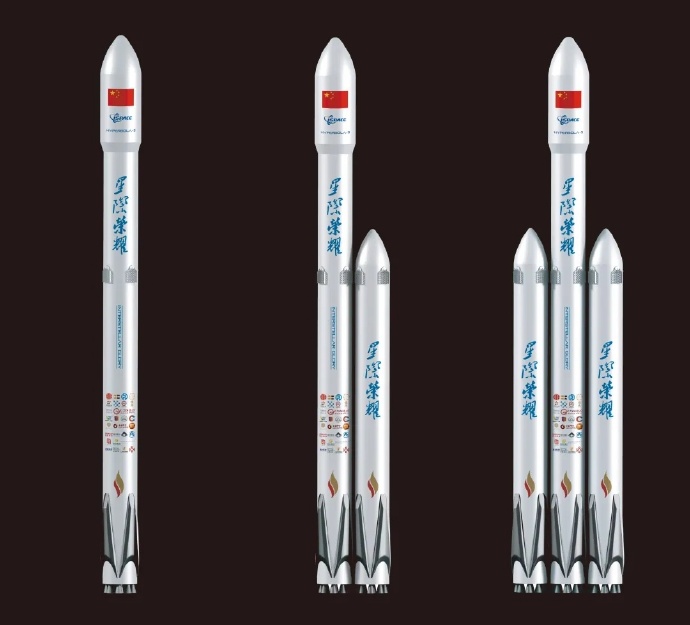
Hyperbolic III series liquid launch vehicle: medium and large reusable liquid launch vehicle, including SQX-3 basic type, SQX-3A (two-core stage parallel connection), SQX-3B (three-core stage parallel connection) three configurations, carrying Capability can meet the needs of a variety of load tasks. In addition to meeting large-scale satellite networking, medium and large-scale satellite launch tasks, it also has the capabilities of space station cargo transportation and deep space exploration also for Space Plane for crew transportation

Images-visuals are from Weibo and their respectives..

#MadeInChina #中國製造| #ISpace #星际荣耀#InterstellarGlory #November2021 | the #Wuhan 7th #InternationalCommercialSpaceSummitForum #ChinesePrivateSpaceCompany – Show casting the #ReusableCarrierRocket of the #Hyperbola2 #CarrierRocket #ReusableCarrierRocketEcosystem  Also what’s to come …

In which iSpace- Interstellar Glory in which it is the first Chinese Private Space Company to do so successfully commercially first out from sixty known private space companies in China People’s Republic of China…  Founded in Beijing 2016 located in Beijing Economic and Technological Development Zone or known for short as E-Town in Capital of China – People’s Republic of China …

Currently Visually on 25th November 2021 Showcasing it’s Reusable Carrier Rockets also it Reusable ecosystem  Hyperbola One: A small solid carrier rocket, with a four-stage solid configuration, with a total length of 24 meters, a diameter of 1.4 meters, a take-off mass of 42 tons, and a 500-kilometer sun-synchronous orbit. Less than 300 kg, 700 km sun-synchronous orbit carrying capacity is not less than 230 kg.


Hyperbola II: Reusable small liquid launch vehicle, adopts a two-stage series configuration, the first and second stages adopt 15-ton reusable liquid oxygen methane liquid rocket engine Focus No. 1 (JD-1), one of which 9 units are installed and 1 unit is installed in the second level. The diameter of the first-class rocket body is 3.35 meters, and the diameter of the second-class rocket body is 2.25 meters. The total length of the rocket is about 28 meters, the take-off weight is about 90 tons, the maximum carrying capacity of low-Earth orbit is 1.9 tons, and the carrying capacity of 500km SSO orbit is 1.1 tons (non-recovery)/0.7 tons (first-stage recovery). The first stage of the rocket has a vertical landing recovery function, which can be reused more than 30 times.

Hyperbolic III series liquid launch vehicle: medium and large reusable liquid launch vehicle, including SQX-3 basic type, SQX-3A (two-core stage parallel connection), SQX-3B (three-core stage parallel connection) three configurations, carrying Capability can meet the needs of a variety of load tasks. In addition to meeting large-scale satellite networking, medium and large-scale satellite launch tasks, it also has the capabilities of space station cargo transportation and deep space exploration also for Space Plane for crew transportation

Images-visuals are from Weibo and their respectives..

#MadeInChina #中國製造| #ISpace #星际荣耀#InterstellarGlory #September2021 | #ZhuhaiAirShow2021 #ChinesePrivateSpaceCompany – Show casting the #ReusableCarrierRocket of the #Hyperbola2 #CarrierRocket #ReusableCarrierRocketEcosystem …

Currently  in Zhuhai City is China International Aviation & Aerospace Exhibition -Air show China  in which is currently running in between 28th  September to 3rd October 2021 Zhuhai City –Guangdong province Greater Bay Area of China- People’s Republic of China….  In which iSpace – Interstellar Glory Main exhibits at this Zhuhai Air Show …..

Showcasting it’s Reusable Carrier Rockets also it Reusable ecosystem  Hyperbola One: A small solid carrier rocket, with a four-stage solid configuration, with a total length of 24 meters, a diameter of 1.4 meters, a take-off mass of 42 tons, and a 500-kilometer sun-synchronous orbit. Less than 300 kg, 700 km sun-synchronous orbit carrying capacity is not less than 230 kg.


Hyperbola II: Reusable small liquid launch vehicle, adopts a two-stage series configuration, the first and second stages adopt 15-ton reusable liquid oxygen methane liquid rocket engine Focus No. 1 (JD-1), one of which 9 units are installed and 1 unit is installed in the second level. The diameter of the first-class rocket body is 3.35 meters, and the diameter of the second-class rocket body is 2.25 meters. The total length of the rocket is about 28 meters, the take-off weight is about 90 tons, the maximum carrying capacity of low-Earth orbit is 1.9 tons, and the carrying capacity of 500km SSO orbit is 1.1 tons (non-recovery)/0.7 tons (first-stage recovery). The first stage of the rocket has a vertical landing recovery function, which can be reused more than 30 times.


Hyperbolic III series liquid launch vehicle: medium and large reusable liquid launch vehicle, including SQX-3 basic type, SQX-3A (two-core stage parallel connection), SQX-3B (three-core stage parallel connection) three configurations, carrying Capability can meet the needs of a variety of load tasks. In addition to meeting large-scale satellite networking, medium and large-scale satellite launch tasks, it also has the capabilities of space station cargo transportation and deep space exploration…

Images-visuals are from Weibo and their respectives..