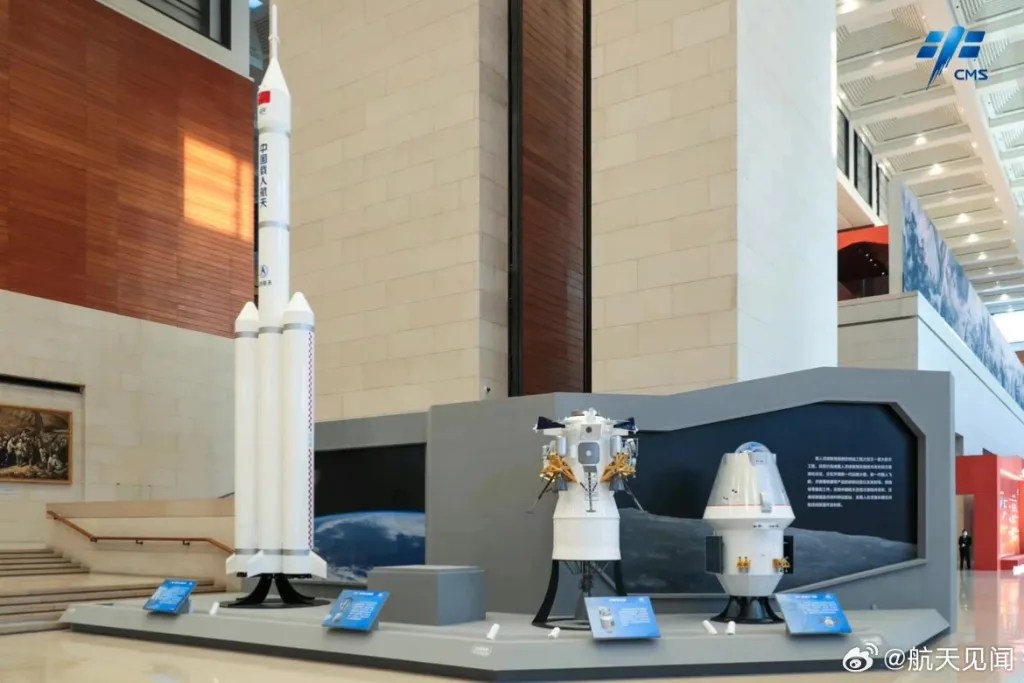
On February 26, 2024, the Aerospace Science and Technology Group released the “Blue Book of China’s Aerospace Science and Technology Activities (2023)” (referred to as the “Blue Book”). According to the published content, 2024 will be a “big year” for China’s aerospace industry, and various mission data will reach record highs. Of the 100 launch missions throughout the year, the Group accounted for 70%
The “Blue Book” shows that China’s aerospace industry is expected to carry out about 100 launch missions throughout the year in 2024, which is expected to set a new record.
Among these 100 or so launch missions, the Aerospace Science and Technology Group plans to arrange nearly 70 (the remaining 30 are expected to be commercial rocket plans), will launch more than 290 spacecraft, and implement a series of major engineering tasks, including:
Completed the first flight missions of the Long March 6C carrier rocket and the Long March 12 carrier rocket;
The space station entered normal operation mode and completed 2 cargo spacecraft, 2 manned spacecraft launch missions and 2 return missions during the year;
Promote the fourth phase of the lunar exploration project, launch the Queqiao-2 relay satellite and the Chang’e-6 probe, and achieve the world’s first sample return from the South Pole-Aitken Basin on the far side of the moon;
Launched ocean salinity detection satellite, electromagnetic monitoring satellite 02, Sino-French astronomical satellite, Shijian No. 19 and other civilian satellites to meet the application needs of users in various industries;
Accelerate the construction of the Aerospace Science and Technology Group’s “new generation commercial remote sensing satellite system”.
Wenchang commercial space launch site will make its debut
The “Blue Book” also shows that the Hainan Wenchang Commercial Space Launch Site will usher in its first launch mission, and the construction of multiple satellite constellations will be accelerated.

1. The Long March 6C carrier rocket made its first flight.
The Long March 6C launch vehicle is a new single-core stage all-liquid oxygen/kerosene-powered liquid launch vehicle. The rocket adopts a two-stage configuration and can perform a variety of orbital launch missions. The 700-kilometer sun-synchronous orbit has a carrying capacity of about 2 tons, 500 The carrying capacity of the sun-synchronous orbit is about 2.4 tons per kilometer. It has the characteristics of high reliability, low launch cost, strong adaptability and short performance period.
2. The Long March 12 carrier rocket made its first flight.

The Long March 12 launch vehicle is my country’s first 3.8-meter-diameter single-core liquid launch vehicle with a two-stage configuration. Its low-Earth orbit carrying capacity is not less than 10 tons and the 700-kilometer sun-synchronous orbit carrying capacity is not less than 6 tons.
At present, all the development work of the rocket has been completed, and it is planned to complete the launch mission of the first rocket at my country’s first commercial launch site in Wenchang, Hainan in 2024.
Space station, lunar exploration… various new missions are available
The Long March 12th launch vehicle is China’s first 3.8-meter-diameter single-core liquid launch vehicle with a two-stage configuration. The low-Earth orbit carrying capacity is not less than 10 tons and the solar range is 700 kilometers. The carrying capacity of the synchronous orbit is not less than 6 tons. At present, all the development work of the rocket has been completed, and it is planned to complete the launch mission of the first rocket at my country’s first commercial launch site in Wenchang, Hainan in 2024.


1. The space station enters normal operation mode.
The China Space Station has entered the normal operation stage. It has completed the launch of the Tianzhou 7 cargo spacecraft in January this year. It plans to launch the Shenzhou 18 manned spacecraft in the first half of the year to welcome the return of the Shenzhou 17 astronauts; in the second half of the year, it plans to launch the Tianzhou 7 cargo spacecraft. The Zhou 8 cargo spacecraft and the Shenzhou 19 manned spacecraft will welcome the return of the Shenzhou 18 astronauts; the Shenzhou 20 manned spacecraft and the Long March 2F rocket will enter the launch site in the second half of the year for emergency rescue duty .


2. Promote the fourth phase of the lunar exploration project.
In the first half of this year, the Queqiao-2 relay satellite and Chang’e-6 detector will be launched at an appropriate opportunity.
Queqiao-2 will provide relay communication services for subsequent lunar exploration missions. The mission goals of the Chang’e-6 probe are: to fly through the Earth and around the moon, land in a selected area of the Antarctic Aitken Basin in the southern hemisphere of the moon, and collect lunar data. Samples will be safely sent to the ground through the processes of lunar surface take-off, lunar orbit rendezvous and sample transfer, lunar-ground transfer and re-entry recovery.
This will be the first time humans have landed on the far side of the moon and returned samples.
3. Launch ocean salinity detection satellites.
The ocean salinity detection satellite is a “13th Five-Year Plan” scientific research satellite of the “National Civilian Space Infrastructure Construction Medium and Long-term Development Plan”. It belongs to the ocean power satellite series and is used to obtain global ocean salinity information.
The satellite will fill the gap in the ocean salinity detection capabilities of China’s marine power satellite series and take into account soil moisture detection to meet the urgent needs of many industries and business departments such as oceans, disaster reduction, agriculture, meteorology, etc., and is an important step in China’s implementation of marine resource development and Important technical support for disaster prevention and environmental monitoring.
4. The new generation of commercial remote sensing satellite systems is accelerated.
During the “14th Five-Year Plan” period, China will comprehensively build “China’s four-dimensional new generation commercial remote sensing satellite system”, including sub-meter high-resolution optical payloads, wide-width optical payloads, high-resolution radar payloads and other diversified types of commercial remote sensing satellites. At present, the construction of the first phase of four satellite systems has been completed and has begun to provide high-efficiency and high-performance spatio-temporal information services to users in traditional and emerging markets.
The “Blue Book” shows that in 2024, the Aerospace Science and Technology Group’s research and development tasks will continue to be high-intensity, and it will comprehensively promote the manned lunar exploration project and the deep space exploration project, and continue to promote the new generation of near-Earth manned spacecraft, Chang’e 7, and Tianwen 2. , geostationary microwave detection satellites, etc., launched more than 230 launch vehicle batches into production, and completed a number of commercial aerospace and whole-satellite export contracts.
Images and visuals are from their Respectives CMS China Manned SpaceCNSA-China National Space Administration