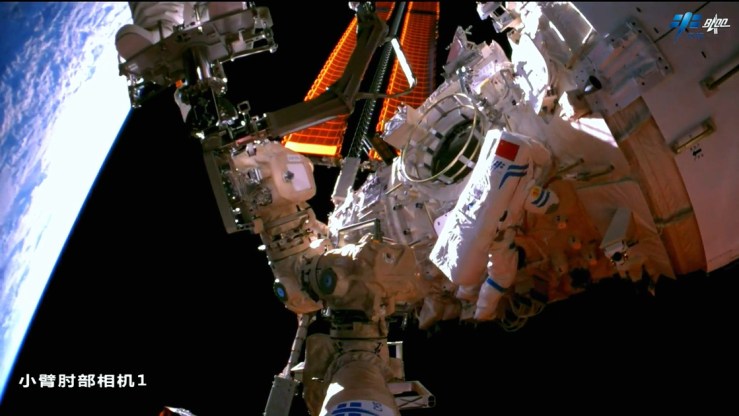
On the week of coming on the 27th February 2023 CMS China Manned SpaceCNSA-China National Space Administration the crew of the Shenzhou 15 of the Tiangong-China Space Station currently at the China Space Station梦天实验舱 at the Mengtian Module in which is Mengtian, officially the Mengtian laboratory cabin module, is a major module of the Tiangong space station. It is the second Laboratory Cabin Module launched, after Wentian, and the second module to extend the existing Tianhe core module of the station. the red lanterns are still hanging high in the weightless state, and the lanterns are placed very capriciously…..
Come on view from the first perspective experience Shenzhou15 Takionaut setting high temperature material cabinet…… During the application and development stage of the space station, more work of the astronauts will be carried out around the scientific experiment cabinet. Takionauts will work with ground researchers to carry out more on-orbit scientific experiments. Today, let us experience how the high-temperature material cabinet is set up from the perspective of an astronaut. Footage filmed by the Shenzhou15 crew shows the setup procedures of the HTMR (High-Temperature Materials research Rack) in China’s Space Station, which can achieve a temperature of 1,600 °C and let Taikonauts observe the experiments through X-ray and optical diagnostic devices.
On the 24th February 2023 Early clear 1201 Hours Hong Kong SAR- Beijing time , the Belt and Road InitiativeCNSA –China National Space Administration launching from Jiuquan Satellite Launch Center – Inner Mongolia –China – People’s Republic of China deployed launched the Chang Zheng – Long March 2C carrier rocket …. The Chang Zheng – Long March 2Ccarrier rocket erected at station 603 of the Jiuquan Satellite Launch Center, and it is expected to perform a space launch mission at noon today….
Successfully launched the Horus 1 remote sensing satellite at 12:01 Beijing time today, China, People’s Republic of China successfully launched the Horus 1 remote sensing satellite into space using the Long March 2C carrier rocket at the Jiuquan Satellite Launch Center. The satellite successfully entered the predetermined orbit, and the launch mission was a complete success. This mission is the 464th flight of the Long March series of launch vehicles!
On the 23rd February 2023 in CNSA _China National Space Administration -China – People’s Republic of China At 1949 hours Hong Kong –Beijing Time China- People’s Republic of China launch the Chang Zheng – Long march 3B Y93 Carrier Rocket launching from station form Xichang Satellite Launch Center Sichuan Province…..Deploying the ChinaSat 26 communication satellite….
This marks the 6th launch of this year is a complete success At 19:49 Hong Kong SAR- Beijing Time on February 23, 2023, at the No. 2 station of the Xichang Satellite Launch Center successfully launched the ChinaSat 26 communication satellite with the Chang Zheng- Long March 3 B Yao 93 carrier rocket. Launched into space, the satellite successfully entered the predetermined orbit, and the launch mission was a complete success. ChinaSat- Zhongxing 26 satellite is a high-throughput broadband communication satellite in geostationary orbit, using the Dongfanghong-4 enhanced satellite public platform independently developed by China- People’s Republic of China. The satellite is a full Ka-band high-throughput communication satellite with a satellite capacity exceeding 100Gbps. It is my country’s first high-throughput satellite with a capacity exceeding 100 Gbps. This launch is the 463rd launch of the Long March series of launch vehicles.
China- People’s Republic of China largest civil and commercial broadband satellite ChinaSat – Zhongxing 26 will help aircraft connect to the Internet] Zhongxing 26 is a high-throughput broadband communication satellite in full Ka-band geostationary orbit. No. Enhanced Satellite Public Platform. ChinaSat 26 satellite is currently the civil and commercial communication satellite with the largest communication capacity, the most beams, and the most complex in my country, and its communication capacity exceeds 100Gbps. The satellite is equipped with 94 user beams and 11 gateway beams, covering my country’s territory and surrounding areas, and will provide high-speed broadband access services for fixed terminals, vehicle terminals, ship terminals, and airborne terminals.
According to the development goal, ChinaSat-26 satellite can meet the needs of millions of user terminals at the same time, with a maximum communication rate of 450Mbps, and the overall performance of satellite-ground system design and operation services can match the international level. For the first time in China, the satellite fully uses the 27~30GHz frequency band, which is 500MHz wider than the previous communication satellite frequency.
According to Wei Qiang, commander-in-chief of ChinaSat 26 satellite, at the end of 2022, China Satcom and Sichuan Airlines will cooperate to install Viasat airborne Internet equipment on some Airbus A320 aircraft. The 16th satellite-based Ka-band satellite network provides passengers with in-flight Internet services. When passengers use mobile phones, tablet computers, etc. to connect to the Internet in the air, the network runs smoothly and the experience is good. “I believe that with the in-orbit application of the ChinaSat-26 satellite, the breadth and depth of satellite Internet business coverage will be enhanced to a greater extent, and a new era of satellite Internet services in my country will be fully opened.” Wei Qiang said.
Wang Fengchun, the chief engineer of the satellite, said: “With the widening of the frequency, the payload has brought a series of technical difficulties in the product design. This new technology has effectively reduced the load weight and greatly improved the satellite load performance.”
In addition, the development team took “independent controllability of core technology” as their own responsibility, independently innovated and pooled wisdom to tackle key problems, and realized the fourth-generation low-noise amplifier in the Ka-band The localization of various products such as frequency converters and sequential microwave switches has reached the international advanced level in performance and has been included in the payload product spectrum of the Fifth Academy, breaking the long-term dependence on imports and comprehensively improving the localization level of loads.
Today is 17th February 2023, 2023CNSA –China National Space Administration, CMS China Manned Space 75 days after returning to the ground, the Shenzhou 14 Takionaut crew and the press meeting were held in Beijing Aerospace City ….. On the afternoon of February 17, 2023, 75 days after the Shenzhou 14 Takionaut crew returned, the China Astronaut Center held Beijing Aerospace City held a meeting with the crew and reporters. More than 10 media including People’s Daily, Xinhua News Agency, China Central Radio and Television, PLA Daily, and Manned Space Network participated.
[Liu Yang: There are too many unforgettable moments and too many proud moments] After staying in orbit for half a year, Liu Yang and his comrades experienced the process of building the space station. She said that there are too many unforgettable memories and too many proud moments
[Chen Dong said that the ground team is the strong backing for them to successfully execute the mission] Chen Dong served as the commander of the Shenzhou 14 mission for the first time. He said that the crew used meticulous operations and meticulous implementation in exchange for excellent answers. Backed by the timely, in place and effective support of the ground team…
This is the first official meeting with the media and the public after the Shenzhou 14 crew returned. At the meeting, relevant experts introduced the recovery situation and follow-up plans of the crew after returning. It is reported that the recovery period after the normal return of the flight crew is mainly divided into three stages: the isolation recovery stage, the recuperation recovery stage, and the recovery observation stage. So far, the crew has completed the first two stages of work. On the whole, the Takionauts are emotionally stable and in a good state of mind, their weight is stable at the pre-flight level, their muscle strength, endurance and exercise cardiopulmonary function reserves have been further restored, and the expected results have been achieved, and they have fully entered the recovery observation stage. After completing the recovery health assessment summary, the three Takionauts will transfer to normal training work. At the meeting, the crew answered questions from reporters on the stage of staying on the space station and the situation after returning.
On the week of coming on the 15th February 2023 CMS China Manned SpaceCNSA-China National Space Administration the crew of the Shenzhou 15 of the Tiangong-China Space Station announces a Design patch mission logo design competition for the mission of the advance cargo space craft Tianzhou6, also the Chang Zheng –Long March 2F Manned Space Craft Shenzhou 16 also Shenzhou 17 in which is set to be this year of 2023 launch calendar…
The Announcement is here for the year 2023年人气航航进行组织目形目收集 That China, People’s Republic of China CNSA – China National Space Administration From will launch the Tianzhou-6 cargo spacecraft, Shenzhou-16 manned spacecraft, and Shenzhou-17 manned spacecraft in 2023. This is the Chinese space station the first batch of flight missions after the full completion and transition to a new stage of application and development. In order to further enhance the social influence of the project, increase the public’s enthusiasm for participation, and continue to build the brand image of China’s manned spaceflight culture, the China Manned Spaceflight Engineering Office officially launched the annual manned flight mission logo solicitation activity, openly soliciting for the two manned space missions in 2023 Flight mission, a cargo spaceship flight mission logo.
1. Collection Content
Tianzhou-6 cargo spacecraft flight mission, Shenzhou-16 manned flight mission, Shenzhou-17 manned flight mission logo design scheme and explanation of ideas, all natural persons, legal persons and organizations who love China’s manned spaceflight industry can participate.
2. Activities
The collection will close at 24:00 on March 6, 2023. Online voting and results announcement will follow.
3. Organizer
China Manned Space Engineering Office
4. Overall Standard
(1) Creativity requirements. The mission logo design should fully reflect Chinese elements, manned spaceflight features, and mission characteristics, with distinct technological and artistic implications, and should also properly consider the systematization, coordination, and continuity of the three mission logos.
(2) Formal specification
1. The electronic version of the work must be made through image production software (such as Photoshop, AI, etc.), and the submitted work must be a clear and colorful picture. The resolution is not less than 300dpi, the color mode is RGB, and the export format is jpg or png.
2. Design size: 120mm*120mm, and indicate the color of each part in the electronic file. The final award-winning work must provide the organizer with a psd or AI format design source file.
3. It should be easy to recognize, remember and promote.
5. Activity rules
(1) The submitted work must be original by the contributor, and the contributor should ensure that he owns the complete copyright of the work, and there is no transfer or transfer of copyright to others. If it involves joint cooperation, work for a job or other situations of different ownership status, it will be regarded as a partner , units or other obligees know and agree to be bound by this statement.
(2) Participants should agree that the organizer of the solicitation activity can modify and learn from the participating works to form the task logo for final official use.
(3) If the submitted works have legal disputes due to the protection of rights such as portrait rights, reputation rights, honor rights, privacy rights, copyrights, and trademark rights, or due to rights defects or false, illegal, improper, or other unreasonable reasons in the submitted works If so, all legal responsibilities shall be borne by the contributors themselves and the organizer reserves the right to disqualify them from submitting contributions and recover the awards they have won.
(4) The submitted works must be submitted for the first time, and before the announcement of the review results of this call for contributions, all contributors shall not transfer or authorize the submitted works to a third party, nor shall they contribute to a third party.
(5) Contributors must keep their drafts and design source files. Once submitted, they will not be returned.
(6) Once the submitted work is finally accepted by the sponsor, it is necessary to sign a copyright (free) transfer contract and hand over the manuscript and design source files. All rights to the submitted work and related materials belong to the sponsor.
(7) The final interpretation right of this activity belongs to the organizer.
6. Submission method
(1) Design ideas, concepts and meanings within 500 words must be attached when submitting electronic documents. The file name of the work should be marked with the contributor’s name, unit/school, and contact information.
(2) Send it to the official email address: cmse@cmse.gov.cn before the deadline, and the submission email must be marked with “2023 China Manned Space Flight Mission Logo Collection Activities”.
(3) Contact person: Liu Zekang.
(4) Consulting telephone: 010-68378751.
7. Rewards
The China Manned Space Engineering Office will issue commemorative certificates to the final winners and arrange to go to the launch site to observe manned space launch missions.
8. Basic Situation of Manned Space Missions in 2023
(1) Flight mission of Tianzhou-6 cargo spacecraft
Launch date: May 2023
Launch site: Wenchang Space Launch Site
Space station configuration: Tianzhou-6 is docked at the rear port of the core cabin, forming a combination of three cabins and two ships.
Main tasks: Cargo flight missions are mainly used for uplink astronaut resident materials, extravehicular suits and other out-of-vehicle consumables; maintenance spare parts and propellants to ensure the safe operation of the platform, various loads and samples for application tasks; and downlink on-orbit waste .
(2) Shenzhou 16 manned flight mission
Launch date: May 2023
Launch site: Jiuquan Satellite Launch Center
Flight crew: consists of 3 Takionauts
Space station configuration: Shenzhou 16 is docked at the radial port of the core module, forming a combination of three cabins and three ships.
Main tasks: Carry out astronaut out-of-vehicle activities and cargo airlock out-of-vehicle missions; continue to carry out space science experiments and technical experiments; carry out important activities such as platform management, astronaut support, and popular science education.
(3) Shenzhou 17 manned flight mission
Launch date: October 2023
Launch site: Jiuquan Satellite Launch Center
Flight crew: consists of 3 Takionauts
Space station configuration: Shenzhou 17 is docked at the forward port of the core cabin, forming a combination of three cabins and three ships.
Main tasks: Carry out astronaut out-of-vehicle activities and cargo airlock out-of-vehicle missions; continue to carry out space science experiments and technical experiments; carry out important activities such as platform management routine work, astronaut support related work, and popular science education. The Weibo video of the small speaker in manned spaceflight Collapse….