#CNSA #ChinaNationalSpaceAdministration #国家航天局 | #BRI #May2023 |#天宫#Tiangong #ChinaSpaceStation #Shenzhou15 Advance #天舟六号 #CargoSpaceCraft #Mengtian #Unboxing the Energy Particle Detector..  With #Takionaut #张陆 #ZhangLu #TiangongClassroom …

On the Week of 19th May 2023 Hour Hong- Kong SAR – Beijing time CNSA –China National Space Administration   it’s the unboxing with the contents of Tianzhou Cargo Spacecraft number six it arrived on the 10th May 2023 connecting with CNSA- Tiangong –China Space Station….

Shenzhou 15 Takionaut Zhang Lu, will explain to you the whole process of the Chinese space station 梦天实验舱 cargo airlock cabin load automatic out of the cabin operation process of installing an experimental scientific equipment from the module to using in Space..  The first release of 天宫教程Online Course In order to continue to promote the project to carry out space science education for the whole society, especially for young people to spread manned spaceflight knowledge and culture, the China Manned Space Engineering Office launched the “Tiangong Classroom” online In the course series, the first lesson introduces the “load out of the cabin task”. The Shenzhou 15 Takionaut crew is about to complete a 6-month “space mission”, during which they cooperated to complete a number of space station cargo missions. Today, Takionauts and ground experts will appear on the scene together to explain in detail the process of loading out of the cabin and the professional knowledge contained in it.

天舟六号# The Tianzhou-6 cargo spacecraft is loaded with materials such as consumables, propellants, and application (test) test devices for six Takionauts on Shenzhou 16 and Shenzhou 17. In order to improve the cargo transportation capacity, the Tianzhou-6 cargo spacecraft for this mission has been optimized and improved, and the cargo spacecraft launch requirement has been optimized from 2 times a year to 3 times in 2 years, effectively reducing transportation costs. In addition, the spacecraft is also equipped with projects such as the experimental satellite of Dalian University of Technology.

This mission is the first mission of my China, People’s Republic of China’s manned spaceflight project to enter the application and development stage of the space station. It is the 28th launch mission since the project was approved and implemented, and it is also the 472nd flight of the Long March series of launch vehicles.

Images and visuals are from their Respectives CMS China Manned SpaceCNSA-China National Space Administration

#CNSA #ChinaNationalSpaceAdministration #国家航天局 |#BRI #May2023 #CMS #ChinaMannedSpace #Shenzhou10 #Shenzhou13 #Takionaut #王亞平 #WangYaping Household congratulation as the most beautiful family in 2023 ….

CNSA China National Space AdmistratonCMS China Manned Space Shenzhou ten and thirteen Senior Colonel Takionaut王亞平Wang Yaping family household is to be congratulate! In which Wang Yaping’s family was named “Shining Name – The Most Beautiful Family in 2023”! May 15th is International Family Day, and just last night, “Shining Names – 2023 Most Beautiful Family Release Ceremony” was broadcast on CCTV. In the release ceremony last night, a total of 10 outstanding representatives of the most beautiful families came to the scene; among them was the Wang Yaping family that we are most familiar with. 王亚平家庭was rated as the most beautiful family in 2023 on national Television on CCTV Science and Education Channel . … the behind the scenes shows her  family life with her lovely daughter and her husband with their parents as equal to her Takionaut Space Career..

Images and visuals are from their respectives- CNSA –China National Space Administration respectives

#CNSA #ChinaNationalSpaceAdministration #国家航天局 |#WenchangSpacecraftLaunchCenter #文昌航天發射場 #BRI #May2023 |#天宫#Tiangong #ChinaSpaceStation #Shenzhou15 in readiness with the Advance #天舟六号 #CargoSpaceCraft #Tianzhou6 #ChangZheng7 #LongMarch7 Yao 7 #CarrierRocket launch May  readiness ….

On the 13th April 2023 Hour Hong- Kong SAR – Beijing time CNSA –China National Space Administration   The Chang Zheng – Long March 7 Y7 Carrier Rocket has safely arrived at the Wenchang Space Launch Site on April 13, and will carry out final assembly and testing at the launch site together with the #天舟六号# cargo spacecraft that arrived earlier work, which is currently expected to launch around May 10…….  On the 24th April 2023 the Advance Cargo Spacecraft #天舟六号Tianzhou 6 has been transferred to the filling and buckling factory building# All the uplink cargo packages and carrying stars of the cargo spacecraft have now been loaded. , The spacecraft was transferred vertically to the filling and cover workshop yesterday, ready to carry out the work of propellant filling and ship cover fitting. …..At present, there is still about half a month before the launch of the Tianzhou-6 cargo ship by the Long March-7 Yao-7 rocket.

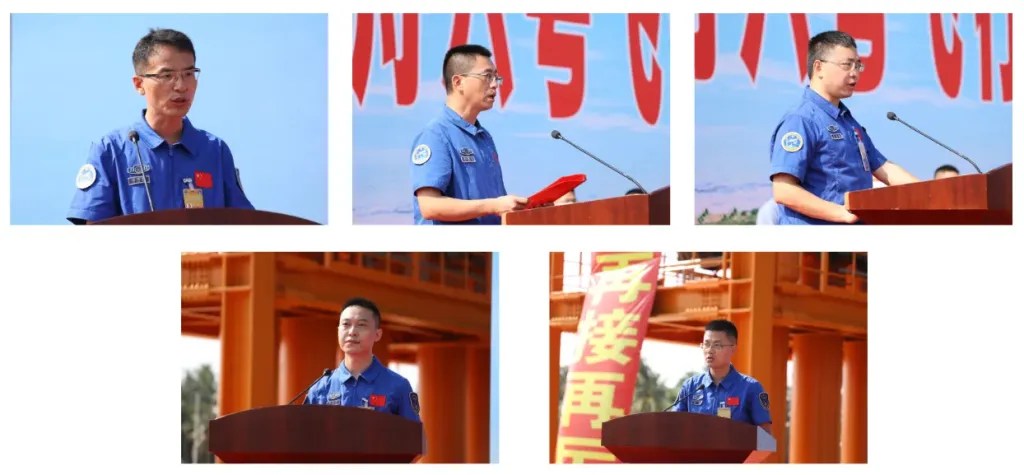
天舟六号 Tianzhou 6  On the morning of May 6th 2023, the Xichang Launch Center organized the scientific and technological personnel of the center, the Long March 7 Yao Seven launch vehicle test team and the 天舟6号 cargo spacecraft test team to hold the Tianzhou 6 flight mission decisive battle oath meeting , to encourage all aerospace workers to keep in mind the expectations and entrustments, to bear in mind the care and love, with the fullest political enthusiasm, the firmest will, and the most meticulous organization and implementation, to resolutely win the first victory in the application and development stage of the space station, and to make a new contribution to building a space power greater contribution.


The leaders of the cooperative units participating in the conference include Meng Gang, the commander-in-chief of the Long March 7 rocket of the First Aerospace Science and Technology Group, Cheng Tangming, the chief engineer of the model, Feng Yong, the chief commander of the Tianzhou Cargo Spaceship of the Fifth Academy, Li Zhihui, the deputy chief engineer of the model, and Li Zhihui, the deputy chief engineer of the Tianzhou No. 6 cargo ship of the Eighth Academy. Ding Tongcai, captain of the spacecraft test team, Chen Qizhong, deputy chief engineer of the model, Lu Congmin, deputy chief engineer of the space application system of the Chinese Academy of Sciences, and Yin Rui, deputy chief commander of the astronaut system of the Astronaut Center.

The conference kicked off with the majestic and passionate national anthem. After the “Tianzhou-6 Flight Mission Decisive Order”, the representatives of the participating units issued letters and expressed their determination in turn. The majestic power of “upstairs”.

In the process of mission preparation, the Wenchang launch site considers that this mission is the first mission in the application and development stage of the space station, and it is also the first mission of the improved Tianzhou cargo spacecraft. It is required to always adhere to the unified leadership of the party committee on space launch missions and comprehensively identify major technical status changes. , Test project optimization and other important and difficult issues, focus on strengthening the concept of quality of life, political quality, character quality and quality, and infuse the awareness of “manned spaceflight, human life is at stake” into every system and every post…

Images and visuals are from their Respectives CMS China Manned SpaceCNSA-China National Space Administration  

CNSA #ChinaNationalSpaceAdministration #國家航天局 |#BRI  #April2023 | #火星 # 天問 #天问一号#TianwenOne #MarsMission #Tianwen1 probe  #祝融号 #ZhuRong stunning Martian landscape new stunning photography during the year 2021   #AGallery

 天问一号飞運騎遊達达3亿CNSA – China National Space Administration – ESA – European Space agency Belt and road initiative mars mission…first Mars exploration mission, Tianwen- Martian Probe One As of September 15, 2022, the Tianwen-1 orbiter has been in orbit for more than 780 days, and the rover has travelled a total of 1,921 meters, completed the established scientific exploration tasks, and obtained 1,480 GB of original scientific exploration data. The scientific research team has obtained rich scientific results through the research on the first-hand scientific data obtained independently by my country. Through a comprehensive study of typical landforms such as concave cones, barrier craters, and trenches distributed in the landing area, the important connection between the formation of the above-mentioned landforms and water activities has been revealed.

Currently as to date of the Zhurong Mars Rover is currently at sleep safe mode due to the Martian Sandstorms….. the location of Zhurong taken by the Tianwen-1 orbiter after it hibernated in Zhurong last year. The rut marks left by Zhurong after traveling 1921 meters are clearly visible….. The local dust on Mars captured by the Tianwen-1 orbiter is very layered. This photo was taken by the medium-resolution camera of the Tianwen-1 orbiter on January 6, 2022, and Zhurong went into a dormant state more than three months after this time point. 

The Tianwen-1 mission was approved by the Party Central Committee in January 2016, and was successfully launched on July 23, 2020. After a deep space flight of 475 million kilometers for 202 days, the probe will rendezvous with Mars on February 10, 2021, and successfully implemented the capture and braking to enter the orbit around Mars. After 3 months of detailed inspection of the pre-selected landing area, the Mars landing was successfully carried out on May 15, 2021. On May 22, the “Zhurong” rover successfully landed on the surface of Mars and began to patrol and explore.

On August 15, 2021, the “Zhurong” rover successfully completed the 90 Martian scientific exploration missions, and continued to carry out extended exploration missions. It has traveled 1,921.5 meters on the surface of Mars. Affected by the severe winter cold and dusty weather in the landing area, the rover will enter the winter dormancy mode on May 18, 2022 as designed. Around December 2022, the “Zhurong” landing area will enter the early spring season. will resume normal work.

The orbiter has circled Mars 1,344 times, achieving global coverage and is currently in normal condition. In the follow-up, it will continue to carry out global remote sensing detection, and choose an opportunity to carry out expansion technology experiments to carry out preliminary technical verification for related tasks.

After nearly two years of flight and exploration for the Tianwen-1 mission, the 13 scientific payloads deployed by the rover and orbiter have obtained a total of about 1040GB of raw scientific data. After receiving and processing on the ground, the standard scientific data products formed are submitted to the rover on a monthly basis. A team of scientists has conducted analysis and interpretation, and relevant scientific results have been published in well-known academic journals at home and abroad. These scientific data will be open to scientists around the world at an appropriate time. Scientists around the world are welcome to actively apply for research and jointly promote the cause of human exploration of the universe.

At present, the Tianwen-1 orbiter continues to carry out scientific exploration in the orbit of the remote sensing mission, continues to accumulate first-hand scientific data, and makes China’s contribution to mankind’s in-depth understanding of Mars.
 ​​​​

Images and visuals are from their Respectives CNSA China National Space AdministrationCLEP China Lunar Exploration Program.

#CNSA #ChinaNationalSpaceAdministration #国家航天局 |#BRI #April2023 | #酒泉卫星发射中心 #JiuquanSatelliteLaunchCenter launched International Icon #ChangZheng4B  #LongMarch4B  Y51  #CarrierRocket successfully launch #Fengyun- 3G #MeteorologicalSatellite, #Satellites  a 100th Launch Center Milestone on 16th April 2023….

On the 16th April 2023 clear 0936 Hours Hong Kong SAR- Beijing time , the Belt and Road Initiative CNSA –China National Space Administration  launching from Jiuquan Satellite Launch Center – Inner Mongolia –China – People’s Republic of China deployed launched the Chang Zheng –   The Chang Zheng – Long March 4B Y51 carrier rocket.. This launch is the 471st launch of the Long March series of launch vehicles.

Successfully launched the Fengyun-3G satellite, and my country has entered a new stage of active precipitation measurement and detection..  At 9:36 Hong Kong SAR- Beijing Time  today, the Long March 4B Yao 51 carrier rocket was ignited and blasted off at the Jiuquan Satellite Launch Center, successfully carrying my country’s first The first precipitation measurement satellite Fengyun-3G was sent into the predetermined orbit, and the launch mission was a complete success…… 

Fengyun-3G satellite is China, People’s Republic of China first low-orbit non-sun-synchronous inclined orbit meteorological satellite, and it is also my country’s first and the third international active precipitation measurement satellite. The satellite is equipped with 4 units/sets of active precipitation measurement radar, microwave imager, medium-resolution spectral imager, and global navigation satellite occultation detector, which will fill the gap in domestic precipitation three-dimensional tomographic detection data. So far, my country has successfully launched a total of 20 “two-generation and four-type” Fengyun meteorological satellites.

Jiuquan Satellite Launch Center’s meritorious tower completed 100 launch missions] On April 16, the Long March 4B carrier rocket successfully sent Fengyun-307 into orbit at the Jiuquan Satellite Launch Center. After the mission was successful, the 100th new red star was engraved on the launch tower that sent the rocket into the sky, which marked the successful completion of the 100th launch mission of the 9401 launch tower. The 69401 launch tower started construction in 2001 and was completed and put into use in 2003. It is my country’s first launch tower with reinforced concrete as the main structure. , test room and other components.


The 9401 launch tower is currently in a “full load” operating state, and the number of launches has increased from a few times a year to more than ten times a year; the test launch process has changed from two months, one month, to half a month now; the post-launch recovery cycle has changed from 15 days compressed into just a few days. “The frequency of satellite launches has increased significantly, the test process has been continuously optimized, the efficiency of post-launch recovery has been continuously improved, the contribution rate to the frequency of mission launches has increased, and the cost-effectiveness and support capabilities of launch towers have been increasing….

The 9401 tower started construction in 2001 and was completed and put into service in 2003. It is the first launch tower with reinforced concrete as the main structure in my country. At present, 9401 is in the “full load” operation state, and the number of launches has increased from several times/year to more than 10 times/year; the test and launch process has changed from 2 months, 1 month, to half a month now; the post-launch recovery cycle has changed from 15 Compressed days into just a few days…. On November 3, 2003, the Long March 2D carrier rocket was successfully launched, starting the first launch mission of the satellite tower.

Images and visuals are from their Respectives CMS China Manned SpaceCNSA-China National Space Administration