#CNSA #ChinaNationalSpaceAdministration #国家航天局 |#BRI #March2023 #Apirl2023 |#天宫 #Tiangong #ChinaSpaceStation #CMS #ChinaMannedSpace #Shenzhou15 #Takionaut Crew complete it’s successfully third #Spacewalk #EVA from the #WentianModule… #Updated

On the week on the 30th  March 2023 CMS China Manned SpaceCNSA-China National Space Administration  the crew of the Shenzhou 15 of the Tiangong-China Space Station Takionauts carried out the third out-of-vehicle activity. With the close cooperation of the ground staff and the Takionaut Deng Qingming in the cabin, the two out-of-vehicle Takionauts Fei Junlong and Zhang Lu successfully completed all the scheduled tasks and returned safely to the Wentian experimental cabin.

From the China Manned Space Office, on March 30, 2023, Beijing time, the crew of Shenzhou 15 Takionauts performed the third out of the cabin activity. With the close cooperation of the ground staff and the astronaut Deng Qingming in the cabin, the two out-of-vehicle astronauts Fei Junlong and Zhang Lu successfully completed all the scheduled tasks and returned safely to the Wentian experimental cabin. Since the manned mission of Shenzhou 12 in 2021, four astronauts have carried out a total of 10 out-of-vehicle activities, making breakthroughs and mastering a series of key technologies. At present, out-of-vehicle activities have become a routine work for astronauts in orbit. The follow-up will continue to be carried out on a normal basis according to the needs of the task.
In addition, the Tianzhou-6 cargo spacecraft has safely arrived at the Wenchang Space Launch Site in the early stage, and the final assembly and testing work in the launch site area is being carried out as planned. It will be launched in early and mid-May…

Takionauts on-orbit work busy The three-chamber module combination of the Chinese space station not only means more space for the Takionauts, but also means more on-orbit work. The achievements of quasi-scientific experiments continue to flow, and extravehicular activities have become routine tasks for on-orbit astronauts. The current status of astronauts is just one word: “busy”

During this footage on the Tiangong TV Season four episode 20, containing the Taikonauts contains during the EVA it was over the Caspian Sea where the continental shelf is the coast of the Caspian Sea in Turkmenistan, and ….  The footage was taken by the Takionauts when they were crawling on the Wentian-Tianhe and the cabin connection device, except for most of the ocean on the ground, the overexposed clouds, there are also blue-green features that appear to be coastal continental shelves. In addition, another key piece of information is the shadow projected on the Tianhe-Shenzhou interface……

The Shenzhou 15 mission is the sixth mission of China’s manned space program in 2022, and it is also the last mission during the construction phase of China’s space station. The crew will work and live in orbit for 6 months. The main purpose of the mission is to verify The space station supports crew rotation capabilities, realizing the first on-orbit rotation of Takionaut crews; carrying out the installation and commissioning of equipment inside and outside the space station and space application mission-related facilities and equipment, conducting space science experiments and technical tests; performing daily maintenance and repair of the space station; The normalized operation mode of the cabin assembly… . The Shenzhou 15 flight crew consisted of Takionauts Fei Junlong , Deng Qingming and Zhang Lu , with Fei Junlong serving as the commander…

Images and visuals are from their Respectives CMS China Manned SpaceCNSA-China National Space Administration

#CNSA #ChinaNationalSpaceAdministration #国家航天局 |#BRI #March2023 |#天宫 #Tiangong #ChinaSpaceStation #CMS #ChinaMannedSpace #Shenzhou15 Crew Awesome the beautiful scenery Lightning and Thunder view of #EarthVideography #EarthViews week 24th March 2023 ……

On the week on the 24th March 2023 CMS China Manned SpaceCNSA-China National Space Administration  the crew of the Shenzhou 15 of the Tiangong-China Space Station… Super beautiful view of the Planet Earth ….!  First Angle of View from Tiangong High Resolution Cameras to see the earth seeing, the mountains and the sea with stunning Lightning and Thunder …….

Seeing, go across the mountains and the sea, to feel If you haven’t tried crossing the mountains and the sea, let the Chinese space station take you to see the mountains and seas in this world, I hope this The video overlooking the beautiful scenery of the earth can give you the courage and motivation to set out. The beautiful mountains and rivers are worthy of you and me to keep moving forward…… seeing the earth’s weather from the space station is myriad, from stratus clouds to lightning, from wind and rain to glow, these charming scenes remind us all the time, Cherish this beautiful planet Watching Earth’s Changes, Lightning and Thunder from China’s Space Station

.   

The Shenzhou 15 mission is the sixth mission of China’s manned space program in 2022, and it is also the last mission during the construction phase of China’s space station. The crew will work and live in orbit for 6 months. The main purpose of the mission is to verify The space station supports crew rotation capabilities, realizing the first on-orbit rotation of Takionaut crews; carrying out the installation and commissioning of equipment inside and outside the space station and space application mission-related facilities and equipment, conducting space science experiments and technical tests; performing daily maintenance and repair of the space station; The normalized operation mode of the cabin assembly… . The Shenzhou 15 flight crew consisted of Takionauts Fei Junlong , Deng Qingming and Zhang Lu , with Fei Junlong serving as the commander…

Images and visuals are from their Respectives CMS China Manned SpaceCNSA-China National Space Administration

#CNSA #ChinaNationalSpaceAdministration #国家航天局 |#BRI #March2023 |#天宫 #Tiangong #ChinaSpaceStation #CMS #ChinaMannedSpace #Shenzhou15 Crew Awesome the beautiful scenery view of #EarthVideography #EarthViews week 22nd March 2023 ……

On the week on the 22nd  March 2023 CMS China Manned SpaceCNSA-China National Space Administration  the crew of the Shenzhou 15 of the Tiangong-China Space Station… Super beautiful view of the Planet Earth ….!  First Angle of View from Tiangong porthole to see the earth seeing, the mountains and the sea …….

Seeing, go across the mountains and the sea, to feel If you haven’t tried crossing the mountains and the sea, let the Chinese space station take you to see the mountains and seas in this world, I hope this The video overlooking the beautiful scenery of the earth can give you the courage and motivation to set out. The beautiful mountains and rivers are worthy of you and me to keep moving forward……

Shenzhou-15 (English: Shenzhou-15… , also known as: Shenzhou XV – referred to as: Shenzhou-15) is the fifteenth spacecraft launched by China in the manned spaceflight project.   

The Shenzhou 15 mission is the sixth mission of China’s manned space program in 2022, and it is also the last mission during the construction phase of China’s space station. The crew will work and live in orbit for 6 months. The main purpose of the mission is to verify The space station supports crew rotation capabilities, realizing the first on-orbit rotation of Takionaut crews; carrying out the installation and commissioning of equipment inside and outside the space station and space application mission-related facilities and equipment, conducting space science experiments and technical tests; performing daily maintenance and repair of the space station; The normalized operation mode of the cabin assembly… . The Shenzhou 15 flight crew consisted of Takionauts Fei Junlong , Deng Qingming and Zhang Lu , with Fei Junlong serving as the commander…

Images and visuals are from their Respectives CMS China Manned SpaceCNSA-China National Space Administration

#CNSA #ChinaNationalSpaceAdministration #国家航天局 |#BRI  #March2023 |#西昌衛星發射中心 #XichangSatelliteLaunchCenter – Successfully launching the advance iconic #ChangZheng3B #LongMarch3B Y90  #CarrierRocket deploying advance Gaofen 13-02  #EarthSciences #RemoteSensing #EnivormentalSatellite  #Satellite The third launch within a week!

On the 17th March  2023  in  CNSA _China National Space Administration -China – People’s Republic of China At 1633 hours Hong Kong –Beijing Time China- People’s Republic of China launch the Chang Zheng – Long march 3B  Carrier Rocket launching from station form Xichang Satellite Launch Center Sichuan Province…..Deploying the Gaofen 13-02  Earth Sciences Environmental satellite….

Long March 3B successfully launched the Gaofen 13-02 satellite successfully launch the Gaofen 13-02 satellite into space, and the satellite went smoothly Entering the predetermined orbit, the launch mission was a complete success. The satellite is mainly used in the fields of land census, crop yield estimation, environmental governance, weather early warning and forecasting, and comprehensive disaster prevention and mitigation. This mission is the 468th flight of the Long March series of launch vehicles!

The 02 satellite is a high-orbit optical remote sensing satellite, which is mainly used in emergency disaster reduction, land census, ocean observation, environmental governance, meteorological observation and other fields, and can provide information services for national economic construction.

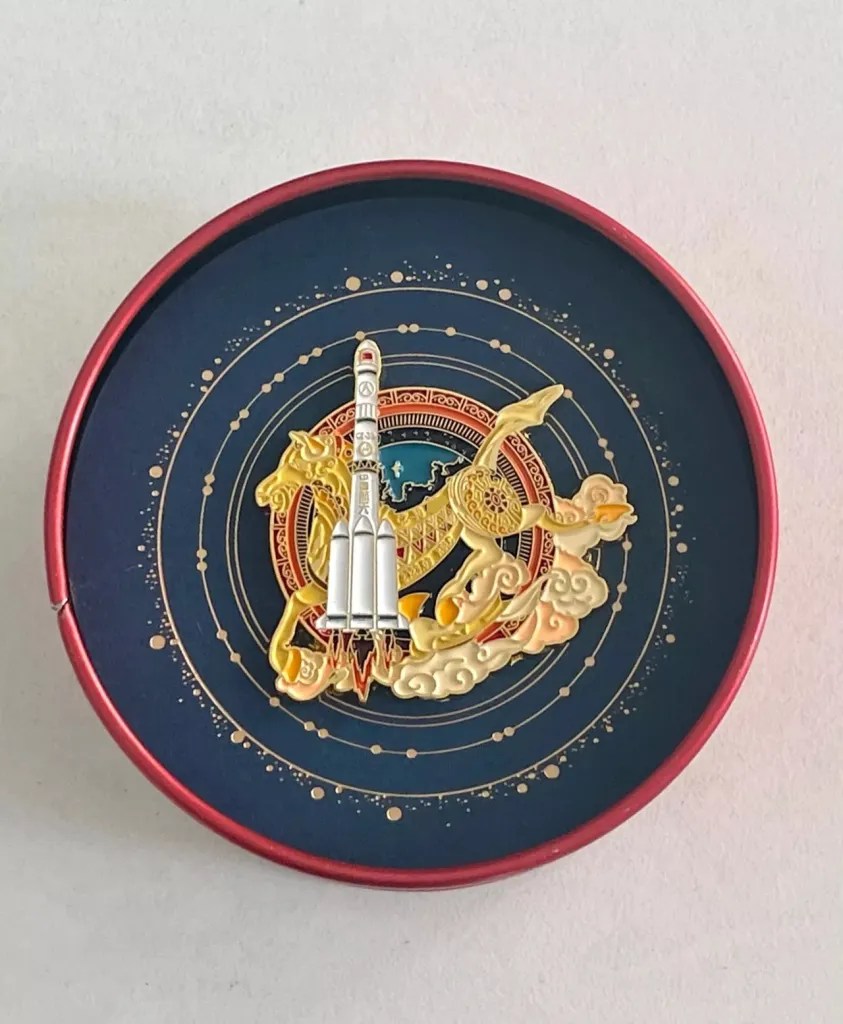
Chang Zheng – Long march 3B  Carrier Rocket yao 90 launches high score 13th No. 02 satellite mission badge: This badge is inspired by the historical allusion of a horse stepping on a flying swallow. Ma Ta Feiyan is a magical and rare treasure in the history of ancient sculpture art in my country. It is a landmark building in Xichang. As an emblem element, it implies the rapid development of China’s aerospace industry and the tenacious and indomitable spirit of astronauts.
The main body of the emblem is the Chang Zheng – Long march rocket, the earth is in the center of the picture, auspicious clouds surround the main body, and the stars mark the launch site, which means that one arrow and one star will be launched from here, and go forward bravely, just like astronauts bravely climbing the peak of science and technology, to write China’s aerospace industry The new chapter dares to overcome all difficulties and obstacles…..

Images and visuals are from their Respectives CMS China Manned SpaceCNSA-China National Space Administration

#CNSA #ChinaNationalSpaceAdministration #國家航天局|#BRI #March2023 |#ChineseAcademyofSciences #NationalAstronomicalObservatory #EinsteinProbe X-ray astronomical #Satellite – pinpoint the source of gravitational waves discovering the mysterious universe planned launch this year.  

國家航天局CNSA –China National Space Administration  China, People’s Republic of China plans to launch the Einstein probe at the end of this year China plans to launch a new X-ray astronomical satellite, the Einstein probe, at the end of 2023. It is expected to capture the first ray of light from a supernova explosion and help search and precise positioning the source of gravitational waves, discovering more distant, fainter celestial objects and fleeting mysterious phenomena in the universe. The satellite project has entered the final stage of positive development.

The X-ray Imaging Laboratory of the National Astronomical Observatory of the Chinese Academy of Sciences has been developing lobster eye X-ray imaging technology since 2010. After years of key technology research, it finally made a breakthrough, fully mastered the technology, and has completely independent intellectual property rights. The team carried out the test and verification of this technology on the space new technology test satellite launched in July 2022, and obtained and publicly released the wide-field X-ray focused imaging sky map for the first time in the world.

Yuan Weimin, the chief scientist of the Einstein Probe Satellite and a researcher at the National Astronomical Observatories of the Chinese Academy of Sciences, introduced at the recently held 35th National Space Exploration Symposium that the satellite project has entered the final development stage.

Inspired by the peculiar focusing imaging principle of lobster eyes, scientists have designed a special new type of X-ray telescope, which has a large observation field of view and higher detection sensitivity.

“That is to say, this kind of telescope can see the darker and farther universe while seeing a wide range. It is thanks to the lobster eye telescope technology that the Einstein Probe satellite can see the currently known universe.” There are very few soft X-ray bands for large-field, high-sensitivity, and fast time-domain survey monitoring.” Yuan Weimin said.

The X-ray Imaging Laboratory of the National Astronomical Observatory of the Chinese Academy of Sciences has been developing lobster eye X-ray imaging technology since 2010. After years of key technology research, it finally made a breakthrough, fully mastered the technology, and has completely independent intellectual property rights. The team carried out the test and verification of this technology on the space new technology test satellite launched in July 2022, and obtained and publicly released the wide-field X-ray focused imaging sky map for the first time in the world

Images and visuals are from their Respectives CMS China Manned SpaceCNSA-China National Space Administration