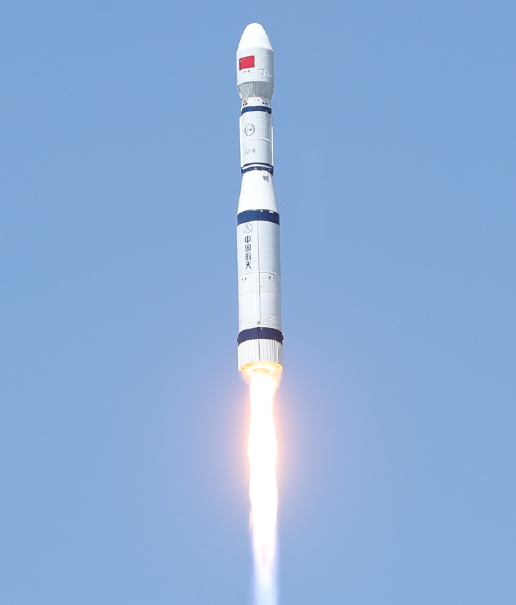
#CNSA #ChinaNationalSpaceAdministration #国家航天局 | #BRI #June2023|#太原卫星发射中心  #TaiyuanSatelliteLaunchCenter  – International Iconic #ChangZheng6 #LongMarch6  yao 12 #CarrierRocket in launched to deploy #TestSatellite #Shiyan Number 25  Satellite  into orbit carry out new earth observation technology experiments #AGallery ..

At 1118 Hours Hong Kong SAR- Beijing Time  20th June 2023 , China- People’s Republic of China- CNSA –China National Space Administration   Successfully launched  the New Next Generation Long March – Chang Zheng 6 Y12 carrier rocket at the Taiyuan Satellite Launch Center Shanxi Province..  the Long March 6 carrier rocket carrying the test 25th satellite ignited and took off at the Taiyuan Satellite Launch Center, and then successfully put the satellite into the predetermined orbit, and the launch was a complete success.

The Long March-6 launch vehicle is a low-temperature liquid three-stage launch vehicle developed by the General Manager of the Eighth Academy of China Aerospace Science and Technology Corporation. Its sun-synchronous circular orbit has a carrying capacity of up to 1.0 tons (orbital height 700 kilometers). In this mission, the rocket test team carried out work in three aspects: optimizing the process, improving reliability and enhancing mission adaptability in response to satellite requirements, to improve the quality and efficiency of rocket launches. The test satellite No. 25 was developed by Aerospace Dongfanghong Satellite Co., Ltd. of the Fifth Academy of Aerospace Science and Technology Group, and is mainly used to carry out new-type earth observation technology experiments. This launch is the 11th launch of the Long March-6 carrier rocket and the 477th launch of the Long March series of carrier rockets

Long March 6 Yao 12 arrow adopts a new inverted cone-shaped frame-type satellite support…… The Long March 6 launch vehicle for this mission was developed by the Eighth Academy of China Aerospace Science and Technology Corporation, and it adopts the Sanping test launch mode A new generation of liquid oxygen kerosene launch vehicle. In this mission, the rocket test team carried out work in three aspects: optimizing the process, improving reliability and enhancing mission adaptability in response to satellite requirements, to improve the quality and efficiency of rocket launches.


Following the launch of the mission, the model team sorted out a total of 36 improvement items, covering operational reliability and test coverage, which further improved the robustness and reliability of the rocket.

“The satellites launched this time are highly compatible with our Long March 6 rocket,” said Yu Yansheng, the overall chief designer of the Eight, Chang Zheng –Long March 6 test team. From the perspective of load weight, there are several types of rockets on the market that can perform this mission, but after an in-depth analysis of the satellite’s shape design and mission requirements, only the fairing envelope and carrying capacity of the Long March 6 are most suitable for the mission.

In view of the overall configuration of the mission satellite with a large aspect ratio, an inverted cone-shaped frame-type satellite support was designed for the model, and it is equipped with a 2.9-meter-diameter satellite fairing to adapt to the layout and interface of the satellite in the fairing. Requirements, provide effective “lifting + support” for satellites. In addition, the foam spraying technology is used on the outside of the satellite fairing to realize the insulation measures of the fairing without operation at the launch site and before launch.

At the same time, in terms of the separation method of the satellite, Chang Zheng –Long March 6 Y12 adopted a point-type connection and separation device composed of four components for the first time, which has the characteristics of light weight and intensive functions of Improved separation reliability.

In view of the fact that there are many satellite operation items after the rocket is transferred to the launch area, the design and operation personnel of the two sides of the model organization, the Star and Rocket, carried out special exchanges to confirm the timing, process, tools, precautions, etc. of the operation one by one; at the same time, arrange Specialized operation drills optimize the operation process to ensure that the time is controllable, safe and smooth in actual operation.

The Taiyuan Satellite Launch Center in June coincided with the season with more thunderstorms, and the model carried out re-identification, re-analysis, and re-confirmation of summer launch risks at the launch site. According to the characteristics of the Long March 6 carrier rocket’s “three-level” test launch mode and unsupported launch, a special review of rain and lightning protection was carried out, including the effectiveness of rain and lightning protection measures, the actual implementation of various measures, and the dismantling and rain protection before launch. Timing, etc., form a tabular inspection and confirmation document to ensure that the rocket meets the pre-launch operation and launch requirements during the thunderstorm season.

Images and visuals are from their Respectives CMS China Manned SpaceCNSA-China National Space Administration

#CNSA #ChinaNationalSpaceAdministration #国家航天局 |#BRI #June2023 | #天宫#Tiangong #ChinaSpaceStation #CMS #ChinaMannedSpace #神舟十六号 #Shenzhou16 –  China  Space Station awesome stunning Earth view with Tiangong’s Tianzhou advance Robotic arm..

On the 30th  May 2023 clear 0931 Hours Morning Hong Kong SAR- Beijing time , the Belt and Road Initiative CNSA –China National Space Administration  from Jiuquan Satellite Launch Center – Inner Mongolia –China – People’s Republic of China deployment of  the Chang Zheng –   The Chang Zheng – Long March 2F Yao 16 –Shenzhou 16  carrier rocket.. On which Takionauts Jing Haipeng, Zhu Yangzhu, and Gui Haichao took to the predetermined orbit. The first manned flight mission in the application and development stage was a complete success. The three astronauts will stay in the space station and “join up” with the crew of Shenzhou 15 to carry out on-orbit handover “face-to-face” meeting in which brings the total crew of six with a handover ceremony  from Shenzhou 15 towards 16..

On the week of 19th June 2023 There is a new perspective to opening view the of the planet earth  with  the elements …….  ​Let you see the rare picture of the experimental cabin, Shenzhou 16 space Craft , the Advance Cargo Spacecraft Tianzhou, robotic arm and the earth in the same frame at one time. Rotate 90° counterclockwise, the rotational transition effect is better!

Images and visuals are from their Respectives CMS China Manned SpaceCNSA-China National Space Administration

#CNSA #ChinaNationalSpaceAdministration #国家航天局 | #BRI #June2023|#太原卫星发射中心  #TaiyuanSatelliteLaunchCenter  – International Iconic #ChangZheng2D #LongMarch2D  #CarrierRocket in launch readiness to deploy #Gaofen #Jilin  series  41 Satellites into orbit..

At  15th June 2023 , China- People’s Republic of China- CNSA –China National Space Administration   Successfully launched  the New Next Generation Long March – Chang Zheng2D carrier rocket at the Taiyuan Satellite Launch Center Shanxi Province..  Is set to launch 41- forty one Satellites in which the Chang Zheng – Long March 2D Carrier Rocket is in preparing readiness to launch in which dates back to On May 22, a total of 41 satellites set off in the Changchun Aerospace Information Industry Park, among them, “Jilin No. 1” Gaofen 03D19-26 satellites, Gaofen 06A series satellites, platform 02A01-02 The 36 satellites including Si-1 are the “Jilin-1” satellites.

The Chang Zheng -Long March 2D “One Carrier Rocket  41 Satellites” will be launched on the next day on expected on 16th June 2023 …. The latest batch of Jilin-1 satellites launched in the form of “One Carrier Rocket  41 Satellites” involves 3 large software systems and 4 satellite models, 41 satellites, and 50 sets of antenna equipment.

At present, the launch of “One Carrier Rocket 41 Satellites” has officially entered the countdown! It is planned to be launched from the Taiyuan Satellite Launch Center in the near future. This will create the record for the largest number of satellites launched in a single spaceflight in China..

[The countdown to launch has entered! Uncover how “one Carrier Rocket  41 satellites ” is achieved? 】

How did “41 satellites  with one Carrier Rocket” come true this time? What’s the point? Li Feng, director of the satellite operation and management technology research office of Chang Guang Satellite Technology Co., Ltd., gave the answer in an exclusive interview with China Jilin Net!


“The launch of ‘One Carrier Rocket  41 Satellites’ poses a huge challenge to the transportation and management system. In the past, a maximum of 16 satellites were launched at one time, but this time the number has reached nearly three times that of the maximum one, and it involves multiple satellite models. For measurement and control , data transmission resources, software system development, and personnel requirements are all higher. In order to do a good job in the operation and management of 41 satellites, the colleagues in the Satellite Operation and Management Technology Research Office started the preparation work at the end of last year, and the internal and external coordination of the company , docking, and recently successfully completed the system development and the joint test of the three-wheel operation and management system, involving 3 large software systems, 4 satellite models, 41 satellites, and 50 sets of antenna equipment, and confirmed the functions, performance and interfaces of each system Matching situation. The 41 satellites launched this time include 8 Jilin-1 Gaofen 03D satellites and 30 Gaofen 06A series satellites. Among them, the weight of the Gaofen 06A single satellite has been successfully reduced to 20kg, and its performance indicators are still very advanced.


Li Feng said, “During the satellite-rocket separation stage, the 41 satellites were separated seven times successively. The separation time of each group of satellites lasted for three to five seconds. . This launch has put forward higher requirements for both satellites and rockets, including separation timing and control of satellite force and torque, so as to ensure that each satellite can enter the predetermined orbit smoothly and safely. “


After the 41 satellites launched this time (including 36 “Jilin-1” satellite constellation networking remote sensing satellites) are in orbit, they will form a network with the 72 “Jilin-1” satellites in orbit. So far, “Jilin-1” “The number of satellites in orbit has increased to 108, marking that the “Jilin-1” satellite constellation network project has successfully achieved the phased goal of “Hundred Stars Flying into the Sky”

Images and visuals are from their Respectives CMS China Manned SpaceCNSA-China National Space Administration

#CNSA #ChinaNationalSpaceAdministration #国家航天局 |#BRI #May2023 #CMS #ChinaMannedSpace #Shenzhou10 #Shenzhou13 #Takionaut #王亞平 #WangYaping Household congratulation as the most beautiful family in 2023 ….

CNSA China National Space Admistraton –CMS China Manned Space Shenzhou ten and thirteen Senior Colonel Takionaut王亞平Wang Yaping family household is to be congratulate! In which Wang Yaping’s family was named “Shining Name – The Most Beautiful Family in 2023”! May 15th is International Family Day, and just last night, “Shining Names – 2023 Most Beautiful Family Release Ceremony” was broadcast on CCTV. In the release ceremony last night, a total of 10 outstanding representatives of the most beautiful families came to the scene; among them was the Wang Yaping family that we are most familiar with. 王亚平家庭was rated as the most beautiful family in 2023 on national Television on CCTV Science and Education Channel . … the behind the scenes shows her  family life with her lovely daughter and her husband with their parents as equal to her Takionaut Space Career..

Images and visuals are from their respectives- CNSA –China National Space Administration respectives

CNSA #ChinaNationalSpaceAdministration #國家航天局 |#BRI  #May2023 | #火星 # 天問 #天问一号#TianwenOne #MarsMission #Tianwen1 probe  #祝融号stunning Martian landscape new stunning Mars Orbital  Selected photography during the year 2023 #AGallery

 天问一号飞運騎遊達达3亿CNSA – China National Space Administration – ESA – European Space agency Belt and road initiative mars mission…first Mars exploration mission, Tianwen- Martian Probe One As of September 15, 2022, the Tianwen-1 orbiter has been in orbit for more than 780 days, and the rover has travelled a total of 1,921 meters, completed the established scientific exploration tasks, and obtained 1,480 GB of original scientific exploration data. The scientific research team has obtained rich scientific results through the research on the first-hand scientific data obtained independently by my country. Through a comprehensive study of typical landforms such as concave cones, barrier craters, and trenches distributed in the landing area, the important connection between the formation of the above-mentioned landforms and water activities has been revealed.

Currently as to date of the Zhurong Mars Rover is currently at sleep safe mode due to the Martian Sandstorms….. the location of Zhurong taken by the Tianwen-1 orbiter after it hibernated in Zhurong last year. The rut marks left by Zhurong after traveling 1921 meters are clearly visible….. The local dust on Mars captured by the Tianwen-1 orbiter is very layered. This photo was taken by the medium-resolution camera of the Tianwen-1 orbiter on January 6, 2022, and Zhurong went into a dormant state more than three months after this time point. 

On the week of 10th May 2023 there have been new images release of the CNSA –CLEP Mars The Lunar and Planetary Data Publishing System released a new batch of Tianwen-1 data today, including a large number of Martian surface photos taken by the obiter’s medium-resolution camera! The total number is estimated to be hundreds to thousands!  But here are some stunning incredible randomly selected a few pictures is beautiful!

Currently as to date of the Zhurong Mars Rover is currently at sleep safe mode due to the Martian Sandstorms….. the location of Zhurong taken by the Tianwen-1 orbiter after it hibernated in Zhurong last year. The rut marks left by Zhurong after traveling 1921 meters are clearly visible….. The local dust on Mars captured by the Tianwen-1 orbiter is very layered. This photo was taken by the medium-resolution camera of the Tianwen-1 orbiter on January 6, 2022, and Zhurong went into a dormant state more than three months after this time point. 

The Tianwen-1 mission was approved by the Party Central Committee in January 2016, and was successfully launched on July 23, 2020. After a deep space flight of 475 million kilometers for 202 days, the probe will rendezvous with Mars on February 10, 2021, and successfully implemented the capture and braking to enter the orbit around Mars. After 3 months of detailed inspection of the pre-selected landing area, the Mars landing was successfully carried out on May 15, 2021. On May 22, the “Zhurong” rover successfully landed on the surface of Mars and began to patrol and explore.

On August 15, 2021, the “Zhurong” rover successfully completed the 90 Martian scientific exploration missions, and continued to carry out extended exploration missions. It has traveled 1,921.5 meters on the surface of Mars. Affected by the severe winter cold and dusty weather in the landing area, the rover will enter the winter dormancy mode on May 18, 2022 as designed. Around December 2022, the “Zhurong” landing area will enter the early spring season. will resume normal work.

The orbiter has circled Mars 1,344 times, achieving global coverage and is currently in normal condition. In the follow-up, it will continue to carry out global remote sensing detection, and choose an opportunity to carry out expansion technology experiments to carry out preliminary technical verification for related tasks.

After nearly two years of flight and exploration for the Tianwen-1 mission, the 13 scientific payloads deployed by the rover and orbiter have obtained a total of about 1040GB of raw scientific data. After receiving and processing on the ground, the standard scientific data products formed are submitted to the rover on a monthly basis. A team of scientists has conducted analysis and interpretation, and relevant scientific results have been published in well-known academic journals at home and abroad. These scientific data will be open to scientists around the world at an appropriate time. Scientists around the world are welcome to actively apply for research and jointly promote the cause of human exploration of the universe.

At present, the Tianwen-1 orbiter continues to carry out scientific exploration in the orbit of the remote sensing mission, continues to accumulate first-hand scientific data, and makes China’s contribution to mankind’s in-depth understanding of Mars.
 ​​​​

Images and visuals are from CNSA China National Space Administration – CLEP China Lunar Exploration Program.