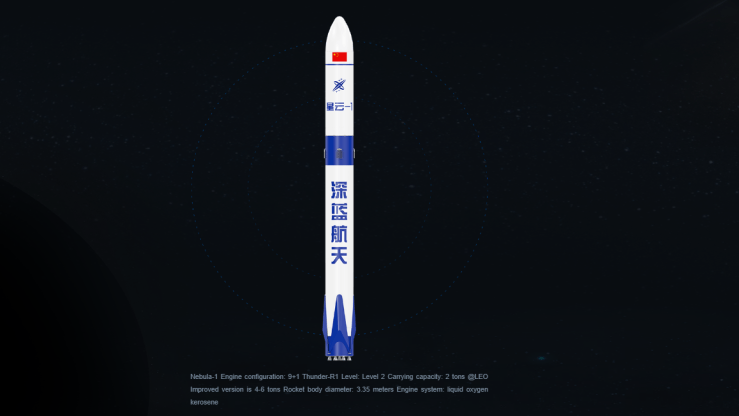
深蓝航天 Deep Blue Limited – Deep Blue Aerospace Landspace One of sixty Chinese private space Carrier Rocket Companies in China-People’s Republic of China… As many of sixty plus Private Rocket Deep Blue Aerospace Co., Ltd. was established in 2017. The company is mainly a high-tech aerospace enterprise that focuses on the direction of liquid recovery and reusable launch vehicles and provides users with commercial launch services. Deep Blue Aerospace Co., Ltd. is headquartered in Nantong City, Jiangsu Province. At the same time, the company has rocket general and liquid engine R&D centers in Yizhuang, Beijing and Xi’an, Shaanxi, respectively, and a rocket power system test base in Tongchuan, Shaanxi…..

At 12:00 on September 11, 2024 Beijing Time Jiuquan Satellite launch Center, Inner Mongolia, China, People’s Republic of China , the Suzaku-3 VTVL-1 reusable vertical take-off and landing recovery test rocket independently developed by Blue Arrow Space Technology Co., Ltd. successfully completed a ten-kilometer-level vertical take-off and landing return flight test at the Blue Arrow liquid oxygen and methane rocket launch station at the Jiuquan Satellite Launch Center in China .This mission is the first time in China to achieve secondary ignition of a vertical take-off and landing return rocket in the air, joint guidance and control of the “grid rudder-cold air attitude control-engine” in a transonic high dynamic pressure environment, and engineering application of real-time wind repair technology for high-altitude winds. It marks a major breakthrough in China’s commercial aerospace industry in reusable launch vehicle technology, and is a crucial step towards the realization of large-capacity, low-cost, high-frequency, reusable space launches in the future!
In this test, the total air flight time of the Suzaku-3 VTVL-1 test rocket was 200.7s, and it went through the process of “ascent – engine shutdown – unpowered gliding – engine secondary start in the air – soft landing”. Among them, the engine was shut down for the first time about 113 seconds after takeoff. After shutdown, the rocket continued to rely on inertia to fly to the highest point of 10002m above the ground. In order to offset the high-altitude crosswind interference of 36m/s, the rocket relied on high-altitude wind correction, grid rudder and cold air attitude control to stabilize the flight attitude; after about 40s of unpowered gliding, when the rocket altitude dropped to 4.64km and the speed reached 0.8Ma, the engine was ignited again in the air at 100% working conditions, and the rocket entered the landing deceleration section, and through the online guidance control algorithm, the engine thrust and flight state were adjusted to guide the rocket body to achieve a soft landing on the recovery field about 3.2km away from the launch station; the center of the landing position was 1.7m away from the center of the recovery field, the landing vertical speed was -1.65m/s, and the landing attitude angle deviation was 0.3°. All indicators met the expected design and reached the domestic leading level.

This mission is an advanced verification of various key technologies for vertical take-off, landing and recovery of large liquid oxygen-methane reusable rockets, following the successful execution of the 100-meter-class flight test mission in January 2024. The test rocket is a single-stage liquid oxygen-methane rocket with a body diameter of 3.35m, a length of 18.3m, a take-off mass of approximately 68t, a take-off thrust of 800 kilonewtons, and is equipped with 3 sets of landing cushion legs and a new 4-piece grid rudder system. It uses a high-strength stainless steel body structure consistent with the Suzaku-3 rocket; it is equipped with an 80-ton Tianque-12 (TQ-12) improved liquid oxygen-methane engine of the same type as the Suzaku-3 rocket, which has achieved continuous orbital flight verification, and has orthogonal double pendulum, 45%~111% variable thrust adjustment and multiple ignition capabilities. The verification results achieved in this mission are as follows:

The Suzaku-3 VTVL-1 test rocket is an engineering prototype built with a full-size engine, and is an important part of the development of the Blue Arrow Aerospace reusable rocket project. This test strictly followed the company’s quality management system and test safety management requirements , carried out comprehensive risk identification and control , organized special review and recalculation and process review , and formulated and improved mission operating procedures and emergency response plans to ensure the success of the test. Through two vertical take-off and landing recovery tests, the model team successfully verified a number of key technologies for reusable rockets, laying a solid foundation for the future first flight and recovery of the Suzaku-3.

Since October 2022, Blue Arrow Aerospace has been fully committed to promoting the demonstration and development of large liquid oxygen and methane reusable rockets, and has clarified the development route of the next-generation reusable rocket Suzaku-3. At the beginning of this year, Suzaku-3 has completed the transition from the scheme stage to the prototype stage, and has fully carried out the development of various system products in the prototype stage. It is planned to carry out its first flight in 2025 and realize the recovery and reuse of the first stage in 2026, striving to help China’s commercial aerospace achieve a fundamental breakthrough in large-capacity, low-cost, and reusable launch vehicle technology in the next three years!

There are ways to pursue dreams, and Suzaku will fly again. Landspace will continue to focus on core technology research and substantial capacity improvement, build advanced rocket manufacturing systems, and ensure the efficient independent research and development and batch production capabilities of the “Suzaku” series rockets and “Tianque” series engine products , injecting strong momentum into the rapid progress of China’s aerospace technology, stimulating new quality productivity, and leading the vigorous development of future industries !

We would like to thank the Jiuquan Satellite Launch Center of China for its strong guidance and assistance to Blue Arrow Aerospace!
We would like to thank Beijing City, Beijing Economic and Technological Development Zone, Shanghai City, Zhejiang Province, Jiaxing City, Huzhou City and other party and government agencies and departments at all levels for their deep support and care for Blue Arrow Aerospace!


Thank you satellite customers for your firm trust and valuable support to Landspace!
We would like to thank all shareholders for their strong support and for working side by side with Blue Arrow Aerospace to achieve great success!
We would like to thank our partner China Merchants Bank for its sincere trust in Landspace!
We would like to thank all media platforms for their continued attention and coverage, and for supporting Blue Arrow Aerospace’s mission!
Thank you to every Blue Arrow employee, and salute every bit of effort and sweat you have put into Blue Arrow! Deeply thank all Blue Arrow family members for their silent dedication and tolerance and understanding!
Thank you to all the friends who pay attention to and support China’s space industry. Your enthusiasm and expectations are the driving force for us to keep moving forward!
Zhuque-3 (model code: ZQ-3) is the next-generation reusable liquid oxygen-methane carrier rocket of Landspace, China’s first stainless steel liquid carrier rocket, with a body diameter of 4.5m, a fairing diameter of 5.2m, a total length of 76.6m, a takeoff mass of approximately 660t, and a takeoff thrust of approximately 900t. The power system uses the Tianque series liquid oxygen-methane engine independently developed by Landspace.
The first stage of ZQ-3 is designed to be reused no less than 20 times. Its low-orbit carrying capacity for a one-time use mission can reach 21.3 tons, and its area recovery mission is 18.3 tons. It can strongly support the high-density launch of my country’s satellite Internet network, the GTO orbit launch of large communication satellites, and the launch of various types of spacecraft, and comprehensively promote China’s commercial space industry to enter the era of high-capacity, repeatable and low-cost satellite Internet!
Images and visuals are from their Respectives.