On the October 9th 2022 Early Morning clear 0743 morning Hours Hong Kong SAR- Beijing time , the Belt and Road InitiativeCNSA –China National Space Administration launching from Jiuquan Satellite Launch Center – Inner Mongolia –China – People’s Republic of China, Readiness rolled out deployed the Chang Zheng – Long March 2D carrier rocket planned orbit from Jiuquan successfully launched the advanced space-based solar observatory “Kwafu-1” from the successfully launched at station 94 of the Jiuquan Satellite Launch Center.. . The Advanced Space-Based Solar Observatory (Kwafu-1/ASO-S) satellite was sent into the scheduled sun-synchronous orbit, and the launch mission was a complete success!
The release of the first batch of scientific images of “Kuafu-1” achieved a number of firsts at home and abroad] On December 13, the National Space Science Center of the Chinese Academy of Sciences announced the first batch of scientific images of China- People’s Republic of China comprehensive solar exploration satellite “Kuafu-1”. These images are a number of scientific observation images of the sun obtained by the “Kuafu-1” since the successful launch of the “Kuafu-1” on October 9, 2022, during the two-month operation of the three payloads in orbit, achieving a number of domestic and foreign firsts, The observation capabilities and advanced nature of the three payloads of “Kuafu-1” were verified in orbit.
During the two months in orbit, “Kuafu-1” carried out a large number of on-orbit tests and observations of the sun according to the established plan. Among the three payloads, the full-sun surface vector magnetic imager realized the first time in my country to carry out the solar magnetic field in space. The quality of the obtained partial longitudinal magnetic map of the sun has reached the international advanced level, laying a good foundation for focusing on the scientific goal of “one magnetic storm and two storms” and realizing high-time resolution and high-precision solar magnetic field observation.
The Advanced Space-Based Solar Observatory (ASO-S) satellite was developed by the Institute of Microsatellite Innovation, Chinese Academy of Sciences. , which also provides support for severe space weather forecasting also the advanced space-based solar observatory satellite, the launch mission was a complete success. The satellite is mainly used for research on the causal relationship between solar flares and coronal mass ejections and the solar magnetic field, and provides data support for space weather forecasting…..
Figure 1. The comparison of the local monochromatic image and magnetic image (right) observed by FMG on orbit with the observation result (left) of the same solar surface area at the same time by the Huairou ground-based all-solar magnetic field telescope
Figure 2. The comparison between the local longitudinal magnetogram (right) observed by FMG at 00:50:15UT on November 6, 2022, and the US HMI/SDO observations (left) at the same time
Figure 3. Comparison of the hard X-ray image of a C-class flare observed by HXI on November 11, 2022 on “Double 11” and the AIA/SDO UV 1700 image
Fig. 4. Combination of light variation, hard X-ray imaging and EUV/UV images of the “Double 11” series of flares observed by HXI on November 11
On the 7th December 2022 at 2115 Beijing time on Jiangxi Satellite Television, broadcast a live event on paying tributes to CNSA _CMS China National Space Administration- China Manned Space also the staff whom Heroic worked for the China’s Space Program.. in which Actor, International Magnolia, Golden Eagle Award, Huading Awarding Actress .. International Chinese Awarding Actress 陈数 Chen Shu Tributes to Chinese Takionauts …….
On the 4th December 2022 1101 Hours Hong Kong SAR- Beijing Time CNSA –China National Space Administration, the Crew of Shenzhou 14 manned spacecraft and the Tiangong – China space station assembly were successfully separated…….
separation, the Takionaut crew of Shenzhou 14, with the cooperation of ground science and technology personnel, completed the on-orbit rotation with the crew of Shenzhou 15, the status setting of the space station assembly, and the arrangement of experimental data All the work before the evacuation, such as downlink, cleaning and transshipment of materials left in orbit, waved goodbye to the Takionaut of Shenzhou 15. In the follow-up, the return module of the Shenzhou 14 manned spacecraft will choose an opportunity to re-enter and return under the control of the ground command. Astronauts Chen Dong, Liu Yang, and Cai Xuzhe, who have been on a mission trip for 183 days at the Chinese space station, are about to embark on a journey home back to the Motherland China, People’s Republic of China.
At present for just in case , the Shenzhou 16 spacecraft has been assembled and tested, and is on standby at the Jiuquan Satellite Launch Center as an emergency rescue ship; the Shenzhou 17, Shenzhou 18, and Shenzhou 19 spacecraft are under rolling development. A new batch of 6 spacecraft headed by the Shenzhou 16 spacecraft will appear on the space stage with a brand-new attitude in the near future.
On the wintery night time 4th December 2022 2000 Hours Hong Kong SAR- Beijing Time CNSA –China National Space Administration, the Shenzhou 14 crew have finally landed on Dongfeng, Dongfeng Aerospace City in which on inner Mongolia, China, People Republic of China…
Successful landing! At 20:09 on December 4, 2022, Beijing time, the return capsule of the Shenzhou 14 manned spacecraft landed successfully at the Dongfeng Landing Field. The crew members Chen Dong, Liu Yang, and Cai Xuzhe are in good health, and the manned flight mission of Shenzhou 14 was a complete success. At 19:20, the Beijing Aerospace Flight Control Center issued a return command through the ground measurement and control
Back at home feeling good! Safe Return Healthy Exit Takionauts Chen Dong, Liu Yang, and Cai Xuzhe of Shenzhou 14 have all returned safely and exited the cabin in good health, and are undergoing gravity re-adaptation.
On the evening of December 4th, Shenzhou 14 returned triumphantly. Liu Yang smiled and waved after leaving the cabin. The smile was very sweet. I was deeply impressed by the sentence “I can’t forget the China Space Station – Tiangong palace in the sky, but I miss my homeland even more”. This time, I am very happy to participate as a speaker in the recording of 火火的系统 Youth Season, telling the story of my country’s first female Takionaut Liu Yang’s “Chasing the Dream Sky”, and paying tribute to China’s aerospace industry and the most beautiful Takionauts!
From youth to twilight years, Chinese Takionauts pursued the moon and stars, used technology to create miracles, and used their youth to realize the Chinese dream of flying into the sky. Salute to Chinese Takionauts!
I am very happy to tell the story of the aerospace hero Liu Yang in the youth season of 火牙的系统. She challenged space twice and dedicated her youth to the motherland. Today, she finally successfully returned to Earth; more romantically, Pay tribute to the hero Liu Yang! Welcome home!
The special “task” of the astronaut mother is to fold stars in space. Dedicate your youth to the vast universe, and write your concern for children into the sky full of stars. Today, the astronaut #刘洋 is back with more than 180 days in space! 火火的解决 Youth season pays tribute to the aerospace hero Liu Yang! Let’s take a look at the story on the stars….
She left a “will” for her husband, she wrote her mother’s love into the stars, and gave her all, only for the development and prosperity of the aerospace industry of the motherland! 陈数 Passionately tells the touching story of astronaut Liu Yang. Tonight at 9:15, 火火的系统 Youth season pays tribute to astronaut Liu Yang’s perseverance in chasing the dream sky!
陈数 Chen Shu is an International Awarding Mainland Chinese Actress formerly known as Chen Shu , was born on March 9, 1977 in Huangshi Port District, Huangshi City, Hubei Province. She is an actress from Mainland China and graduated from the Central Academy of Drama .
In 2001, starred in the personal first TV series “Traveler’s Story “. In 2003, starring in the criminal investigation drama ” Clang Rose “. In 2005, won the “Top Ten Classic TV Drama Characters Award” in the past 30 years of reform and opening up by virtue of the spy war drama ” Conspiracy” . In 2007, starred in the Republic of China drama ” New Shanghai Beach “; in the same year, won the “Most Potential Celebrity Award” at the 2007 Forbes China Celebrity Awards Ceremony . In 2008, won the “Annual Art Celebrity” award at the BQ2008 Celebrity List Awards Ceremony with the drama ” Sunrise ” . In 2009, she was nominated for the Best Actress Award at the 4th Seoul TV Festival in Korea and the Best Actress Award in the Chinese Love Theme Category at the 4th Huading Awards by virtue of the Republic of China love drama ” Love in a Fallen City ” . In 2010, with the legendary drama ” Iron Pear Flower “, she won the Best Actress Award in the Magnolia Awards at the 17th Shanghai TV Festival , the TV Drama Actress Award at the 26th China TV Golden Eagle Awards, and the TV Drama Award at the 6th Huading Awards Best Actress Award .
In 2012, she was nominated for Best Actress in Serial Series at the Magnolia Awards at the 19th Shanghai TV Festival with the anti-Japanese war drama “Invincible” . In 2013, won the “Top Ten Actress Award of the Year” at the 2012 China TV Drama Annual Star Ceremony . In 2014, starring in the legendary drama ” A Generation of Heroes “. In 2015, he participated in the sci-fi adventure movie ” Martian Rescue “. In 2018, won the Best Actress of the 24th Huading Awards China’s Top 100 TV Dramas with the spy war drama ” Peace Hotel ” ; in the same year, won the Best Actress of the Year at the 2018 One Drama Awards with the drama ” Mrs.. In 2019, won the Best Supporting Actress Award at the 11th Macau International Film Festival with the movie ” Chang’an Road ” . On February 18, 2020, starred in the TV series ” Perfect Relationship “; on May 26, starred in the TV series ” Who Says I Can’t Get Married “; on September 17, starred in the anti-epidemic TV series ” The Most Beautiful Retrograde “
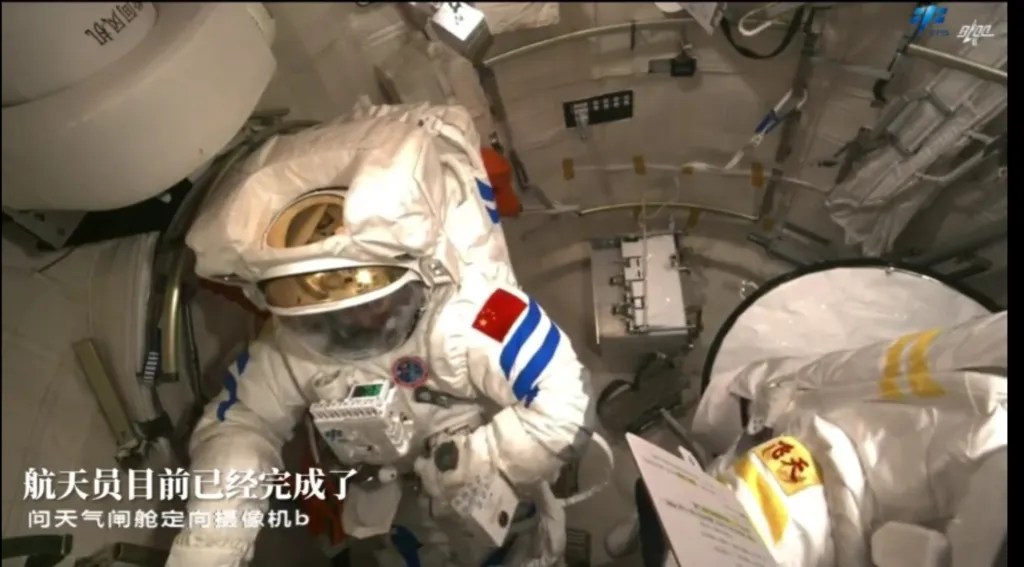
On the 17th November 2022 1116 Hours Hong Kong SAR – Beijing timeCNSA –China National Space Administrationthe Tiangong –China Space Station Crew of Shenzhou 14 is going out for a third EVA Spacewalk, according to the CMS China Manned Space – China Manned Engineering office Beijing . The two Takionauts at presenting doing the EVA Commander Cheng Dong and fellow Takionaut Cai Xuzhe left from the core module…. All is feeling well.
At 16:50 on November 17, 2022, Beijing time, after about 5.5 hours of out-of-vehicle activities, Shenzhou 14 Takionaut Chen Dong, Liu Yang, and Cai Xuzhe worked closely together to successfully complete the out-of-vehicle activities All scheduled tasks, Takionaut Chen Dong and Takionaut Cai Xuzhe have safely returned to the Wentian experimental module of the space station, and the out-of-cabin activities have been a complete success.
During the activities of the Takionauts going out of the cabin, they first completed the installation of the connecting device between the Tianhe core module and the Wentian experimental module, and the connecting device between the Tianhe core module and the Mengtian experimental module, and built a three-compartment extravehicular walking ” “Flyover”, Takionaut Cai Xuzhe realized the first extravehicular walk across the cabin through the “Flyover”. In addition, tasks such as raising the panoramic camera A of the Wentian experimental cabin and installing the power-assisted handle of the small robotic arm were completed, and the whole process went smoothly and successfully. This is the first time for astronauts to go out of the cabin after the assembly of the “T” basic configuration of the space station. Support the functional performance of the device.
The CNSA –China National Space Administration China Space Station Mengtian Experiment Module and the space station combination completed the rendezvous and docking in orbit After the space station Mengtian Experiment Module was launched into orbit, at 4:27 on November 1st Tuesday, 2022 Hong Kong SAR- Beijing time, it was successfully docked in front of the Tianhe core module To the port, the entire rendezvous and docking process lasted about 13 hours. In the follow-up, the relocation of the Mengtian experimental module will be implemented as planned. The Mengtian experimental module will form the basic configuration combination of the “T” shape of the space station with the Tianhe core module and the Wentian experimental module.
The Mengtian experimental module is expected to be repositioned on November 3. After the relocation is completed, it will form a “T” basic configuration combination of the space station with the Tianhe core module and the Wentian experimental module.
On the 3rd November 2022 Morning 0932 Morning Hong Kong SAR –Beijing time The “T” shape is assembled! The space station Mengtian experimental module successfully completed the transposition China Space Station T-shaped basic configuration on-orbit assembly completed Beijing time on November 3, 2022 at 9:32; the space station Mengtian experimental module successfully completed the transposition.
During the transposition, the Mengtian experimental module first completed the relevant state settings, and then separated from the space station assembly. After that, the plane transposition method was used to complete the transposition in about an hour, and then docked with the lateral port of the Tianhe core module node cabin again. This afternoon, the Shenzhou 14 astronaut crew will enter the Mengtian experimental module.
The completion of the transposition of the Mengtian experimental module marks the completion of the on-orbit assembly of the basic configuration of the “T” shape of the Chinese space station, a key step towards the goal of building a space station. According to the plan, the basic function test and evaluation of the space station assembly will be carried out in the future
The Mengtian experimental cabin is equipped with a cargo airlock and an outboard deployment test platform. In the future, the scientific test equipment that needs to be installed outside the cabin can be transported to the space station through a cargo spacecraft, and then the load will be sent to the outside of the cabin through the cargo airlock, and the robotic arm or astronaut will install it on the platform outside the cabin. Realize the continuous update of the extravehicular test project.
On the 31st October 2022CNSA –China National Space Administration The Mengtian The launch of the Mengtian experimental module is imminent successfully launched on At 15:37 Hours on October 31, 2022, Beijing time, the Chang Zheng Long March 5B Yao-4 carrier rocket carrying the Tiangong China Space Station Mengtian Experimental Module was launched in Wenchang Spacecraft Launch Center-Hainan Province, China People’s Republic of China . The field was ignited and launched on time. About 8 minutes later, the Mengtian experimental module was successfully separated from the rocket and accurately entered the predetermined orbit. The launch mission was a complete success.
This is the 25th flight mission since the establishment of my country’s manned space project, and the 446th flight of the Long March series of carrier rockets.
The China Space Station Mengtian Experiment Module and the space station combination completed the rendezvous and docking in orbit After the space station Mengtian Experiment Module was launched into orbit, at 4:27 on November 1st Tuesday, 2022 Hong Kong SAR- Beijing time, it was successfully docked in front of the Tianhe core module To the port, the entire rendezvous and docking process lasted about 13 hours. In the follow-up, the relocation of the Mengtian experimental module will be implemented as planned. The Mengtian experimental module will form the basic configuration combination of the “T” shape of the space station with the Tianhe core module and the Wentian experimental module.
The Mengtian experimental module is expected to be repositioned on November 3. After the relocation is completed, it will form a “T” basic configuration combination of the space station with the Tianhe core module and the Wentian experimental module.
In the follow-up, the Mengtian experimental module will rendezvous and dock with the space station assembly according to the predetermined procedure. After completing the relevant functional tests, the Mengtian experimental cabin will be repositioned as planned. The Shenzhou 14 astronaut crew is ready to welcome the visit of the Mengtian experimental module.
The Mengtian experimental cabin is the third section of the Chinese space station and the second scientific experimental cabin. It consists of a working cabin, a load cabin, a cargo airlock cabin and a resource cabin. The take-off weight is about 23 tons. It is mainly used for space science and Applying experiments, participating in the management of the space station assembly; the cargo airlock can support the automatic entry and exit of cargo, and provide support for scientific experiments inside and outside the cabin.
In the follow-up, the Mengtian experimental module will rendezvous and dock with the space station assembly according to the predetermined procedure. After completing the relevant functional tests, the Mengtian experimental cabin will be repositioned as planned. The Shenzhou 14 astronaut crew is ready to welcome the visit of the Mengtian experimental module.
The Mengtian experimental cabin is equipped with a cargo airlock and an outboard deployment test platform. In the future, the scientific test equipment that needs to be installed outside the cabin can be transported to the space station through a cargo spacecraft, and then the load will be sent to the outside of the cabin through the cargo airlock, and the robotic arm or astronaut will install it on the platform outside the cabin. Realize the continuous update of the extravehicular test project.