#MadeInChina #中國製造| #中科宇航 #ZhongkeAerospace #ChinaAcademyOfScience #CASSPace #June2023 | the Greater Bay Area Science Forum- the 2023 Zhongguancun Forum

Beijing Zhongke Aerospace Exploration Technology Co., Ltd. is the first domestic aerospace enterprise with mixed ownership, and it is also the target enterprise that Oriental Aerospace Port focuses on introducing. Relying on the scientific research strength and resource advantages of the Institute of Mechanics of the Chinese Academy of Sciences and the Aerospace Flight Technology Center of the Chinese Academy of Sciences, China Aerospace Science and Technology has been committed to the research and development and integration of space technology and aerospace vehicles as a platform for the transformation of major national scientific research projects, as well as the transformation and provision of technological achievements. Aerospace launch service. The Lijian-1 rocket project also adds a brand-new name card to the Oriental Space Port, which will surely promote the construction of the Oriental Space Port to take a solid step forward.

From May 25th to 30th, the 2023 Zhongguancun Forum the 25th China Beijing International Science and Technology Industry Expo (hereinafter referred to as the “Science Expo”) was successfully held in the Exhibition Center of Zhongguancun National Independent Innovation Demonstration Zone in Beijing. Zhongke Aerospace, as the achievement transformation platform of the Chinese Academy of Sciences in the field of aerospace science and technology, was invited to participate in the exhibition, and made a big debut with a number of major powers such as the Arrow series of launch vehicles

On May 24, Bai Chunli, chairman of the Greater Bay Area Science Forum, chairman of the “Belt and Road” International Science Organization Alliance, academician of the Chinese Academy of Sciences, and Feng Wei, vice president of the Guangzhou Branch of the Chinese Academy of Sciences, and their delegation visited the China Science and Technology Aerospace Flight Science and Technology Industrialization Base for investigation and guidance , conducted in-depth exchanges and discussions with Yang Yiqiang, chairman and president of Zhongke Aerospace.
As Academician Bai Chunli said in his speech at the opening ceremony of the 2023 Greater Bay Area Science Forum: “China is moving from a scientific and technological power to a technological power.” Zhongke Aerospace will also be guided by the major strategic needs of my country’s aerospace field and give full play to the new national system and the advantages of mixed ownership, lead the development of aerospace technology with innovation, and contribute to the realization of the dream of a technologically powerful country

On May 22, the 2023 Greater Bay Area Science Forum “Belt and Road” high-quality development sub-forum hosted by the Qinghai-Tibet Plateau Institute of the Chinese Academy of Sciences was held in Nansha, Guangzhou. Yang Yiqiang, director of the Aerospace Science and Technology Center of the Chinese Academy of Sciences and chairman and president of China Aerospace Corporation, was invited to attend as a guest speaker.
In the future, Zhongke Aerospace will serve the “Belt and Road” initiative, combine the needs of national strategic scientific and technological strength construction and the regional coordinated development strategy, and look forward to setting sail from the Greater Bay Area, heading to the South China Sea, covering the Indian Ocean and the Mediterranean coast, and going to sea for one-time final assembly , Multiple launches, construction of the home port of the Southern Aerospace Port aimed at the space service of the Belt and Road, to meet the launch needs of near seas and far seas…

Images and visuals are from their respectives

CNSA #ChinaNationalSpaceAdministration #國家航天局 |#BRI  #June2023 | #火星 # 天問 #天问一号#TianwenOne #MarsMission #Tianwen1 probe  #祝融号stunning First Mars Global Remote Sensing and Regional Patrol Exploration Mission photography #December2021 #AGallery Briefly


天问一号飞運騎遊達达3亿CNSA – China National Space Administration – ESA – European Space agency Belt and road initiative mars mission…first Mars exploration mission, Tianwen- Martian Probe One As of September 15, 2022, the Tianwen-1 orbiter has been in orbit for more than 780 days, and the rover has travelled a total of 1,921 meters, completed the established scientific exploration tasks, and obtained 1,480 GB of original scientific exploration data. The scientific research team has obtained rich scientific results through the research on the first-hand scientific data obtained independently by my country. Through a comprehensive study of typical landforms such as concave cones, barrier craters, and trenches distributed in the landing area, the important connection between the formation of the above-mentioned landforms and water activities has been revealed.

Currently as to date of the Zhurong Mars Rover is currently at sleep safe mode due to the Martian Sandstorms….. the location of Zhurong taken by the Tianwen-1 orbiter after it hibernated in Zhurong last year. The rut marks left by Zhurong after traveling 1921 meters are clearly visible….. The local dust on Mars captured by the Tianwen-1 orbiter is very layered. This photo was taken by the medium-resolution camera of the Tianwen-1 orbiter on January 6, 2022, and Zhurong went into a dormant state more than three months after this time point. 

On the week of 6th June 2023 there have been new images release of the CNSA –CLEP Mars The Lunar and Planetary Data Publishing System released a new batch of Tianwen-1 data today, including a large number of Martian surface photos taken by the obiter’s medium-resolution camera! The total number is estimated to be hundreds to thousands!  But here are some stunning incredible randomly selected a few pictures is beautiful in which has been process during the Month of December 2021 at the time when before the Martian Sandstorm!

Some of the images taken by the Zhurong rover in December 2021 come from the latest data released by the China Planetary Exploration Engineering Ground Application System

中国planet detection…. First Mars Global Remote Sensing and Regional Patrol Exploration Mission


The second batch of publicly released data is the Korolev crater (Korolev). This picture is made by mosaicing 8 orbiter medium resolution camera (MoRIC) images obtained by searching in an area with (72.77N, 164.58E) as the center and a search radius of 300 km. It was taken at detection periods 656 and 677 and 698, using OpenCV, SKImage, Lr for processing. [CAS/GRAS, CNSA/PEC; export production…..


Northeast of the Utopia Plain, west of Mie (Mie), the pirate who landed here in 1976 The impact craters in the area around the No. 2 lander are mostly named after the launch sites, measurement and control stations and other aerospace facilities in various countries in the 1970s. Among them, Xuancheng Meteor Crater (Hsūanch’eng) is named after Xuancheng City, Anhui Province. my country’s early suborbital sounding rocket launch site – Guangde Rocket Launch Site (603 Base) is located in Shijie Town, Guangde City, Xuancheng City. This is the main site for the T-7 series of sounding rockets to conduct meteorological, biological, and new technology flight tests in the 1960s. It is also the place where the brave flying pathfinding dogs “Little Leopard” and “Shanshan” set off in July 1966.


(Figure 5 shows the first flight of the T-7A rocket, and Figure 6 shows the puppy carrying out the vibration test before the flight.) 3 MoRIC images were mosaiced, taken on December 3, 2021-detection cycle 641, and processed using OpenCV, SKImage, Lr and Ps. [CAS/GRAS, CNSA/PEC; export production:

Images and visuals are from their respectives also CNSA China National Space AdministrationCLEP China Lunar Exploration Program.

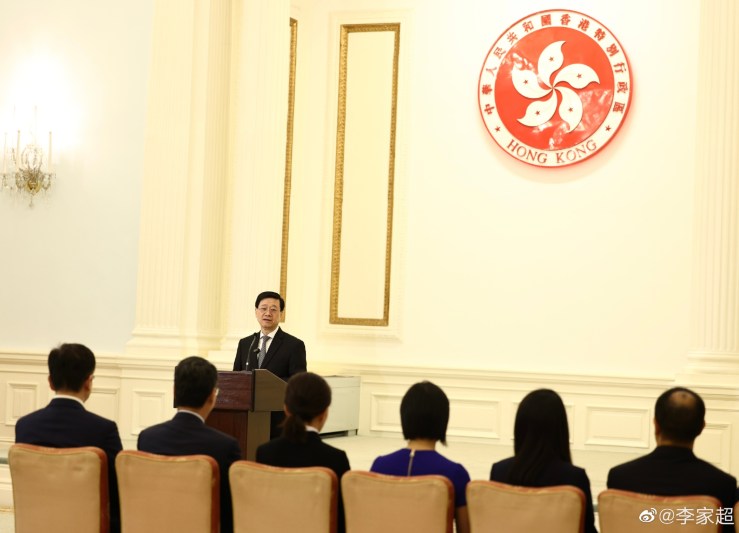
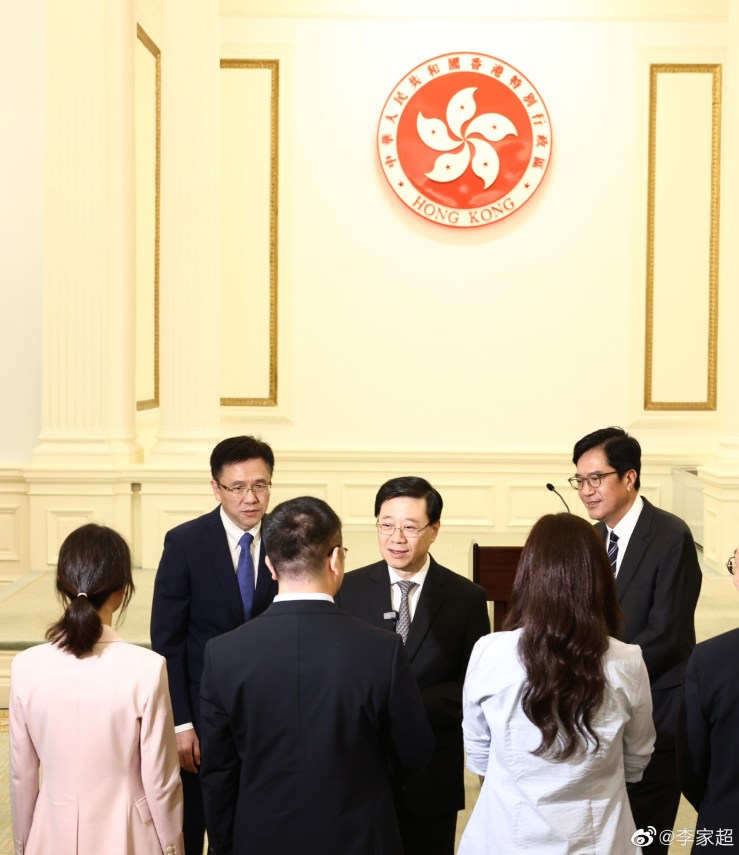
#CNSA #ChinaNationalSpaceAdministration #国家航天局 | #June2023 | #CMS #ChinaMannedSpace #Shenzhou Civilian  #Takionauts #HongKongSAR Selection for #PayloadSpecialist Candidates presented  hosted by # 李家超 John Lee Ka-chiu-Chief Executive of the Hong Kong Special Administrative Region China, People’s Republic of China.

中国空间站 On the 7th June 2023 CNSA –China National Space Administration  at the Grounds of the Hong Kong SAR, China, People’s Republic of China, at Hong Kong SAR Government house in Central the 李家超 John Lee Ka-chiu-Chief Executive of the Hong Kong Special Administrative Region China, People’s Republic of China. Held a hosting meeting with the Hong Kong SAR Civilian Takionaut selection of the Role of Payload Specialist candidates..  His meeting is described as Meeting with payload expert- Specialists candidates…… as李家超 John Lee Ka-chiu-Chief Executive of the Hong Kong Special Administrative Region Quote below..

[Meeting with payload expert candidates]

I am very pleased to meet with Hong Kong payload expert candidates at the Government House this afternoon. They will go to Beijing this week to participate in the selection and re-election of payload experts for the National Manned Space Engineering Project. My team and I cheer for them.


It is the first time that the country selects payload experts in Hong Kong, which marks the country’s high attention and affirmation to Hong Kong’s scientific and technological circles, as well as its recognition of Hong Kong as an international innovation and technology center. This selection not only represents that the country encourages and welcomes Hong Kong compatriots to contribute to the country’s development, but also reflects the country’s concern for the development of Hong Kong youth.

These payload expert candidates are all elites in related fields, representing Hong Kong’s scientific research and innovation strength. We are proud that they can stand up at this historical moment, contribute to the country and shoulder the public’s expectations for Hong Kong people to participate in space exploration.

The following selection will be very rigorous. I hope that everyone will cherish and experience this process of struggle, experience and learning. I would like to take this opportunity to encourage you all to go all out and do your best to fight for the country, Hong Kong, and your aerospace dream!

Images and visuals are from their respectives.

CNSA #ChinaNationalSpaceAdministration #國家航天局 |#BRI  #June2023 | #火星 # 天問 #天问一号#TianwenOne #MarsMission #Tianwen1 probe  #祝融号 stunning Martian landscape new stunning Mars Orbitally  Selected photography during the year #December2021 #AGallery   ——-

 天问一号飞運騎遊達达3亿CNSA – China National Space Administration – ESA – European Space agency Belt and road initiative mars mission…first Mars exploration mission, Tianwen- Martian Probe One As of September 15, 2022, the Tianwen-1 orbiter has been in orbit for more than 780 days, and the rover has travelled a total of 1,921 meters, completed the established scientific exploration tasks, and obtained 1,480 GB of original scientific exploration data. The scientific research team has obtained rich scientific results through the research on the first-hand scientific data obtained independently by my country. Through a comprehensive study of typical landforms such as concave cones, barrier craters, and trenches distributed in the landing area, the important connection between the formation of the above-mentioned landforms and water activities has been revealed.

Currently as to date of the Zhurong Mars Rover is currently at sleep safe mode due to the Martian Sandstorms….. the location of Zhurong taken by the Tianwen-1 orbiter after it hibernated in Zhurong last year. The rut marks left by Zhurong after traveling 1921 meters are clearly visible….. The local dust on Mars captured by the Tianwen-1 orbiter is very layered. This photo was taken by the medium-resolution camera of the Tianwen-1 orbiter on January 6, 2022, and Zhurong went into a dormant state more than three months after this time point. 

On the week of 6th June 2023 there have been new images release of the CNSA –CLEP Mars The Lunar and Planetary Data Publishing System released a new batch of Tianwen-1 data today, including a large number of Martian surface photos taken by the obiter’s medium-resolution camera! The total number is estimated to be hundreds to thousands!  But here are some stunning incredible randomly selected a few pictures is beautiful in which has been process during the Month of December 2021 at the time when before the Martian Sandstorm!

Some of the images taken by the Zhurong rover in December 2021 come from the latest data released by the China Planetary Exploration Engineering Ground Application System.


The famous Olympus Mons (Olympus Mons), a giant shield volcano on the northwest side of Mars Tharsis (Tharsis). This image is stitched together from 6 MoRIC images selected from the December 2021-detection cycle 00734 data released today, and processed using OpenCV, SKImage, and Lr. [CAS/GRAS, CNSA/PEC; export production

Selected from the December 2021 data set of the medium-resolution camera of the Tianwen-1 orbiter, source: China Planetary Exploration Engineering Ground Application System​​​​….

On August 15, 2021, the “Zhurong” rover successfully completed the 90 Martian scientific exploration missions, and continued to carry out extended exploration missions. It has traveled 1,921.5 meters on the surface of Mars. Affected by the severe winter cold and dusty weather in the landing area, the rover will enter the winter dormancy mode on May 18, 2022 as designed. Around December 2022, the “Zhurong” landing area will enter the early spring season. will resume normal work.

The orbiter has circled Mars 1,344 times, achieving global coverage and is currently in normal condition. In the follow-up, it will continue to carry out global remote sensing detection, and choose an opportunity to carry out expansion technology experiments to carry out preliminary technical verification for related tasks.

After nearly two years of flight and exploration for the Tianwen-1 mission, the 13 scientific payloads deployed by the rover and orbiter have obtained a total of about 1040GB of raw scientific data. After receiving and processing on the ground, the standard scientific data products formed are submitted to the rover on a monthly basis. A team of scientists has conducted analysis and interpretation, and relevant scientific results have been published in well-known academic journals at home and abroad. These scientific data will be open to scientists around the world at an appropriate time. Scientists around the world are welcome to actively apply for research and jointly promote the cause of human exploration of the universe.

At present, the Tianwen-1 orbiter continues to carry out scientific exploration in the orbit of the remote sensing mission, continues to accumulate first-hand scientific data, and makes China’s contribution to mankind’s in-depth understanding of Mars.
 ​​​​

Images and visuals are from CNSA China National Space AdministrationCLEP China Lunar Exploration Program.

#CNSA #ChinaNationalSpaceAdministration #国家航天局 | #BRI #June2023 |#天宫#Tiangong #ChinaSpaceStation #神舟十五号 #Shenzhou15 Returning The experimental samples returned to the ground with the return capsule Spacecraft Module.. #ChineseAcademyOfSciences..

On the Week of 3rd June 2023 Hour Hong- Kong SAR – Beijing time CNSA –China National Space Administration  At the  CNSA- Tiangong –China Space Station At Saturday 21:29 on June 3rd , 2023,  Hong Kong SAR- Beijing time, the manned spacecraft of Shenzhou 15 and the space station assembly successfully separated. Before the separation, the astronaut crew of Shenzhou 15, with the cooperation of the ground personnel, completed various tasks before the evacuation, such as setting the status of the space station assembly, sorting and downloading experimental data, cleaning and transferring materials left in orbit, and cooperated with the crew of Shenzhou 16. The group completed the work handover.


In the follow-up, the return capsule of the Shenzhou 15 manned spacecraft will choose an opportunity to re-enter and return. Astronauts Fei Junlong, Deng Qingming, and Zhang Lu, who have been on  Mission on stay at the Tiangong – China Space Station  for 186 days at the Chinese space station, are about to embark on a journey home towards landing at Dongfeng Aerospace City, Inner Mongolia, China, People’s Republic of China.

A complete success! 神舟十五号回复#Everything goes well….. At 6:33 on June 4th, 2023, Beijing time, the return capsule of the Shenzhou 15 manned spacecraft landed successfully at the Dongfeng Landing Field. , Deng Qingming, and Zhang Lu are in good health, and the manned flight mission of Shenzhou 15 was a complete success.

Today on the 5th June 2023 , the fourth batch of space science in China’s space station The experimental samples returned to the ground with the return capsule of the Shenzhou 15 spacecraft, and were delivered to the space application system led by the Chinese Academy of Sciences at the Dongfeng Landing Field. At around 14:00 Beijing time, some experimental samples arrived at the Space Application Engineering and Technology Center of the Chinese Academy of Sciences in Beijing. The overall space application system and relevant experimental personnel checked and confirmed the basic status of the returned experimental samples, and handed over to relevant experimental scientists for follow-up research.


The space application system went down with the return module of the Shenzhou 15 spacecraft for experimental samples of 15 scientific projects, including life experimental samples such as cells, nematodes, Arabidopsis, and ratooned rice, as well as various alloy materials, new infrared detector materials, amorphous Material experimental samples such as thin film materials. The total weight of downlink experimental samples is more than 20 kg.


Subsequent scientists will conduct molecular biology, cell biology, on-orbit growth and development, and metabolism related analyzes on the returned life samples. Through comparative analysis and research with the ground, they will analyze the laws and molecular mechanisms of the effects of space microgravity and radiation on experimental samples. Provide a theoretical basis for further creating crops adapted to the space environment and developing and utilizing resources such as space microgravity and radiation…

Images and visuals are from their Respectives CMS China Manned SpaceCNSA-China National Space Administration