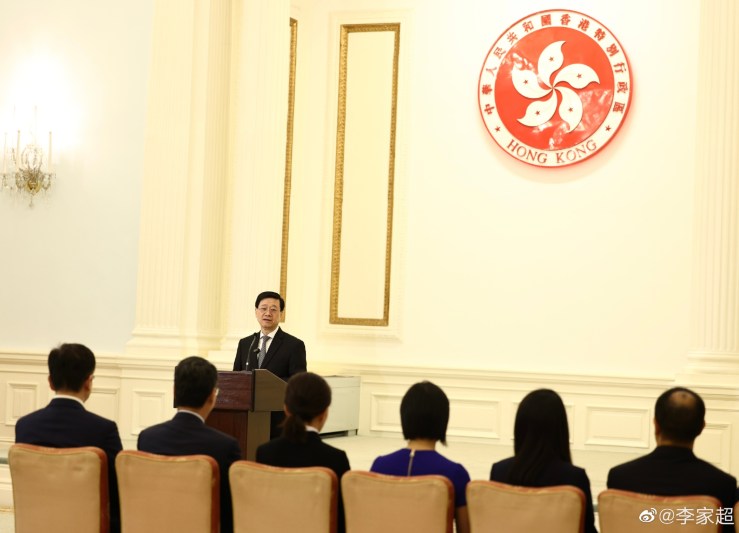
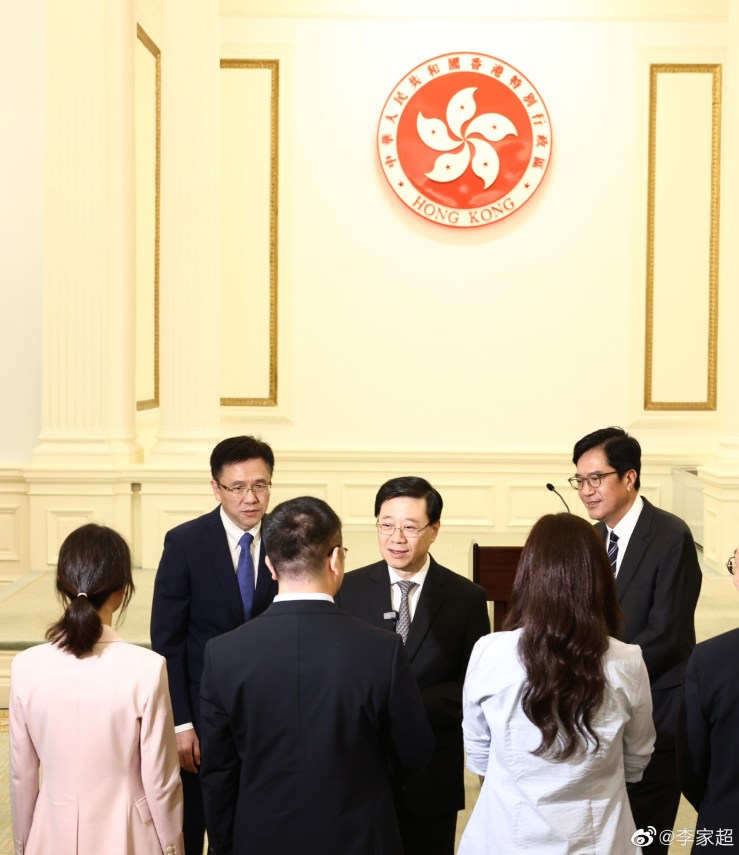
中国空间站 On the 7th June 2023CNSA –China National Space Administrationat the Grounds of the Hong Kong SAR, China, People’s Republic of China, at Hong Kong SAR Government house in Central the 李家超 John Lee Ka-chiu-Chief Executive of the Hong Kong Special Administrative Region China, People’s Republic of China. Held a hosting meeting with the Hong Kong SAR Civilian Takionaut selection of the Role of Payload Specialist candidates.. His meeting is described as Meeting with payload expert- Specialists candidates…… as李家超 John Lee Ka-chiu-Chief Executive of the Hong Kong Special Administrative Region Quote below..
[Meeting with payload expert candidates]
I am very pleased to meet with Hong Kong payload expert candidates at the Government House this afternoon. They will go to Beijing this week to participate in the selection and re-election of payload experts for the National Manned Space Engineering Project. My team and I cheer for them.
It is the first time that the country selects payload experts in Hong Kong, which marks the country’s high attention and affirmation to Hong Kong’s scientific and technological circles, as well as its recognition of Hong Kong as an international innovation and technology center. This selection not only represents that the country encourages and welcomes Hong Kong compatriots to contribute to the country’s development, but also reflects the country’s concern for the development of Hong Kong youth.
These payload expert candidates are all elites in related fields, representing Hong Kong’s scientific research and innovation strength. We are proud that they can stand up at this historical moment, contribute to the country and shoulder the public’s expectations for Hong Kong people to participate in space exploration.
The following selection will be very rigorous. I hope that everyone will cherish and experience this process of struggle, experience and learning. I would like to take this opportunity to encourage you all to go all out and do your best to fight for the country, Hong Kong, and your aerospace dream!
On the 30th May 2023 clear 0931 Hours Morning Hong Kong SAR- Beijing time , the Belt and Road InitiativeCNSA –China National Space Administration from Jiuquan Satellite Launch Center – Inner Mongolia –China – People’s Republic of China deployment of the Chang Zheng – The Chang Zheng – Long March 2F Yao 16 –Shenzhou 16 carrier rocket.. On which Takionauts Jing Haipeng, Zhu Yangzhu, and Gui Haichao took to the predetermined orbit. The first manned flight mission in the application and development stage was a complete success. The three astronauts will stay in the space station and “join up” with the crew of Shenzhou 15 to carry out on-orbit handover “face-to-face” meeting in which brings the total crew of six with a handover ceremony from Shenzhou 15 towards 16..
On 6th June 2023, The CNSA –China National Space Administration Takionaut Crew of the Shenzhou 16 0310 Hours Hong Kong SAR-Beijing Time, ] Tianzhou-5 cargo spacecraft completed rendezvous and docking with the space station assembly again #天舟五号According to the China Manned Space Engineering Office, the space station assembly has been evacuated in the early stage and has been flying independently in orbit for 33 days The Tianzhou-5 cargo spacecraft completed rendezvous and docking with the space station assembly at 3:10 on June 6, 2023, Beijing time. At present, the space station complex is in good condition, and various tasks will be carried out as planned.
On the 30th May 2023 clear 0931 Hours Morning Hong Kong SAR- Beijing time , the Belt and Road InitiativeCNSA –China National Space Administration from Jiuquan Satellite Launch Center – Inner Mongolia –China – People’s Republic of China deployment of the Chang Zheng – The Chang Zheng – Long March 2F Yao 16 –Shenzhou 16 carrier rocket.. On which Takionauts Jing Haipeng, Zhu Yangzhu, and Gui Haichao took to the predetermined orbit. The first manned flight mission in the application and development stage was a complete success. The three astronauts will stay in the space station and “join up” with the crew of Shenzhou 15 to carry out on-orbit handover “face-to-face” meeting in which brings the total crew of six with a handover ceremony from Shenzhou 15 towards 16..
[神舟六号Long March 2 F Yao 16 rocket test launch process shortened to 35 days, 20 technical status changes]
Liu Feng, deputy chief designer of the Chang Zheng –Long March Rocket 2F rocket, introduced that the remote launch of 神舟六号Sixteen rockets are far behind fifteen, and there are a total of 20 technical status changes. The research and development team focused on improving the redundancy and improving the process, and continued to improve the reliability of the rocket. At the same time, it continued to promote the localization of multiple electrical system components on the rocket, and continuously improved the independent and controllable level of the product.
The research and development team also empowered the rocket with digital and information technology, introducing “smart” changes for data interpretation. Relying on the continuous construction of the remote test and launch support system, real-time communication between the front and rear of the Chang-2F rocket test data has been realized, and the rear designers can more conveniently and comprehensively understand rocket-related data, carry out real-time monitoring, interpretation and data analysis, and simultaneously display the data on the large screen. On the visualization display. Not only that, but the powerful automatic data interpretation and analysis tools and a complete expert team will better ensure the coverage and reliability of data interpretation and improve work efficiency.
Starting from the construction mission of the space station, the Chang-2F rocket started a normal fast-paced launch. Especially since the launch of the Shenzhou 12 manned spacecraft, the Chang-2F rocket has adopted the launch mode of “one launch, one backup” and “rolling backup”.
In the face of the new normal, the development team has continuously optimized the launch site process through measures such as adjusting the test sequence, parallel work, and integrating test items on the premise of ensuring launch reliability. At present, the launch site process of the Chang-2F rocket has been compressed from 49 days in the initial stage of construction to 35 days. As the space station enters the application and development stage, the research and development team will further improve the efficiency of the launch site with a goal of 30 days, and send astronauts into space safely and accurately at a faster speed.
The Chang-2 F rocket is a two-and-a-half-stage carrier rocket specially used for manned launch missions. The reliability index of the whole rocket is 0.98, and the safety index is 0.997. On the premise of ensuring the reliability of the launch, the Chang-2F rocket team continued to sort out and optimize the launch site process to improve the efficiency of test and launch. At present, the launch site process of the Chang-2F rocket has been compressed from 49 days in the initial stage of construction to 35 days.
【神舟六号Shenzhou 16 is the first new batch of Shenzhou spacecraft, with hundreds of device changes, supporting the Beidou positioning system】
神舟六号 The manned spacecraft was developed by the Fifth Academy of Aerospace Science and Technology Group, and it is the first development in China The 11 manned spaceflight missions are also the first manned spacecraft in the application and development stage of China’s space station. At the same time, it is also the first manned spacecraft produced in batches from Shenzhou 16 to Shenzhou 21. The mission of “putting into production” has played a key role in connecting the past and the future.
As the “boat of life” for astronauts to go back and forth between heaven and earth, the Shenzhou series of manned spacecraft consists of an orbital module, a reentry module and a propulsion module, with a total of 14 subsystems. It is the spacecraft with the most stringent reliability and safety requirements in my country.
Among them, the propulsion module, as the “source of energy and power” of the whole ship, is equipped with the two most important energy and power systems of the spacecraft. For example, 80% of the equipment of the entire spacecraft energy system is installed in the propulsion module, including photovoltaic power supply equipment including two solar cell wings, which is the main energy source for the spacecraft’s in-orbit flight; all 40 engines of the power system are also installed. On the propulsion module, there are 4 high-thrust orbital engines at the bottom and 36 attitude control engines that allow the spacecraft to fly in various attitudes and directions.
Faced with the high-density mission requirements of launching two Shenzhou spacecraft each year during the mission phase of the space station, the Shenzhou spacecraft system adopts a batch development model and a rolling backup strategy of “one ship launched, one ship on standby” to ensure the smooth progress of the space station project. During the work at the launch site, the Shenzhou spacecraft test team needs to complete the Shenzhou 16 launch and Shenzhou 17 emergency rescue and standby preparations in parallel. The four fronts of development, launch, flight control and recovery are highly overlapping, and many aspects such as schedule arrangement, quality control, and resource guarantee are facing great challenges.
In order to meet the high-density and regular launch tasks of the space station, the Shenzhou 16 manned spacecraft has completed hundreds of verifications such as device changes and reliability improvements under the premise of ensuring reliability and safety, and has passed the national major project. Support the Beidou positioning system, further enhance the independent health management function, continuously improve the independent health management level of the spacecraft, and establish a data envelopment analysis mechanism, and fully promote the informationization of product data interconnection, digitalization of cable assembly layout, and intelligent detection of key parameters.
Badge design description: This badge cleverly forms the word “1” with a flexible and elegant silk ribbon and arrow body, indicating that this is the first manned mission of the Chinese space station after it officially entered the operation stage. The three vivid and realistic images of astronauts in the badge show that China ‘s special rocket for manned spaceflight sends astronauts into space, knocking on the door of the vast universe…
[神舟十六号 #Shenzhou16 manned spacecraft and space station assembly completed autonomous rapid rendezvous and docking]
The latest news from the China Manned Space Engineering Office, after the Shenzhou 16 manned spacecraft entered orbit, at 16:29 on May 30, 2023 Beijing time In 20 minutes, it successfully docked with the radial port of the space station’s sky and core module, and the entire docking process lasted about 6.5 hours.
According to the mission plan, the three Takionauts will then enter the sky and core module of the space station from the Shenzhou 16 manned spacecraft. The crew of Shenzhou 15 has made all preparations for the arrival of the crew of Shenzhou 16…
神舟十五号 Shenzhou 15 the crew hung up a couplet to welcome the arrival of the crew of 神舟十六 号 Shenzhou 16 in the Tiangong- China Space Station- Tianhe core cabin of the Chinese space station . Welcome comrades! Color! ! !
神舟六号 3 Shenzhou 16 Takionauts successfully stationed in China’s space station … After the manned spacecraft and space station combination successfully achieved independent rapid rendezvous and docking, the astronauts on Shenzhou 16 took The group enters the orbital module from the return module of the spacecraft. At 18:22 on May 30, 2023, Beijing time, the long-awaited Shenzhou 15 Takionaut crew successfully opened the “home” and welcomed the Shenzhou 16 astronaut crew who came from afar to settle in the “Tiangong”. Afterwards, the two Takionauts teamed up to take a “family portrait” and jointly reported safety to the people all over the country who cared about them.
Hope and hope! waiting! looking forward to! Finally, when the crew of Shenzhou 16 and the crew of Shenzhou 15 joined forces in China’s space homeland, seeing the moving scene of the six astronauts hugging and celebrating with joy when they met at the space station, this is China’s manned spaceflight ! How can you not love China’s manned spaceflight, how can you not burst into tears…. Subsequently, the two Takionaut crews will perform on-orbit rotations on the space station. During the period, the six Takionauts will work and live on the space station together for about 5 days to complete various scheduled tasks.
On the 2nd June 2023 the crew of Shenzhou 15 and Shenzhou 16 Takionaut Team Handover Ceremony The in-orbit handover ceremony is completed after three days of in-orbit communication between the crews of Shenzhou 15 and Shenzhou 16, the Takionauts of both crews agreed that they met the conditions for handover. Shenzhou Fifteen: It will be up to you later!
Shenzhou 15 and Shenzhou 16 crews have been working and living together in orbit for about 5 days, watching the wonderful scenes of the two crews’ “dream linkage” in orbit, and the touching moment of Yiyi saying goodbye, did you cry? !
On today on the 29TH May 2023 in according to the CMS China Manned SpaceCNSA-China National Space Administration China Manned Space Engineering Office At 11:00 on May 29, 2023, Beijing time, the three astronauts will meet with Chinese and foreign media reporters at the Wentian Pavilion of the Jiuquan Satellite Launch Center…… Official announcement! According to the research and decision of the Space Station Application and Development Stage Flight Mission Headquarters, the Shenzhou 16 astronaut crew consists of command commander Jing Haipeng, spaceflight engineer Zhu Yangzhu, payload expert Gui The tide is composed of 3 astronauts. This is the first time that my country’s third group of astronauts has performed a flight mission, and it is also the “first show” of the “new members” of my country’s astronaut team – aerospace flight engineers and payload experts. Tomorrow, a brand-new crew composed of three types of astronauts will go to space to perform the first manned mission in the application and development phase of the space station. The Shenzhou-16 crewed spaceship is scheduled to be launched at 9:31 a.m. Tuesday 30th May 2023 Beijing Time from the Jiuquan Satellite Launch Center in northwest China, Inner Mongolia, China, People’s Republic of China. in which they will join with the Shenzhou 15 Crew together record breaking of six months. .
On the Same time during the Shenzhou 16 Takionaut Crew announcement it is also announcement of the China, People’s Republic of China’s CNSA-CMS China National Space Administration –China Manned Space Program of the Manned Lunar Landing within seven years of Year 2030 or least.. the scheduled for a manned landing was discussion previously but with a conclusion using the Next Generation长征十号 Chang Zheng- Long March 10F Manned Freighter Carrier Rocket Developed by China Academy of launch Vehicles with a landing vehicle module …
During the Shenzhou 16 Chang Zheng –Long March 2F Carrier Rocket announcement With the help of the Dongfeng of the Shenzhou 16 mission, at the press conference of the manned flight mission, China’s manned mission to the moon was officially announced: China’s manned mission to the moon has been…. launched, and the goal is to complete the mission by 2030. The Chinese Takionauts sent it to the surface of the moon. Specifically, it includes carrying out lunar scientific investigations and related technical experiments, making breakthroughs and mastering key technologies such as manned ground-to-moon round trips, short-term mainstream human-machine joint exploration of the lunar surface, and completing multiple tasks such as “landing, patrolling, mining, research, and returning” to form an independent Manned lunar exploration capability …..Lin Xiqiang, deputy director of the CMSA China Manned Space Agency (CMSA), said at the conference that China has recently initiated the lunar landing phase of its manned lunar exploration program.
At present, the China Manned Space Engineering Office has fully deployed and carried out various research and construction work, including the development of a new generation of manned launch vehicles (Long March 10), a new generation of manned spacecraft, lunar landers, lunar landing suits and other flight products, New launch sites related to test launch facilities and equipment,
The overall goal is to achieve China’s first manned landing on the moon by 2030 and carry out lunar scientific exploration and related technological experiments, he added.
According to Lin, the goal also includes mastering the key technologies such as Earth-moon manned roundtrip, lunar surface short-term stay, human-robot joint exploration, accomplishing multiple tasks of landing, roving, sampling, researching and returning, and forming an independent capability of manned lunar exploration.
On the 22st May 2023 clear 1600 Hours Hong Kong SAR- Beijing time , the Belt and Road InitiativeCNSA –China National Space Administration from Jiuquan Satellite Launch Center – Inner Mongolia –China – People’s Republic of China deployment of the Chang Zheng – The Chang Zheng – Long March 2F carrier rocket..
As the 神舟十六号 Shenzhou 16 Chang Zheng – Long March 2F Yao 16 move towards vertical transfer On May 22, 2023,1600 Beijing time, the combination of the Shenzhou 16 manned spacecraft and the Chang Zheng Long March 2F Yao 16 carrier rocket has been transferred to the launch area. At present, the facilities and equipment of the launch site are in good condition, and various functional inspections and joint tests before launch will be carried out as planned, and the launch is planned to be carried out in the near future of Shenzhou 16 manned Launch towards the Tiangong – China Space Station ….