#CNSA #ChinaNationalSpaceAdministration #国家航天局 |#BRI #October2023 #Tiangong #ChinaSpaceStation #CMS #ChinaMannedSpace #Shenzhou17 #谭昊瑜 #TanHaoyu the Shenzhou 17 mission Batch Designer winner watches her mission launch excited beyond words.. ..

It is on the morning of October 26, 2023, the “Shenzhou 17” manned spacecraft carrying three Takionauts will be launched from the 921 station of the Jiuquan Satellite launch Center, Inner Mongolia, China, People’s Republic of China  by the “Long March 2F” Yao 17 carrier rocket to joining up with the Crew of the Shenzhou 16 Takionaut Crew onboard the Tiangong –China Space Station, On the 25th October 2023 CNSA- China National Space Administration According to the China Manned Space Engineering Office, the Takionaut Shenzhou 17 Crew is aiming to be launched at 11:14 on October 26th 2023.

The crew for the Shenzhou 17 manned mission will consist of three Takionauts: Tang Hongbo, Tang Shengjie, and Jiang Xinlin, with Tang Hongbo serving as the commander. The crew includes 1 second-batch astronaut and 2 third-batch Takionauts. It is the youngest average age of the Takionaut crew since the launch of the space station construction mission…..

On the morning of October 26 2023, the Shenzhou 17 manned spacecraft was launched from the Jiuquan Satellite Launch Center. Three Takionauts, Tang Hongbo, Tang Shengjie, and Jiang Xinlin, and the “Shenzhou 17 manned mission logo” carried the spacecraft to space. As the designer of the Shenzhou 17 manned mission logo, Tan Haoyu, a student at Sichuan Fine Arts Institute, was also invited to the launch site to observe and witness.

At 11:13:59 in the morning, the Shenzhou 17 spacecraft was ignited and launched. There was a special audience at the scene. She was the designer of the Shenzhou 17 mission logo—Tan Haoyu, a first-year postgraduate student majoring in cultural and creative design at the Sichuan Academy of Fine Arts.

At noon on the 26th, a cover news reporter contacted Tan Haoyu. She said that watching the logo she personally designed fly into space, she felt like she was still “in a dream.” “I arrived at the scene two days before the launch. In fact, before I came, I expected that I would be very excited, but when I went to the scene and watched it with the surrounding audience, it was a different feeling. That is the word ‘excited’ Two words can’t describe it.”

Due to a tight schedule, Tan Haoyu can only communicate with reporters by phone. She said that although the sunlight at the Jiuquan launch site was very strong, it still could not stop the enthusiasm of the audience in anticipating the launch of the “Shenzhou 17”.

“Especially the moment the rocket ignited, I could hear the roar of the rocket taking off and the cheers of the surrounding audience.” Tan Haoyu said that at that moment, he felt more deeply the pride of participating in the design, “It was like a huge wave facing us. It rushed forward and instantly drowned out all my thoughts, leaving only the spacecraft at the scene in my mind.”

According to previous reports, on February 15, 2023, the China Manned Space Engineering Office solicited from the public the logos of the three missions of Tianzhou 6, Shenzhou 16, and Shenzhou 17. After Tan Haoyu learned the news, he actively participated in the creative team of Sichuan Fine Arts Institute and designed the Shenzhou 17 mission logo using “symmetrical” composition, highlighting the central focus, and combining the number “17” with the spacecraft tail flame.

In May of this year, Tan Haoyu accepted an exclusive interview with cover news and introduced in detail how she used just 11 days to design the “winning” work.

“Although the whole creation process only lasted 11 days, I used every bit of the creative feeling I accumulated in my life. Therefore, for me, the meaning of ‘ Shenzou 17- ‘ is even more special.” Tan Haoyu said this .

At the end of the call, Tan Haoyu told the cover news that experiencing this design has strengthened his belief in being an excellent designer. “I hope there will be more opportunities in the future to participate in design projects that serve the country.”​​​​

The Shenzhou 17 manned mission logo is the first mission logo publicly solicited from the whole society for the manned space project. It is the only work designed and selected by college students. As the mission is approaching, Tan Haoyu, the designer of the mission logo and a graduate student at Sichuan Fine Arts Institute, is invited to share the design concept and mental journey of the mission logo.

Some feelings Exploring the vast universe has always been the millennium dream of our Chinese nation. I clearly remember the excitement and excitement every time I sat in front of the TV to count down and watch the launch of the spacecraft.

The mission logos of the Shenzhou 16, Shenzhou 17 manned spacecraft and Tianzhou 6 cargo spacecraft launched this year are the first mission logos in the history of China’s manned space project to be publicly solicited from the whole society. When I saw this solicitation , as a student, I have both expectations and some apprehensions about being able to participate in this activity. At that time, I submitted the manuscript with a learning attitude and asked myself to do my best. The School of Design of Sichuan Academy of Fine Arts gave us great support for our creative submissions and organized a team of instructors to provide in-depth guidance.

​When I learned that the logo I designed was selected, I was very excited and surprised. I felt that my design was recognized. This greatly encouraged me and made me more confident on the road of learning and work hard. Come up with more meaningful designs. I hope my example can encourage more students to actively participate and contribute to the people, society and country!

Logo design concept

During the design and research phase, I conducted in-depth research on the logos of previous domestic manned space missions and related foreign space mission logos. I gained a systematic understanding of the design style, information transmission, and use of elements of aerospace logos, and clarified the concept of “solemn, vigorous, and vigorous” “Upward” is the main design direction of the Shenzhou 17 manned mission logo.

​In the process of designing the logo of the Shenzhou 17 manned mission, I used “starry sky”, “earth”, “space station” and “spacecraft tail flame” as the main elements in the logo. In order to express the mission and space station configuration characteristics more accurately, with the help of a team of instructors, I systematically sorted out the configuration changes of the space station from construction to completion, and gradually became familiar with the docking relationship between the spacecraft and the space station. In the end, I It can use intuitive graphic language to show the state of the Shenzhou 17 manned spacecraft docking with the forward port of the Tianhe core module of the space station after launch, and forming a three-cabin and three-ship combination.

I think the biggest design highlight of the Shenzhou 17 manned mission logo is the mission number “17”. After many attempts at expressing the mission number, I finally came up with the design idea of ​​combining the shape of the tail flame of Shenzhou 17 with the mission number “17”. The tail flame of this eruption makes the whole picture show a surging upward trend, which symbolizes the momentum of our country’s aerospace industry being prosperous and vigorously developing.

In my original design of the logo, the number “17” was not in the tail flame of the spacecraft. Instead, “17” is pressed behind the entire space station. Later, my instructor gave me some advice. If “17” was placed at the back, the hierarchy would look confusing and the space station and spacecraft would not be highlighted. So, I adjusted it to make the hierarchy clearer. During the process of many adjustments, I suddenly discovered that this tail flame part seems to be used to highlight the “17”, which will make the layers appear clearer. At the same time, there will also be a visual center point, so that “17” will be more conspicuous.

In addition, during the preliminary research, I also found that the previous task logo designs were not symmetrical, so I came up with the idea of ​​​​creating based on “symmetry”. The design of “17” and the spacecraft can be combined to present a state of “soaring into the sky”, and some of the stars I drew on both sides of “17” also have the overall effect of “rising up into the sky”. This kind of design is our best blessing to China’s aerospace industry, and also reflects the booming trend of our country’s aerospace industry.

In terms of the color matching of the logo, I will use dark blue representing “space” as the background color, with red representing “China” as the center. The significant color contrast makes the digital tail flame as eye-catching as a torch. Through the combination of blue and red These two colors pay tribute to what I consider the great spirit of manned spaceflight.

How the Shenzhou Seventeen logo was born
 

Let me share with you its evolution based on the works I drew.


This picture is my attempt at the logo of the Shenzhou 17 manned mission in the early draft stage. first Draft
process draft
 
During the revision stage, I further refined the configuration of the space station and spacecraft, and also made different attempts at composition, color matching, etc. After receiving feedback from the teacher, I was not satisfied with the colors, so I continued to adjust.
process draft
 
Entering the late revision stage, I recolored the logo, readjusted the composition, and came up with the idea of ​​using numbers as tail flames. I also appropriately shrunk the space station to highlight the main spacecraft of the current mission. 
At this time, I still felt that the overall tail flame digital combination was not satisfactory, so I continued to adjust.
Task ID final submission version
 
After repeated attempts, I chose to highlight the mission spacecraft and tail flame 17. I adjusted the stars in the background to match the dynamics of the spacecraft to give the feeling of rising. I modified the stars surrounding the outer ring of the logo and added changes in thickness to the lines to make them more dynamic. 
Done, submit!

On the eve of the launch mission, the China Manned Space Engineering Office will invite Tan Haoyu, the designer of the Shenzhou 17 manned mission logo, to the Jiuquan Satellite Launch Center to watch the launch. At the same time, we welcome more aerospace enthusiasts from all walks of life to actively participate in the subsequent mission logo collection activities. The exciting launch moment is waiting for you to witness!

Images and visuals are from their Respectives CMS China Manned SpaceCNSA-China National Space Administration

#MadeInChina #中國製造 #中國 | #长光卫星 #ChangGuangSatelliteTechnology #October2023 | For the first time, independently completed the high-speed image transmission test of The #Jilin-1 constellation is satellite-to-ground laser for commercial applications….!

Chang Guang Satellite Technology Co is located in No. 1299, Mingxi Road, Beihu Technological Development Zone, Changchun City, Jilin Province, China People’s Republic of China.. in which their philosophy is Unity, Innovation, hard work and pragmatic ..

Their Story is CGSTL (Changguang Satellite Technology Co., Ltd) is the first commercial remote sensing satellite supplier in China. Now, CGSTL has set up a commercial business dealing with the development and operation of commercial satellites as well as remote sensing information processing all in one. hang Guang Satellite Technology Co., Ltd. ( CGSTL), founded on December 1st, 2014, it’s a unique commercial aerospace enterprise with the development and operation of satellite research, management as well as remote sensing information processing all in one. With a total registered capital of 1.97 billion RMB, the company comprises Jilin Provincial Government, Changchun Institute of Optics, Fine Mechanics and Physics (CIOMP), social capital, and technical backbone.

For the first time, Commercially China, People’s Republic of China has independently completed the commercial application of satellite-to-ground laser high-speed image transmission test! Changguang Satellite Technology Co., Ltd. (Changguang Satellite) used a self-developed vehicle-mounted laser communication ground station to conduct a satellite-to-ground laser high-speed image transmission test with the “Jilin-1” constellation MF02A04 satellite-borne laser terminal and achieved success. This marks that Changguang Satellite has successfully engineered the entire business chain of satellite-to-ground laser high-speed image transmission, and its engineering application capabilities have reached the international advanced level. This is also the first time that my country has independently completed a commercial application of satellite-to-ground laser high-speed image transmission tests.

[For the first time, Commercially China, People’s Republic of China has has independently completed the high-speed image transmission test of satellite-to-ground laser for commercial applications] Changguang Satellite Technology Co., Ltd. (Changguang Satellite) uses a self-developed vehicle-mounted laser communication ground station to carry out satellite-borne laser communications with the “Jilin-1” constellation MF02A04 The laser terminal has carried out satellite-to-ground laser high-speed image transmission tests and achieved success. This marks that Changguang Satellite has successfully engineered the entire business chain of satellite-to-ground laser high-speed image transmission, and its engineering application capabilities have reached the international advanced level. This is also the first time that my country has independently completed a commercial application of satellite-to-ground laser high-speed image transmission tests.


The “Jilin-1” constellation is the core project under construction of Changguang Satellite. As the spatial and temporal resolution of the constellation continues to improve, the amount of data it generates increases exponentially. At the beginning of 2020, Changguang Satellite realized that the bandwidth of satellite-to-ground data transmission links has become a “stuck neck” problem that restricts the transmission of massive data from satellites. Laser communication has become a massive problem due to its high bandwidth, low latency, and good security. One of the best solutions for ultra-high-speed data transfer. In March 2020, Changguang Satellite simultaneously established a research team for “vehicle-mounted laser communication ground station” and “space-borne laser communication terminal” based on business applications. Based on the design principle of “simple and reliable”, we adopt the joint design concept of heaven and earth to carry out comprehensive research and development work. On April 8, 2023, the vehicle-mounted laser communication ground station and the space-borne laser communication terminal completed the ground horizontal docking test with a horizontal distance of 500m, achieving 10Gbps downlink and 10Mbps uplink two-way laser communication. On June 14, 2023, the vehicle-mounted laser communication ground station and the “Jilin-1” MF02A04 satellite-borne laser terminal carried out a satellite-ground two-way acquisition and tracking test, completing the satellite-ground two-way link establishment for the first time. On October 5, 2023, the vehicle-mounted laser communication ground station received the 120GB remote sensing image downloaded from the MF02A04 satellite-borne laser terminal, completing the first satellite-ground two-way high-speed laser image transmission test.

The laser communication ground station independently developed by Changguang Satellite adopts a vehicle-mounted configuration. It not only has the characteristics of high bandwidth and miniaturization, but can also be moved at any time and deployed anywhere. Through the flexible change of the ground station site, it can avoid extreme weather and atmospheric turbulence. Providing effective support, this feature will bring huge improvements to the reliability and stability of satellite-to-ground laser data transmission. Wang Xingxing, technical director of Changguang Satellite Laser Communication Ground Station, said, “The communication bandwidth of this satellite-to-ground laser image transmission test reached 10Gbps, which is more than 10 times the traditional microwave data transmission bandwidth. In the future, Changguang Satellite plans to expand this bandwidth to 40Gbps ~100Gbps, with stations deployed in many places across the country, will greatly improve the efficiency of Jilin-1 remote sensing image data acquisition.”

Since its establishment, Changguang Satellite has always been committed to using scientific and technological innovation to promote the progress of satellite technology and the development of the aerospace industry. The application of satellite-to-ground laser high-speed image transmission technology will provide more real-time, high-quality remote sensing data in disaster warning, environmental monitoring, resource management and other fields, and provide better technical support and services for high-quality national economic and social development and social public needs. . (Jilin No. 1) 

Images and visuals are from their respectives also Chang Guang Satellite Technology Co

#MadeInChina #中國製造| #中科宇航 #ZhongkeAerospace #ChinaAcademyOfScience #CASSPace #September2023 | #ReusableCarrierRocket #CarrierRocket eco systems. final assembly testing has been further improved! Lijian-1 Yaosan carrier rocket has completed the final assembly….

Beijing Zhongke Aerospace Exploration Technology Co., Ltd. is the first domestic aerospace enterprise with mixed ownership, and it is also the target enterprise that Oriental Aerospace Port focuses on introducing. Relying on the scientific research strength and resource advantages of the Institute of Mechanics of the Chinese Academy of Sciences and the Aerospace Flight Technology Center of the Chinese Academy of Sciences, China Aerospace Science and Technology has been committed to the research and development and integration of space technology and aerospace vehicles as a platform for the transformation of major national scientific research projects, as well as the transformation and provision of technological achievements. Aerospace launch service. The Lijian-1 rocket project also adds a brand-new name card to the Oriental Space Port, which will surely promote the construction of the Oriental Space Port to take a solid step forward.

Holding the torch of science and casting the heavy arrow of a great country | the ability of final assembly testing has been further improved! Lijian-1 Yaosan carrier rocket has completed the final assembly at the China Science and Technology Aerospace Industrialization Base and has entered the testing stage…

On August 19 2023, the Lijian-1 Yao-3 launch vehicle successfully completed the final assembly work as planned at the China Aerospace Industrialization Base. During this period, each final assembly link achieved the “three noes”: no accidents, no hidden dangers, and no redundant objects. , currently has the test conditions and is undergoing factory testing. It is planned to leave the factory in October and carry out the third launch mission at the Jiuquan Satellite Launch Center.

On August 19th 2023, the Lijian-1 Yao-3 launch vehicle successfully completed the final assembly work as planned at the China Aerospace Industrialization Base. During this period, each final assembly link achieved the “three noes”: no accidents, no hidden dangers, and no redundant objects. At present, the test conditions have been met, and the factory test is in progress. It is planned to leave the factory in October and carry out the third launch mission at the Jiuquan Satellite Launch Center. The Lijian-1 launch vehicle successfully launched twice in a row, successfully sending a total of 32 satellites into predetermined orbits. The total weight of the satellites was nearly 2 tons, further promoting a new chapter in the flight launch of China’s commercial launch vehicles. Based on the accumulated practical experience of previous multi-engine missions, the China Aerospace General Assembly team has continuously improved the technical details. Based on the pulsating production line of the industrial base, it has optimized the entire assembly production process, applied automatic intelligent tooling equipment, and strengthened personnel organization and management. etc., shortening the final assembly cycle of Lijian-1 Yaosan launch vehicle to 30 days .

In order to meet the refined design requirements and production needs of the rocket assembly process, Zhongke Aerospace technicians independently designed a variety of tooling products to assist in the final assembly , which can be used to improve measurement accuracy, simplify operation difficulty, and improve product reliability. For example, due to the existence of the rotating shaft, the zero position measurement of the servo system is difficult to locate and read with ordinary vernier calipers or steel rulers. In order to solve this problem, technicians designed special tooling according to actual needs, which effectively solved the difficulty of positioning and inaccurate readings. problem, greatly improving the accuracy and efficiency of measurement.

It is worth mentioning that, in order to improve the level of product launch services, the factory test project of the Lijian-1 Yaosan launch vehicle adopted a de-mission design , subverting the traditional process of waiting for the launch mission to be confirmed before carrying out test design, making the rocket production And the test cycle is greatly shortened, and the process is greatly simplified.

Zhongke Aerospace Technology Industrialization Base – a world-class serial launch vehicle production base built by Zhongke Aerospace. It is located in Nansha, the only sub-center of Guangzhou. It is mainly used for the development, production, and development of a series of solid and liquid launch vehicles. Testing, final assembly and testing have formed a complete manufacturing service system, marking the official entry into the stage of mass production, large-scale operation and serial development. The base has the final assembly and testing capabilities to produce 30 launch vehicles per year, the manufacturing and assembly capabilities of electronic equipment, and the production capabilities of launch vehicle structural compartments and storage tanks . At present, a semi-physical simulation laboratory, a comprehensive laboratory, etc. have been built, and have the capabilities of semi-physical simulation test and comprehensive test .

Zhongke Aerospace is the first commercial aerospace enterprise in China to develop medium and large-scale launch vehicles . With innovative, advanced, and efficient design ideas, it develops innovative, advanced, and economical launch vehicles. It is capable of undertaking low-orbit satellite constellation construction and space station cargo transportation. Ability. The Lijian-1 carrier rocket has a series of outstanding advantages such as large carrying capacity, high orbital accuracy, high inherent reliability, fast response, high launch efficiency, low support requirements, low launch cost, flexible and convenient use, and good environmental adaptability. , is a medium-sized launch vehicle with core competitiveness in the current commercial rocket launch market, and can provide high-quality, low-cost, and fast-response customized launch services for domestic and foreign satellite users .

Images and visuals are from their respectives

#CNSA #ChinaNationalSpaceAdministration #国家航天局 |#BRI #August2023 | #天宫 #Tiangong #ChinaSpaceStation #CMS #ChinaMannedSpace #神舟十六号 #Shenzhou16 Crew – #Space Cleaning today …   

On the 30th  May 2023 clear 0931 Hours Morning Hong Kong SAR- Beijing time , the Belt and Road Initiative CNSA –China National Space Administration  from Jiuquan Satellite Launch Center – Inner Mongolia –China – People’s Republic of China deployment of  the Chang Zheng –   The Chang Zheng – Long March 2F Yao 16 –Shenzhou 16  carrier rocket.. On which Takionauts Jing Haipeng, Zhu Yangzhu, and Gui Haichao took to the predetermined orbit. The first manned flight mission in the application and development stage was a complete success. The three astronauts will stay in the space station and “join up” with the crew of Shenzhou 15 to carry out on-orbit handover “face-to-face” meeting in which brings the total crew of six with a handover ceremony from Shenzhou 15 towards 16..

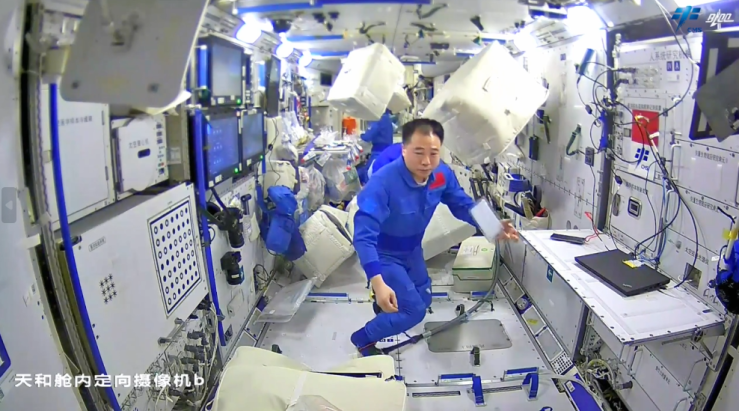
On the week of 30th August 2023, the Shenzhou 16 Takionauts crew on the Tiangong –China Space Station have been massive cleaning reorganisations the inventories supplies packages on the China Space Station, cleaning their Space Home little by little making it neatly clean as ever…

In the blink of an eye, the crew of Shenzhou 16 has been in orbit for more than half. During their stay in orbit, they completed an extravehicular activity, carried out a number of scientific experiments and technical experiments, and also planted green vegetables in space, living a colourfully….

Images and visuals are from their Respectives CMS China Manned SpaceCNSA-China National Space Administration

#MadeInChina #中國製造 #中國 | #长光卫星#ChangGuangSatelliteTechnology #August2023 | 2024 Campus Recruitment Air Briefing Video come and have a look… An Innovative hard working #RemoteSensing  #Satellite company

Chang Guang Satellite Technology Co is located in No. 1299, Mingxi Road, Beihu Technological Development Zone, Changchun City, Jilin Province, China People’s Republic of China.. in which their philosophy is Unity, Innovation, hard work and pragmatic ..

Their Story is CGSTL (Changguang Satellite Technology Co., Ltd) is the first commercial remote sensing satellite supplier in China. Now, CGSTL has set up a commercial business dealing with the development and operation of commercial satellites as well as remote sensing information processing all in one. hang Guang Satellite Technology Co., Ltd. ( CGSTL), founded on December 1st, 2014, it’s a unique commercial aerospace enterprise with the development and operation of satellite research, management as well as remote sensing information processing all in one. With a total registered capital of 1.97 billion RMB, the company comprises Jilin Provincial Government, Changchun Institute of Optics, Fine Mechanics and Physics (CIOMP), social capital, and technical backbone.

In the “China Unicorn Enterprise Research Report 2021” released by Great Wall strategic consulting, CGSTL became the only Unicorn enterprise in Northeast China and ranked first in the field of commercial aerospace.

COMPANY VALUE CGSTL strictly adheres to the spirit of “unity, innovation, hard-work, and pragmatic”, adopting the development concept of “mass development, broad innovation “, with the mission of “serving 7 billion people on the globe with the remote sensing information product integrating sky, space and ground”, aiming for “building internet-based remote sensing information platform, and constantly introduce innovative products”, the company goes all out to promote the industrial transformation and upgrading of Jilin Province, to drive the revitalization of the old industrial base in northeast China, and to strive to compose the brilliant chapter of the Chinese commercial remote sensing satellite.

Who is JL1- changguang Jilin 1 satellite constellation is the core project under construction by CGSTL. The first phase of the project consists of 138 high-performance optical remote sensing satellites covering video, high resolution, wide band, infrared, multispectral and other series. At present, CGSTL has sent 73 Jilin-1 satellite constellation networking remote sensing satellites into the designated orbit through 19 launches (of which, SP04 has been retired on August 31, 2022). Up to now, Jilin-1 satellite constellation has 72 in orbit remote sensing satellites, and has built the world’s largest sub meter commercial remote sensing satellite constellation.

Images and visuals are from their respectives also Chang Guang Satellite Technology Co