#MadeInChina #中國製造| #ISpace #星际荣耀 #August2020 | #ChinesePrivateSpaceCompany innovative rapid #ReusableCarrierRocket #Hyperbola securing more expansions for developments of heavier #CarrierRocket #RocketEngine for commercialization ……

In which iSpace in which it is the first Chinese Private Space Company to do so successfully commercially first out from sixty known private space companies in China..  founded in Beijing 2016 located in Beijing Economic and Technological Development Zone or known for short as E-Town… launching the SQX-1 Y1 from one of many CNSA-China National Space Administration launching complexes, launching from Jiuquan Satellite Launch complex, in which is situated in North East China…. Located at the Gobi Desert Inner Mongolia ……

On July 8 Wednesday, 2020, Beijing Focus Interspace Technology Co., Ltd (referred to as “Interplanetary Glory”). independently developed Focus One (codename “JD-1”) reusable liquid oxygen methane engine successfully passed the continuous variable thrust Long-distance test run , test run time 200 seconds. This test verified the correctness of the JD-1 thrust adjustment system, and obtained accurate data on the JD-1 continuously variable thrust function and performance. The test was a complete success. According to public information, this is the first time that China has completed a large-scale continuous thrust adjustment test for a pump-type cryogenic engine……

 On August 25, 2020, Beijing Interstellar Glory Space Technology Co., Ltd. (hereinafter referred to as “Interstellar Glory”) announced the completion of RMB 1,192.5 million in Series B financing. This round of financing was led by the Beijing Financial Street Capital Operation Center, including CICC Jiazi, Guanghe Xincheng, Taizhonghe Investment, Sequoia Capital China Fund, CITIC Securities, China Merchants Securities, Xuanshi Tiancheng, Shanghai Science and Technology Fund, Yinshengtai Capital, Linglong Jinshan Equity Investment, Yaxiang Xingtai, Kailian Capital, Zhuhai Shunlian, Nanping Baiyi, etc. participated in the investment. Old shareholders Jingwei China, CDH Investment, and Ganquan Capital continued to participate in the investment. Thanks to all shareholders for their trust and support for Interstellar Glory!

This round of financing will be mainly used for the development of the hyperbolic series of launch vehicles, the development of the focus series of reusable liquid oxygen methane engines, and the construction and training of talent teams .

Interstellar Glory is a leading domestic commercial aerospace company with the mission of expanding human living space. Previously, the company had obtained CITIC Juxin, Boyu City, Jiutai Lanshan, Xiangyang Zhengqi, Tianfeng Ruili, Ruixin Capital, Fosun Group, Shunwei Capital, Jingwei China, Solan Investment, CDH Investment, and Electronics Invested by more than ten well-known domestic investment institutions and strategic partners such as Galaxy, Ganquan Capital, World Financial Finance, Jinggang Hezhong, etc. Since its establishment, Interstellar Glory has always adhered to the technological development path of ” from solid to liquid, from small to large ” (from solid-powered rockets to liquid-powered rockets, and from small launch vehicles to medium and large launch vehicles). Since the last round of financing, Corresponding progress has been made in the research and development of solid launch vehicles and liquid reusable launch vehicles:

In terms of solid launch vehicles , on July 25, 2019, Interstellar Glory successfully completed the launch of the Hyperbolic One Yaoyi launch vehicle at the Jiuquan Satellite Launch Center, and the model’s first flight is about to send the payload into the predetermined orbit with extremely high precision, becoming the first in China. A private company that successfully completed the launch mission of a carrier rocket into orbit has achieved a breakthrough in the successful launch of a Chinese civilian-operated carrier rocket.

Regarding liquid reusable launch vehicles , the Focus One reusable liquid oxygen methane engine independently researched and developed by Interstellar Honor has successively completed a series of important ground tests such as full-system long-range test runs, secondary start test runs, and large-scale continuous variable thrust test runs. , Laying the foundation for the successful launch of Hyperbola-2 reusable launch vehicle .

In the future, Interplanetary Glory will continue to carry out the commercial launch of the small solid launch vehicle Hyperbola One, the small liquid reusable launch vehicle Hyperbola 2, the medium liquid reusable launch vehicle Hyperbola 3, and the reusable liquid oxygen methane. The research and development work of Engine Focus One. The company plans to conduct a 100-kilometer-level vertical take-off and landing test of the first sub-class of Hyperbola 2 in 2021 , and perform the first flight and first-class vertical recovery mission of the first flight of the hyperbola 2 in the same year .

In April this year, the National Development and Reform Commission clarified the scope of “new infrastructure” for the first time. Satellite Internet was incorporated into the communications network infrastructure along with 5G, Internet of Things, and Industrial Internet. As the only means of transportation for carrying satellites and other payloads into orbit, launch vehicles have a broad market space. In this context, Interstellar Glory will continue to lay a solid foundation in the private commercial aerospace field, and actively explore the market space in suborbital travel, commercial space station construction and other large-scale space applications and deep space exploration …


Images and visuals are from Weibo

#MadeInChina #中國製造| #ISpace #星际荣耀 #July2020 | #ChinesePrivateSpaceCompany innovative rapid #ReusableCarrierRocket #Hyperbola2 Engine testing the# JD1 #CarrierRocket #RocketEngine for its variable thrust for precession..


On July 8 Wednesday, 2020,  iSpace -Beijing Focus Interspace Technology Co., Ltd (referred to as “Interplanetary Glory”). independently developed Focus One (codename “JD-1”) reusable liquid oxygen methane engine successfully passed the continuous variable thrust Long-distance test run , test run time 200 seconds. This test verified the correctness of the JD-1 thrust adjustment system, and obtained accurate data on the JD-1 continuously variable thrust function and performance. The test was a complete success. According to public information, this is the first time that China has completed a large-scale continuous thrust adjustment test for a pump-type cryogenic engine……

In which iSpace in which it is the first Chinese Private Space Company to do so successfully commercially first out from sixty known private space companies in China..  founded in Beijing 2016 located in Beijing Economic and Technological Development Zone or known for short as E-Town… launching the SQX-1 Y1 from one of many CNSA-China National Space Administration launching complexes, launching from Jiuquan Satellite Launch complex, in which is situated in North East China…. Located at the Gobi Desert Inner Mongolia ……

In this test, the thrust was continuously changed from high operating conditions to low operating conditions, and then to high operating conditions. The “V” shape changes to cover the actual flight conditions . In order to ensure the smooth progress of the continuous thrust adjustment test, the Star Glory Mirror Laboratory also conducted a semi-physical simulation test and simulated test test of the engine thrust adjustment before the test . This is the first domestic simulation test of a liquid rocket engine thrust adjustable system, which has broken through the key simulation test technology of liquid rocket recycling.

 The engine’s ability to continuously change thrust is a necessary condition to realize the vertical recovery technology of the launch vehicle, and it is also one of the core technologies. The variable thrust rocket engine can achieve the best thrust control on the one hand, thereby achieving precise control of the rocket recovery and return process; on the other hand, it can also accurately control the overload during the flight of the carrier rocket, ensure flight safety, and provide a good mechanical environment for the satellite condition.

 JD-1 achieved continuous variable thrust test this time. Compared with the traditional stepped variable thrust, the engine thrust adjustment control system can drive the flow adjustment valve to continuously adjust the flow of propellant, which can not only achieve continuous thrust It can also control the mixing ratio of the thrust chamber under variable thrust conditions.

In order to ensure the ability of JD-1 to continuously change the thrust, Interplanetary Glory has designed semi-physical simulation tests of engine thrust adjustment control law, engine system fault diagnosis and control reconstruction, engine controller, flow adjustment mechanism, low temperature continuous medium adjustment valve, engine thrust control , Simulated test drive test and many other aspects have made technical breakthroughs, and were verified in this test drive:

 JD-1 is a 15-ton reusable liquid oxygen methane engine independently developed by Interstellar. The engine adopts a multi-purpose design idea, derived from a basic type of fixed thrust to form a variable thrust type and a vacuum type total of three types of engines. The components can be shared, which is conducive to reducing the development cycle and funding. It is understood that both the engine 15 ton thrust by way of the multi-parallel as a basis a rocket powered, may be a rocket engine as a single vertical or upper stage power recovered power, a balance type two requirements . Prior to this, JD-1 has completed several long-range system-wide test runs and two start-up test runs in succession, with a cumulative test run time exceeding 2200 seconds. In the follow-up, JD-1 will continue to carry out ground tests such as swing test run, engine vibration mode test, various engine boundary tests, engine life and reliability test run test and so on.

  In the future, the JD-1 series configuration engine will be used on the reusable launch vehicle “Hyperbola II” independently developed by Interplanetary Glory, with 9 units installed in the first stage and 1 unit installed in the second stage . The company plans to break through the 100-kilometer vertical take-off and landing test of the hyperbolic No. 2 subclass one and fully master the reusable launch vehicle technology, and will perform the first flight of the hyperbolic No. 2 launch vehicle in 2021 . At that time, the company will master the reusable technology of the liquid propellant launch vehicle, and realize another leap-forward improvement of my country’s commercial aerospace capabilities in space.


Images and visuals are from Weibo ISpace ..
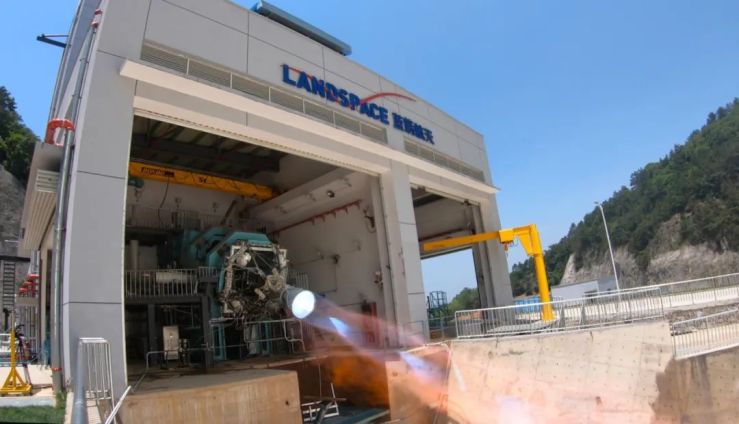
#MadeInChina #中國製造 |#LandSpace #蓝箭航天Testing the New # Zhuque2 #Suzaku2 #CarrierRocket #Tianque Engine testing verification of the control systems in making a major technology breakthrough……

Onwards LandSpace 蓝箭航天  One of sixty Chinese private space Carrier Rocket Companies in China-People’s Republic of China..   On perform a major breakthrough on May 9th to 13th, 2020, the Blue Arrow Aerospace Suzaku 2 rocket control system was successfully matched with the Tianque 80-ton liquid oxygen methane engine and successfully completed three swing test ignition tests. … located in Beijing (Zhonghang International Plaza, No. 13 Ronghua South Road, Yizhuang Economic and Technological Development Zone, Beijing as their main head office in  Land Space’s headquarter, Beijing R&D Center is located in Beijing Economic and Technological Development Zone in E-town…  in which they also have numerous branches in Xian Research and Development Center.. also Located Huzhou Intelligent Manufacturing center in providing testing as assemblies of the components together …

According to R & D engineers of Blue Arrow Space Rocket, Suzaku 2 rocket is the first dual cryogenic liquid rocket in China that uses electromechanical servo technology. The launch vehicle control system swings the engine through a high-power electromechanical servo system and performs engine thrust vector control to achieve rocket attitude stability and high-precision control. Tianque 80-ton liquid oxygen methane engine adopts advanced pump back swing technology. Compared with the traditional pump front swing, the pump back swing can effectively reduce the size of the engine, reduce the weight of the engine structure, and reduce the swing torque.

This round of test drive completed the swing of various angles, frequencies and waveforms, verified the matching between the engine and the high-power electromechanical servo system, and obtained the static and dynamic performance characteristics of the engine swing system. Major milestones…..

In the test, the engine completed a maximum angle swing of ± 8 °, the swing frequency covered 0-20Hz, and the sine wave, triangle wave and square wave swing tests were carried out. The test project covered various control needs of the Zhuque 2 carrier rocket flight and was carried out Strict assessment was conducted and the large-scale joint swing test was successfully completed.

This test is an important breakthrough in the initial sample development stage of Tianque’s 80-ton liquid oxygen methane engine and Zhuque-2 carrier rocket. Prior to this, Blue Arrow Aerospace has completed the relevant tests of the engine system test and long-range test.

This test is the first matching verification of the engine and rocket control system. The success of the test means that the flight status of the engine has been basically confirmed, marking that the Suzaku 2 liquid carrier rocket has entered the joint matching verification stage from the single engine verification stage, which will be the future The rocket’s first flight laid a solid foundation.

LandSpace 蓝箭航天  Images and visuals are from Weibo