#CNSA #ChinaNationalSpaceAdministration #国家航天局 |#WenchangSpacecraftLaunchCenter #文昌航天發射場 #BRI #February2024 | #ChangZheng8 #LongMarch8 Yao 3 #CarrierRocket Arrived Wenchang for the Lunar Mission #Change7  #Queqiao2 relay #TelecommunicationSatellite #Satellite ….   

On the Sunset of 14th Febuary  Hour Hong- Kong SAR – Beijing time CNSA –China National Space Administration   the combination of the Chang Zheng -Long March 8 Yao 3 carrier rocket has been shipped towards Wenchang Spacecraft Launch Center, Hainan Province, China, People’s Republic of China. in the during the National Holidays of celebrating the Year of the Dragon of the Chinese Lunar New Year, Spring Festival..

On the 22 February 2024 Day the components of the Chang Zheng – Long March 8 Yao 3 Carrier Rocket have arrived Wenchang Space Launch Site,  Hainan Province, China,  People’s Republic of China. The rocket is used to carry out the launch mission of the Chang’e-7 relay star (Queqiao 2) in the fourth phase of the lunar exploration project. After arriving, various final assembly tests will be carried out at the launch site. As the main medium-sized rocket of the new generation, the Long March 8 launch vehicle uses green and environmentally friendly liquid propellant and is developed according to the idea of ​​modular combination. It will fly for the first time in 2020, filling the gap in my country’s 3-5 tons sun-synchronous orbit carrying capacity.

At present, the launch site facilities are in good condition, and preparations for the relay At present, the launch site facilities are in good condition, and preparations for the relay satellite mission are being carried out in an orderly manner, and will be launched at an appropriate time in the first half of this year….

After arriving, various final assembly tests will be carried out at the launch site. As the main medium-sized rocket of the new generation, the Long March 8 launch vehicle uses green and environmentally friendly liquid propellant and is developed according to the idea of ​​modular combination. It will fly for the first time in 2020, filling the gap in my country’s 3-5 tons sun-synchronous orbit carrying capacity. At present, the launch site facilities are in good condition, and preparations for the relay satellite mission are being carried out in an orderly manner, and will be launched at an appropriate time in the first half of this year.

The loading work of the Chang Zheng -Long March 8 Yao 3 carrier rocket was completed at an This mission is the first time that the Chang Zheng -Long March 8 Yao 3 carrier uses the China Satellite Maritime Measurement and Control Department’s Yuanwang series transport measurement and control vessels and the first time to perform an Earth-moon transfer orbit mission. The launch window is tight. To ensure the successful completion of the mission, every minute and every second cannot be spared…

Chang Zheng -Long March 8 Yao 3 carrier rocket has been shipped and is about to arrive….According to the China Academy of Launch Vehicle Technology, the Long March-8 Yao-3 rocket that will be used to launch the Queqiao-2 relay star has been shipped today…..Which will be subsequently shipped to Wenchang Qinglan Port by sea. On February 2nd 2024, the lunar exploration project phase 4 relay satellite (Queqiao-2 satellite) arrived at Hainan Meilan International Airport by air, and then passed the road Transport method to Wenchang Space Launch Site in China. Subsequent test preparations before launch will be carried out as planned. The relay satellite will establish a ground relay communication link to realize communication between the lunar surface detector and the ground station, and provide relay support for the four missions of Chang’e 4, Chang’e 6, Chang’e 7 and Chang’e 8. . At present, the launch site facilities are in good condition and all preparations are being carried out in an orderly manner as planned. The Queqiao-2 satellite is scheduled to be launched in the first half of this year…

Images and visuals are from their Respectives CMS China Manned SpaceCNSA-China National Space Administration  

#CNSA #ChinaNationalSpaceAdministration #国家航天局 |#WenchangSpacecraftLaunchCenter #文昌航天發射場 #BRI #February2024 | #ChangZheng8 #LongMarch8 Yao 3 #CarrierRocket Shipped to Wenchang for the Lunar Mission #Change7  #Queqiao2 relay #TelecommunicationSatellite #Satellite ….  A Summary ..  

On the Sunset of 14th February  Hour Hong- Kong SAR – Beijing time CNSA –China National Space Administration   the combination of the Chang Zheng -Long March 8 Yao 3 carrier rocket has been shipped towards Wenchang Spacecraft Launch Center, Hainan Province, China, People’s Republic of China. in the during the National Holidays of celebrating the Year of the Dragon of the Chinese Lunar New Year, Spring Festival..

The working logistics of the Chang Zheng – Long March 8 Yao 3 was transported at an over speed in which making its way before schedule. The Chang Zheng -Long March 8 Yao 3 carrier rocket is executing a major national special project – the fourth phase of the lunar exploration project, the Chang’e-7 relay star mission. Can the relay star (Queqiao-2 satellite) go smoothly? The launch will directly affect the progress of the overall plan for the fourth phase of the lunar exploration project, which is of great significance and cannot be missed.

The loading work of the Chang Zheng -Long March 8 Yao 3 carrier rocket was completed at an This mission is the first time that the Chang Zheng -Long March 8 Yao 3 carrier uses the China Satellite Maritime Measurement and Control Department’s Yuanwang series transport measurement and control vessels and the first time to perform an Earth-moon transfer orbit mission. The launch window is tight. To ensure the successful completion of the mission, every minute and every second cannot be spared…

Chang Zheng -Long March 8 Yao 3 carrier rocket has been shipped and is about to arrive….According to the China Academy of Launch Vehicle Technology, the Long March-8 Yao-3 rocket that will be used to launch the Queqiao-2 relay star has been shipped today…..Which will be subsequently shipped to Wenchang Qinglan Port by sea.

On February 2nd 2024, the lunar exploration project phase 4 relay satellite (Queqiao-2 satellite) arrived at Hainan Meilan International Airport by air, and then passed the road Transport method to Wenchang Space Launch Site in China. Subsequent test preparations before launch will be carried out as planned. The relay satellite will establish a ground relay communication link to realize communication between the lunar surface detector and the ground station, and provide relay support for the four missions of Chang’e 4, Chang’e 6, Chang’e 7 and Chang’e 8. . At present, the launch site facilities are in good condition and all preparations are being carried out in an orderly manner as planned. The Queqiao-2 satellite is scheduled to be launched in the first half of this year…

Images and visuals are from their Respectives CMS China Manned SpaceCNSA-China National Space Administration  

#CNSA #ChinaNationalSpaceAdministration #国家航天局 |#BRI #January2024 |#西昌衛星發射中心 #XichangSatelliteLaunchCenter the advance iconic #ChangZheng2C  #LongMarch2C  launches  Advance  #Einstein Probe #Satellite explore X-ray signals from #GravitationalWave sources #BlackHoles #neutronStars ….

On the 9th January 2024 in  CNSA _China National Space Administration -China – People’s Republic of China 1503 hours Hong Kong –Beijing Time China- People’s Republic of China launch the Chang Zheng – Long march 2C  Carrier Rocket launching from station form Xichang Satellite Launch Center Sichuan Province….. In which中国 successfully launched the 2C carrier rocket ignited and took off from the Xichang Satellite Launch Center, and then successfully sent the Einstein probe satellite into the predetermined orbit. The first mission of the Chang-II C rocket in 2024 was a complete success. This mission also means that China Aerospace Science and Technology Corporation has won its first victory in the 2024 space launch mission.

The Chang Zheng – Long March 2C carrier rocket at the Xichang Satellite Launch Center to successfully launch the Einstein Probe satellite. space, the satellite successfully entered the scheduled orbit, and the launch mission was a complete success. The Einstein probe satellite is the first large-scale application of “lobster eye” microhole array focusing imaging technology in the world, which can achieve a 10-fold improvement in sensitivity and spatial resolution. It can accurately capture the universe while conducting large-field monitoring. We will detect more distant and faint high-energy temporary sources and fleeting unknown phenomena, and issue early warnings to guide other astronomical equipment based on space and ground to conduct follow-up observations. Thumbs up!!!

Einstein probe According to reports, the Einstein probe satellite is a catcher of explosions of cosmic objects. It can accurately capture more distant and faint temporary sources and explosive objects, and explore X-ray signals from gravitational wave sources. , is of great scientific significance for studying stellar activity, the formation, evolution, merger and other processes of compact objects such as black holes and neutron stars.

The Einstein probe satellite uses astronomical time-domain observation methods in the soft physical process. The Einstein probe satellite carries two payloads: the Widefield X-ray Telescope (WXT) and the Follow-up X-ray Telescope (FXT). For the first time in the world, the “lobster eye” microhole array focusing imaging technology is used on a large scale. The detection capability is world-leading, and the sensitivity and spatial resolution can be improved by 1 to 2 orders of magnitude. While detecting a large field of view, it can accurately detect Capture distant and faint high-energy temporary sources and fleeting unknown phenomena in the universe, and issue early warnings to guide other astronomical equipment based on space and ground to conduct subsequent observations. The satellite design life is 5 years

“The Einstein probe satellite launched this time is one of the space science satellites established and implemented under my country’s Space Science Pilot Project (Phase II). It is also my country’s first large-field X-ray astronomy satellite, used to capture Einstein’s predictions. astronomical phenomena such as black holes and gravitational wave electromagnetic counterparts.” At the mobilization meeting, Cui Zhaoyun emphasized the importance of this mission to the team members.

This mission involves the “Princess and the Pea” who cannot tolerate a speck of dust. Several high-end cameras were installed on this payload, and the lenses had very high requirements for cleanliness. To this end, the operators also performed “dust-proof treatment” on the inner wall of the long 2-propylene rocket fairing.

The fairing usually consists of a basic structure with a composite skin and metal reinforcements. After being fixed with rivets, there will be very small debris in the gaps in the inner wall. These debris may fall onto the lens during fairing closure or flight vibrations. “General loads will not be affected by this, but considering the particularity of this mission, we sprayed a layer of coating on the inner wall of the fairing to seal in fine dust.”

Images and visuals are from their Respectives CMS China Manned SpaceCNSA-China National Space Administration

#CNSA #ChinaNationalSpaceAdministration #国家航天局 |#BRI #September2023 | #嫦娥五号#CLEP #中秋節 #MidAutumnFestival- The #Moon #嫦娥六号; #Change6 #SouthPole-#AitkenBasin #LunarSample return mission from the #Darkside #OtherSide of the #Moon Announcement   —–

On the 29th September 2023 the嫦娥六号; Change 6 Lunar Sample Return Mission onboard the  Chang Zheng – Long March Five Carrier Rocket modified announcement by CNSA – China National Space Administration China Wenchang spaceport launch, Change lunar series  Lunar probes… The National Space Administration announced today that the development of the lunar exploration project Chang’e-6 mission is currently underway as planned and is planned to be launched around 2024. At the same time, our country is accelerating the scientific project of the International Lunar Research Station, and hopes that more international partners will join in to jointly expand the boundaries of human cognition, contribute to the peaceful use of space, and promote the construction of a community with a shared future for mankind.

嫦娥六号; Change 6  planned to be launched around 2024  Queqiao 2 is planned to be launched in the first half of 2024  The China National Space Administration reported on the 29th September 2023 that currently, the development work of the lunar exploration project Chang’e-6 mission is being carried out as planned, and the plan It will be launched around 2024.


  According to arrangements, the Chang’e-6 mission will carry out sample returns from the far side of the moon. The 10 lunar sampling returns that humans have carried out so far are all located on the front side of the moon. The far side of the moon is generally older than the front side of the moon, and there is the Aitken Basin, one of the three major lunar terrestrial bodies, which has important scientific research value. The pre-selected landing area for the Chang’e-6 mission is located in the South Pole-Aitken Basin on the far side of the moon, with a view to discovering and collecting lunar samples from different regions and ages to enhance human understanding of the moon.
  

According to arrangements, the Chang’e-6 mission will carry out sample returns from the far side of the moon. The 10 lunar sampling returns that humans have carried out so far are all located on the front side of the moon. The far side of the moon is generally older than the front side of the moon, and there is the Aitken Basin, one of the three major lunar terrestrial bodies, which has important scientific research value. The pre-selected landing area for the Chang’e-6 mission is located in the South Pole-Aitken Basin on the far side of the moon, with a view to discovering and collecting lunar samples from different regions and ages to enhance human understanding of the moon.


It is reported that in order to successfully complete the communication between the spacecraft on the far side of the moon and the earth, China, People’s Republic of China newly developed Queqiao-2 relay communication satellite is planned to be launched in the first half of 2024.

In terms of international cooperation, the Chang’e-6 mission carried payloads and satellite projects from four countries, including France’s radon detector, ESA’s negative ion detector, Italy’s laser angle reflector, and Pakistan’s CubeSat. At the same time, our country is accelerating the scientific project of the International Lunar Research Station, and hopes that more international partners will join in to jointly expand the boundaries of human cognition, contribute to the peaceful use of space, and promote the construction of a community with a shared future for mankind..

About a month ago, on August 31, the China Manned Space Engineering Office announced that the moon landing phase of China’s manned lunar exploration project has been fully launched! According to the plan, our country will achieve the first Chinese landing on the moon before 2030, and carry out lunar scientific expeditions and related technology tests. The Chinese moon landing is just around the corner!

Via CNSA China National Space AdministrationCLEP China Lunar Exploration project management office ….

#CNSA #ChinaNationalSpaceAdministration #国家航天局 |#BRI #August2023 | #天宫 #Tiangong #ChinaSpaceStation #CMS #ChinaMannedSpace #神舟十六号 #Shenzhou16 Crew – #Space Cleaning today …   

On the 30th  May 2023 clear 0931 Hours Morning Hong Kong SAR- Beijing time , the Belt and Road Initiative CNSA –China National Space Administration  from Jiuquan Satellite Launch Center – Inner Mongolia –China – People’s Republic of China deployment of  the Chang Zheng –   The Chang Zheng – Long March 2F Yao 16 –Shenzhou 16  carrier rocket.. On which Takionauts Jing Haipeng, Zhu Yangzhu, and Gui Haichao took to the predetermined orbit. The first manned flight mission in the application and development stage was a complete success. The three astronauts will stay in the space station and “join up” with the crew of Shenzhou 15 to carry out on-orbit handover “face-to-face” meeting in which brings the total crew of six with a handover ceremony from Shenzhou 15 towards 16..

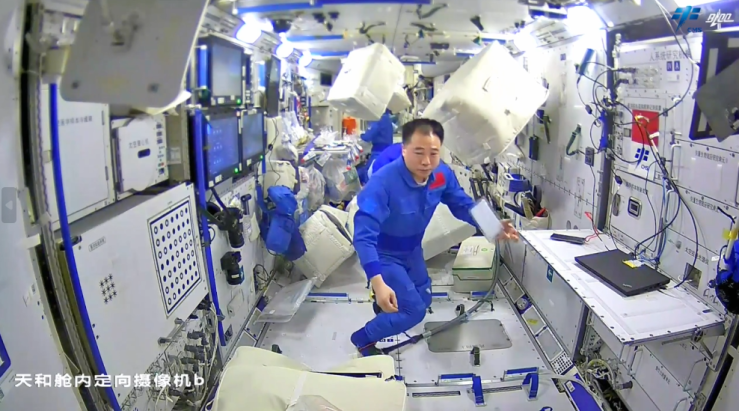
On the week of 30th August 2023, the Shenzhou 16 Takionauts crew on the Tiangong –China Space Station have been massive cleaning reorganisations the inventories supplies packages on the China Space Station, cleaning their Space Home little by little making it neatly clean as ever…

In the blink of an eye, the crew of Shenzhou 16 has been in orbit for more than half. During their stay in orbit, they completed an extravehicular activity, carried out a number of scientific experiments and technical experiments, and also planted green vegetables in space, living a colourfully….

Images and visuals are from their Respectives CMS China Manned SpaceCNSA-China National Space Administration