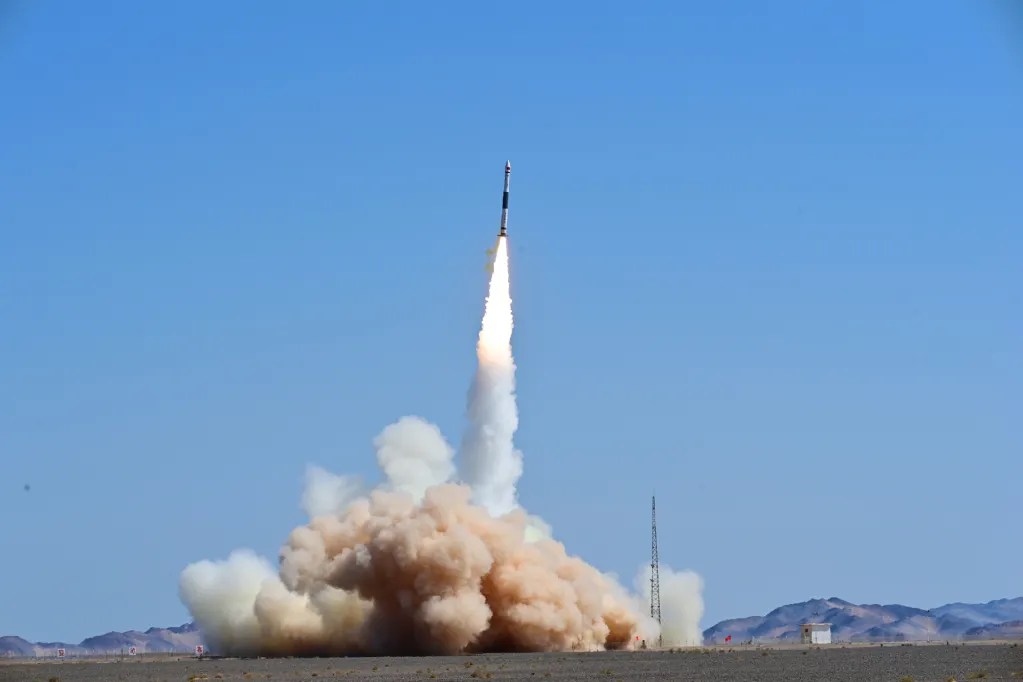
#CNSA #ChinaNationalSpaceAdministration #国家航天局 | #BRI #June2023|#太原卫星发射中心  #TaiyuanSatelliteLaunchCenter  – International Iconic #ChangZheng2D #LongMarch2D  yao 88 #CarrierRocket in launched to deploy #Gaofen #Jilin  series  41 Satellites into orbit #AGallery ..

At 1330 Hours Hong Kong SAR- Beijing Time  15th June 2023 , China- People’s Republic of China- CNSA –China National Space Administration   Successfully launched  the New Next Generation Long March – Chang Zheng2D carrier rocket at the Taiyuan Satellite Launch Center Shanxi Province..  launch 41- forty one Satellites in which the Chang Zheng – Long March 2D Carrier Rocket is in preparing readiness to launch in which dates back to On May 22, a total of 41 satellites set off in the Changchun Aerospace Information Industry Park, among them, “Jilin No. 1” Gaofen 03D19-26 satellites, Gaofen 06A series satellites, platform 02A01-02 The 36 satellites including Si-1 are the “Jilin-1” satellites.

The Chang Zheng- Long March 2 D yao 88 carrier rocket at the No. 9 station of the Taiyuan Satellite Launch Center, with the method of “one Carrier Rocket 41 satellites “, 41 optical remote sensing satellites of Jilin No. It entered the predetermined sun-synchronous orbit, and the launch mission was a complete success.

In response to the launch mission requirements of “one arrow with 41 satellites”, the Changerding rocket development team took a series of effective measures to ensure the safe and accurate orbiting of 41 satellites by rationally arranging in the limited fairing space and selecting the optimal separation scheme. .

[Chang Zheng – Long March 2D yao 88 /Jilin-1 “One Carrier Rocket 41 Satellites” adopts the satellite layout of wall-mounted*38+sidewall*3】

One arrow launches 41 satellites, setting a new record for the largest number of satellites launched in one time in my country. But to safely and smoothly send so many satellites into orbit at one time, the first thing to solve is the layout of the satellites in the fairing, not only to ensure “sit down”, but also “sit comfortably”. To this end, the development team of Eight Director Erding fully sorted out the structure and mission requirements of the satellites, fully tapped the potential, optimized the layout design, adopted the layout method of 38 satellites on the wall + 3 satellites on the side wall, and successfully found 41 satellites. Safe and comfortable location.


In order to allow 41 ” satellite passengers” to enjoy a comfortable flight experience, the model team effectively used the space in the fairing to move the “feet” of the “passengers” under the adapter, and opened up 3 “special seats” on the support cabin , Successfully let 41 satellites “board” smoothly. Although the form of the “seat” is relatively new, but a closer look shows that they are all high-quality parts that have been sent to the “passengers” before, which effectively guarantees the safety and reliability of this mission.


In addition, in order to avoid crowded collisions when “getting off the car”, the research and development team of the Eighth Academy ingeniously designed the “drop-off plan” to allow the satellites to separate in an orderly manner. The overall design team divided the 38 satellites on the cylindrical multi-satellite adapter into one group of “passengers” on each floor, a total of 6 groups; the 3 “passengers” on the lower support cabin were taken as the seventh group, and the satellites were carried out in sequence according to the group separate. In addition, this rocket is also equipped with 10 reverse thrust rockets. By turning on the reverse thrust rockets, the distance between each group of satellites is widened to ensure the safety of separation from each other

At  15th June 2023 , China- People’s Republic of China- CNSA –China National Space Administration   Successfully launched  the New Next Generation Long March – Chang Zheng2D carrier rocket at the Taiyuan Satellite Launch Center Shanxi Province..  Is set to launch 41- forty one Satellites in which the Chang Zheng – Long March 2D Carrier Rocket is in preparing readiness to launch in which dates back to On May 22, a total of 41 satellites set off in the Changchun Aerospace Information Industry Park, among them, “Jilin No. 1” Gaofen 03D19-26 satellites, Gaofen 06A series satellites, platform 02A01-02 The 36 satellites including Si-1 are the “Jilin-1” satellites.

The Chang Zheng -Long March 2D “One Carrier Rocket  41 Satellites” will be launched on the next day on expected on 16th June 2023 …. The latest batch of Jilin-1 satellites launched in the form of “One Carrier Rocket  41 Satellites” involves 3 large software systems and 4 satellite models, 41 satellites, and 50 sets of antenna equipment.

At present, the launch of “One Carrier Rocket 41 Satellites” has officially entered the countdown! It is planned to be launched from the Taiyuan Satellite Launch Center in the near future. This will create the record for the largest number of satellites launched in a single spaceflight in China

[The countdown to launch has entered! Uncover how “one Carrier Rocket  41 satellites ” is achieved?

How did “41 satellites  with one arrow” come true this time? What’s the point? Li Feng, director of the satellite operation and management technology research office of Chang Guang Satellite Technology Co., Ltd., gave the answer in an exclusive interview with China Jilin Net!


“The launch of ‘One Carrier Rocket  41 Satellites’ poses a huge challenge to the transportation and management system. In the past, a maximum of 16 satellites were launched at one time, but this time the number has reached nearly three times that of the maximum one, and it involves multiple satellite models. For measurement and control , data transmission resources, software system development, and personnel requirements are all higher. In order to do a good job in the operation and management of 41 satellites, the colleagues in the Satellite Operation and Management Technology Research Office started the preparation work at the end of last year, and the internal and external coordination of the company , docking, and recently successfully completed the system development and the joint test of the three-wheel operation and management system, involving 3 large software systems, 4 satellite models, 41 satellites, and 50 sets of antenna equipment, and confirmed the functions, performance and interfaces of each system Matching situation. The 41 satellites launched this time include 8 Jilin-1 Gaofen 03D satellites and 30 Gaofen 06A series satellites. Among them, the weight of the Gaofen 06A single satellite has been successfully reduced to 20kg, and its performance indicators are still very advanced.


Li Feng said, “During the satellite-rocket separation stage, the 41 satellites were separated seven times successively. The separation time of each group of satellites lasted for three to five seconds. . This launch has put forward higher requirements for both satellites and rockets, including separation timing and control of satellite force and torque, so as to ensure that each satellite can enter the predetermined orbit smoothly and safely. “


After the 41 satellites launched this time (including 36 “Jilin-1” satellite constellation networking remote sensing satellites) are in orbit, they will form a network with the 72 “Jilin-1” satellites in orbit. So far, “Jilin-1” “The number of satellites in orbit has increased to 108, marking that the “Jilin-1” satellite constellation network project has successfully achieved the phased goal of “Hundred Stars Flying into the Sky”

Images and visuals are from their Respectives CMS China Manned SpaceCNSA-China National Space Administration

#MadeInChina #中國製造| #中科宇航 #ZhongkeAerospace #ChinaAcademyOfScience #CASSPace #June2023 | the Greater Bay Area Science Forum- the 2023 Zhongguancun Forum

Beijing Zhongke Aerospace Exploration Technology Co., Ltd. is the first domestic aerospace enterprise with mixed ownership, and it is also the target enterprise that Oriental Aerospace Port focuses on introducing. Relying on the scientific research strength and resource advantages of the Institute of Mechanics of the Chinese Academy of Sciences and the Aerospace Flight Technology Center of the Chinese Academy of Sciences, China Aerospace Science and Technology has been committed to the research and development and integration of space technology and aerospace vehicles as a platform for the transformation of major national scientific research projects, as well as the transformation and provision of technological achievements. Aerospace launch service. The Lijian-1 rocket project also adds a brand-new name card to the Oriental Space Port, which will surely promote the construction of the Oriental Space Port to take a solid step forward.

From May 25th to 30th, the 2023 Zhongguancun Forum the 25th China Beijing International Science and Technology Industry Expo (hereinafter referred to as the “Science Expo”) was successfully held in the Exhibition Center of Zhongguancun National Independent Innovation Demonstration Zone in Beijing. Zhongke Aerospace, as the achievement transformation platform of the Chinese Academy of Sciences in the field of aerospace science and technology, was invited to participate in the exhibition, and made a big debut with a number of major powers such as the Arrow series of launch vehicles

On May 24, Bai Chunli, chairman of the Greater Bay Area Science Forum, chairman of the “Belt and Road” International Science Organization Alliance, academician of the Chinese Academy of Sciences, and Feng Wei, vice president of the Guangzhou Branch of the Chinese Academy of Sciences, and their delegation visited the China Science and Technology Aerospace Flight Science and Technology Industrialization Base for investigation and guidance , conducted in-depth exchanges and discussions with Yang Yiqiang, chairman and president of Zhongke Aerospace.
As Academician Bai Chunli said in his speech at the opening ceremony of the 2023 Greater Bay Area Science Forum: “China is moving from a scientific and technological power to a technological power.” Zhongke Aerospace will also be guided by the major strategic needs of my country’s aerospace field and give full play to the new national system and the advantages of mixed ownership, lead the development of aerospace technology with innovation, and contribute to the realization of the dream of a technologically powerful country

On May 22, the 2023 Greater Bay Area Science Forum “Belt and Road” high-quality development sub-forum hosted by the Qinghai-Tibet Plateau Institute of the Chinese Academy of Sciences was held in Nansha, Guangzhou. Yang Yiqiang, director of the Aerospace Science and Technology Center of the Chinese Academy of Sciences and chairman and president of China Aerospace Corporation, was invited to attend as a guest speaker.
In the future, Zhongke Aerospace will serve the “Belt and Road” initiative, combine the needs of national strategic scientific and technological strength construction and the regional coordinated development strategy, and look forward to setting sail from the Greater Bay Area, heading to the South China Sea, covering the Indian Ocean and the Mediterranean coast, and going to sea for one-time final assembly , Multiple launches, construction of the home port of the Southern Aerospace Port aimed at the space service of the Belt and Road, to meet the launch needs of near seas and far seas…

Images and visuals are from their respectives

#MadeInChina #中國製造 #ExPace | #June2023| #CASIC Rocket Technology Company #Expace #PrivateChineseSpaceCompany #Wuhan #CarrierRocketCompany #CarrierRocket #Kuaizhou1A #KX1A #Kuaizhou Yao 20 launched Deployed #Longjiang3″ #ExperimentalSatellite..

Currently at the moment中國製造 Expace Technology Corporation- a CASIC -China aerospace science and industry corporation has been very busy in building a New Carrier Rocket Factory in Wuhan National Aerospace Industrial Base in which the base will be in operations in May 2020   Kuaizhou Rocket Industrial Park that forms the manufacturing of twenty plus more Kuaizhou Rockets also its other sister larger carrier rockets in process of The assembly test capability of 20 solid launch vehicles……in which is now in operation……

快舟一号A Rocket Successfully Launches “Longjiang III” Test Satellite

 On a Clear blue Skies Day on Jiuquan Satellite launch Centre, Inner Mongolia, China, People’s Republic of China…. At 10:35 Hong Kong SAR- Beijing Time on June 9, 2023, the Kuaizhou-1A solid carrier named “Kuaizhou Ruike Laser” The rocket was ignited at the Jiuquan Satellite Launch Center, and sent China’s first flat-panel new system communication test satellite “Longjiang-3” into the predetermined orbit by means of “one rocket, one satellite”. The launch mission was a complete success.


The Kuaizhou-1A rocket that carried out this launch mission is a small solid launch vehicle launched by Aerospace Science and Industry Rocket Technology Co., Ltd. under the Aerospace Sanjiang subsidiary of China Aerospace Science and Industry Corporation. It mainly provides launch for 300 kg low-orbit small satellites It has the characteristics of high flight reliability, high orbital accuracy, short preparation period, less support requirements, and low launch cost.

The “Longjiang-3” experimental satellite was jointly developed by Harbin Institute of Technology and Harbin Institute of Technology Satellite Technology Co., Ltd. It is mainly used to verify key technologies such as satellite-ground high-speed communication and flat-panel satellite platform.

This mission is the 20th launch of the Kuaizhou-1A solid carrier rocket….

Images and visuals are from their respectives..

#MadeInChina #中國製造 #中國 |酒泉衛星發射中心#JiuquanSatelliteLaunchCenter #星河动力空间科技有限公司#GalacticEnergy #May2023| #CarrierRocketShopping #智神星一号 #PallasOne #CarrierRocket #ReusableCarrierRocket No. 1 liquid rocket assembly off the assembly line, first flight expected in the second half of next year

星河动力空间科技有限公司 Galactic Energy-  Galaxy Power (Beijing) Space Technology Co., Ltd. Located in Block D, Aviation Technology Plaza, E-Town, and Beijing – Beijing – China – People’s Republic of China ….Galaxy Aerospace is the first private aerospace company in China to achieve successful continuous launches, the first to send commercial networked satellites into a 500km sun-synchronous orbit, and the first to master the ability to launch multiple satellites with one carrier rocket.

On 17th May 2023 Galaxy Power PallasOne  No. 1 liquid rocket assembly off the assembly line, first flight expected in the second half of next year…..On That May 17, Anhui Xinghe Power Equipment Technology Co., Ltd. The first Chizhou-made “Zhishenxing No. 1” liquid carrier rocket was successfully assembled and rolled off the assembly line. So far, Chizhou’s commercial rockets have officially entered the industrialization.


It is reported that the “PallasOne No. 1″ liquid launch vehicle rolled off the assembly line this time has a total length of 52 meters, a diameter of 3.35 meters, a take-off weight of 257 tons, and a low-orbit carrying capacity of 5 tons. %—105% of the “Sky” liquid oxygen/kerosene engine. The multi-return vortex conical gas generator, coaxial double-suction turbo pump, and multi-functional integrated combined valve adopted by “Zhishenxing No. 1” are all domestically pioneered, and are also at the leading level at the international level.


Liu Baiqi, chairman of Anhui Xinghe Power Equipment Technology Co., Ltd., said: ” PallasOne  “can be reused through vertical recycling. Our goal is to achieve 50 times of reuse in the future, which can greatly reduce the launch cost of the rocket, and It can reduce the cost of constellation network construction.” “

The final assembly of the ‘ PallasOne  ‘ liquid rocket is off the assembly line, which indicates that the production base of the liquid rocket and engine of the Xinghe Power Chizhou project currently has an annual output of 20 liquid launch vehicles and 200 liquid rockets. The production capacity of the engine.” Liu Baiqi said that in the next step, the company will accelerate the industrialization of reusable liquid launch vehicles and contribute to the development of the commercial aerospace industry in Chizhou. “After the first liquid rocket comes off the production line, about 60 large-scale ground experiments will be completed in the follow-up, and the first flight is expected to take place in the second half of next year. “

Images and visuals are from their respectives 星河动力空间科技有限公司 Galactic Energy-  Galaxy Power (Beijing) Space Technology Co., Ltd.

#MadeInChina #中國製造 #中國 |酒泉衛星發射中心#JiuquanSatelliteLaunchCenter #星河动力空间科技有限公司#GalacticEnergy #May2023|#CarrierRocketShopping #智神星一号 #PallasOne #CarrierRocket #ReusableCarrierRocket Takes Shape..  

星河动力空间科技有限公司 Galactic Energy-  Galaxy Power (Beijing) Space Technology Co., Ltd. Located in Block D, Aviation Technology Plaza, E-Town, and Beijing – Beijing – China – People’s Republic of China ….Galaxy Aerospace is the first private aerospace company in China to achieve successful continuous launches, the first to send commercial networked satellites into a 500km sun-synchronous orbit, and the first to master the ability to launch multiple satellites with one carrier rocket.

The Galactic Energy Pallas One  Reusable Carrier Rocket takes shape, the Carrier Rocket/ Reusable Carrier Rocket has three stages towards the first stage Reusable Carrier Rocket component powered with 350 tonnes Seven Welkin Liquid Engines with Liquid Oxygen –Kerosene with a vertical landing gears… it’s secondary stage with a sixty ton thrust with a single Welkin Liquid engines.. The third stage payload with advance liquid stage with One rocket multiple satellites –space ferry…

Visit the “智神星一号 Pallas One” reusable liquid oxygen/kerosene carrier rocket of Galaxy Energy Company. The low-orbit carrying capacity of this type of rocket is not less than 5 tons, and the low-orbit carrying capacity of the expanded bundled configuration can reach 14 tons. The design reuse times are 50 The second time, it is planned to implement the first flight into orbit in 2024. The “Kangqiong” engine is the main power device of its first stage (7 units in parallel) and second stage (1 unit). It is a new type of multiple-start variable thrust gas generator cycle liquid rocket engine. The sea level rated thrust of each engine is 50 tons (the first stage has an “Engine-out” capability), the sea level thrust of the minimum working condition is 10 tons, and the booster stage vertical descent and soft landing recovery requirements are met when the thrust is variable. It has multiple reuse and fault detection and isolation capabilities. Each engine can be reused 50 times, with ±6° swing capability, and the thrust-to-weight ratio of the engine is greater than 120.

“智神星一号 Pallas One” adopts a two-stage configuration, one of which adopts an optimized design of seven “Kangqiong-1” liquid oxygen kerosene engines in parallel (power redundancy increases reliability, repeated use reduces costs), and the ground take-off thrust Reaching 280 tons; the second stage is equipped with a single “Kangqiong-1” liquid oxygen kerosene engine, with a vacuum thrust of 50 tons.

Images and visuals are from their respectives also Galactic Energy is located in Block D, Aviation Technology Plaza, E-Town, Beijing- China – People’s Republic of China